Hearts rules
Hearts is a trick-taking card game where points are bad. Every heart you win costs you 1 point, and the queen of spades costs 13. There is no trump suit and no partners. The lowest score wins. A player who wins every point card in one hand turns it around and gives 26 points to everyone else.
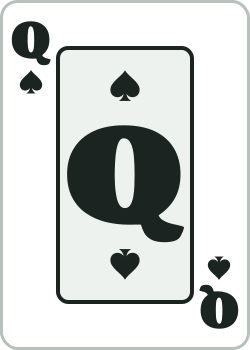
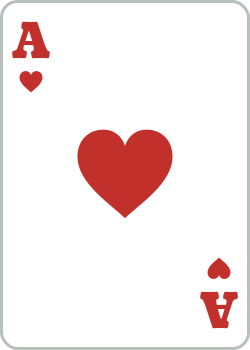
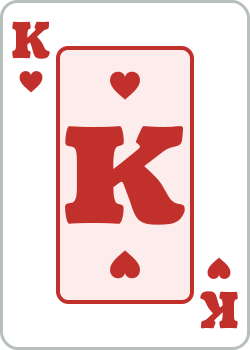
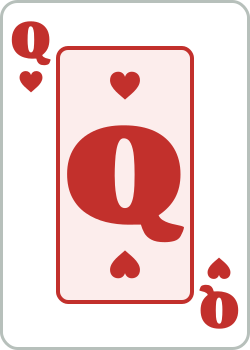
- Players
- 4 is best. 3 or 5 also work, and 6 to 10 with two decks.
- You need
- A standard 52-card deck, plus paper and a pencil for the score
- Deal
- 13 cards each with 4 players. The whole deck is dealt.
- Goal
- Avoid winning hearts and the queen of spades in your tricks
- Game ends
- When someone reaches 100 points. The lowest total wins.
- Playing time
- About 1 hour
Quick start
- Deal the whole 52-card deck one card at a time, so each of the 4 players gets 13. Everyone plays alone. Hearts and the queen of spades are the cards to avoid.
- Pass 3 cards face down: to the left on the first hand, to the right on the second and across on the third. Nobody passes on the fourth. Then the cycle repeats.
- Whoever holds the 2 of clubs leads it. Going clockwise, everyone follows suit if they can. The highest card of the suit led wins the trick. There is no trump suit.
- If you cannot follow suit, play any card. On the first trick, though, you may not play a heart or the queen of spades unless your hand holds nothing else.
- You may not lead a heart until a heart has been played on an earlier trick, unless you hold only hearts. The queen of spades may be led on any trick after the first.
- Each heart you win costs 1 point and the queen of spades costs 13. Win all 14 point cards and everyone else takes 26 instead. When someone reaches 100, the lowest total wins.
Rule sheet and score sheet
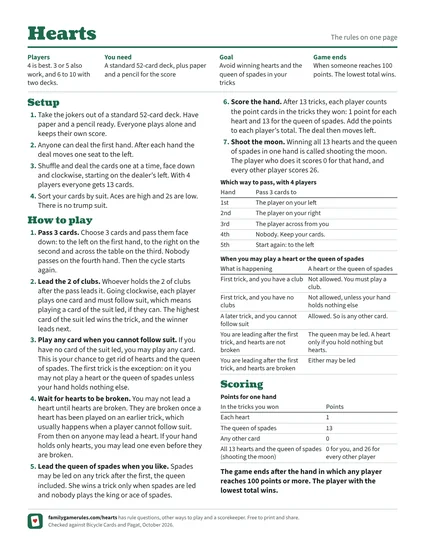
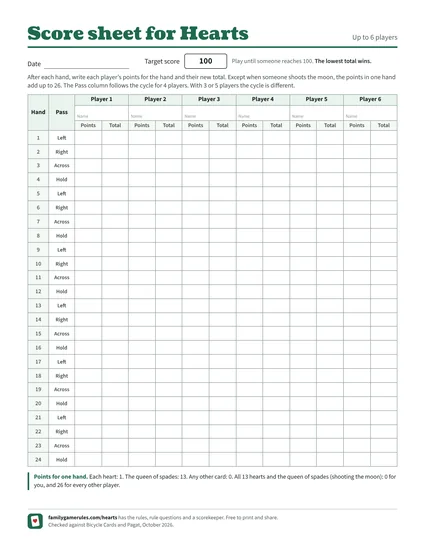
Print the whole game on one page, and a score sheet made for Hearts. Both are free PDFs for Letter paper.
Setup
Best with 4 players, each playing alone. Versions for 3 and 5 players, and a two-deck version for 6 to 10, are further down.
You need: A standard 52-card deck with the jokers taken out.
| In the set | Count | Worth when scoring |
|---|---|---|
| Hearts | 13 | 1 point each |
| Queen of spades | 1 | 13 points |
| Other spades | 12 | 0 |
| Diamonds | 13 | 0 |
| Clubs | 13 | 0 |
| Total | 52 |
- In every suit the ace is the highest card and the 2 is the lowest.
- The 14 point cards hold 26 points between them, so in the one-deck game every hand has 26 points to hand out.
- Take the jokers out of a standard 52-card deck. Have paper and a pencil ready. Everyone plays alone and keeps their own score.
- Anyone can deal the first hand. After each hand the deal moves one seat to the left.
- Shuffle and deal the cards one at a time, face down and clockwise, starting on the dealer’s left. With 4 players everyone gets 13 cards.
- Sort your cards by suit. Aces are high and 2s are low. There is no trump suit.
| Players | Each player gets | Notes |
|---|---|---|
| 4 | 13 cards | The whole deck is dealt. Nothing is left over. |
| 3 | 17 cards | Take out the 2 of diamonds first, leaving 51 cards. |
| 5 | 10 cards | Take out the 2 of clubs and the 2 of diamonds first, leaving 50 cards. |
| 6 | 17 cards | Cancellation Hearts: two decks shuffled together. 2 cards go face down as a kitty. |
| 7 | 14 cards | Cancellation Hearts: two decks. 6 cards go to the kitty. |
| 8 | 13 cards | Cancellation Hearts: two decks. Nothing is left over. |
| 9 | 11 cards | Cancellation Hearts: two decks. 5 cards go to the kitty. |
| 10 | 10 cards | Cancellation Hearts: two decks. 4 cards go to the kitty. |
Each player’s hand
13 cards. Everyone plays for themselves.
- With 3 or 5 players, remove the cards listed above before you shuffle, unless you use the kitty way in the versions further down.
- The cards taken out for 3 or 5 players are never point cards, so every hand still holds 26 points.
How to play
A hand starts with a pass of 3 cards, except on every fourth hand. Then 13 tricks are played. A trick is one trip around the table: each player plays one card, and the best card wins them all. The aim is to avoid winning tricks that hold hearts or the queen of spades.
-
Pass 3 cards
Choose 3 cards and pass them face down: to the left on the first hand, to the right on the second and across the table on the third. Nobody passes on the fourth hand. Then the cycle starts again.
- Put your 3 cards down before you pick up the ones passed to you. You may not look at what you are getting first.
- The hand with no pass is called a hold hand.
- With 3 or 5 players the passing cycle is different. See the versions further down.
-
Lead the 2 of clubs
Whoever holds the 2 of clubs after the pass leads it. Going clockwise, each player plays one card and must follow suit, which means playing a card of the suit led, if they can. The highest card of the suit led wins the trick, and the winner leads next.
- There is no trump. A card of another suit never wins a trick, however high it is.
- You never have to beat the cards already played. The only duty is to follow suit when you can.
- Whoever wins a trick keeps its cards face down in front of them until the hand is scored.
-
Play any card when you cannot follow suit
If you have no card of the suit led, you may play any card. This is your chance to get rid of hearts and the queen of spades. The first trick is the exception: on it you may not play a heart or the queen of spades unless your hand holds nothing else.
- Having no cards of a suit is called being void in it.
- You do not have to play the queen of spades at the first chance. You may keep her until you choose to play her, unless spades are led and she is your only spade.
- Some groups allow hearts and the queen of spades on the first trick. See the variants.
-
Wait for hearts to be broken
You may not lead a heart until hearts are broken. They are broken once a heart has been played on an earlier trick, which usually happens when a player cannot follow suit. From then on anyone may lead a heart. If your hand holds only hearts, you may lead one even before they are broken.
- The limit is only on leading. Playing a heart because you cannot follow suit is allowed on every trick after the first.
- Groups differ on the queen of spades. Some count her as breaking hearts too when she is played. Agree on this before the game.
- If hearts are not broken and you hold only hearts and the queen of spades, the strict rule makes you lead the queen. Many groups let you lead a heart instead.
-
Lead the queen of spades when you like
Spades may be led on any trick after the first, the queen included. She wins a trick only when spades are led and nobody plays the king or ace of spades.
- Whoever wins the trick with the queen of spades in it takes her 13 points, whoever played her.
-
Score the hand
After 13 tricks, each player counts the point cards in the tricks they won: 1 point for each heart and 13 for the queen of spades. Add the points to each player’s total. The deal then moves left.
- In the one-deck game the point cards hold 26 points between them, so a hand’s points always add up to 26 unless someone shoots the moon.
- Points count against you. A trick with no point cards in it costs nothing.
-
Shoot the moon
Winning all 13 hearts and the queen of spades in one hand is called shooting the moon. The player who does it scores 0 for that hand, and every other player scores 26.
- Some groups take 26 off the shooter’s total instead, or let the shooter choose. Agree on the rule before the game. See the variants.
| Hand | Pass 3 cards to |
|---|---|
| 1st | The player on your left |
| 2nd | The player on your right |
| 3rd | The player across from you |
| 4th | Nobody. Keep your cards. |
| 5th | Start again: to the left |
| What is happening | A heart or the queen of spades |
|---|---|
| First trick, and you have a club | Not allowed. You must play a club. |
| First trick, and you have no clubs | Not allowed, unless your hand holds nothing else |
| A later trick, and you cannot follow suit | Allowed. So is any other card. |
| You are leading after the first trick, and hearts are not broken | The queen may be led. A heart only if you hold nothing but hearts. |
| You are leading after the first trick, and hearts are broken | Either may be led |
Example: no clubs on the first trick
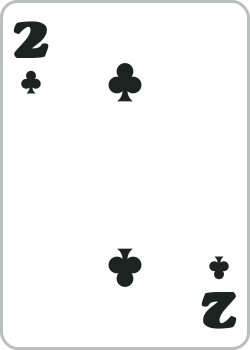
North holds the 2 of clubs after the pass and leads it. East plays the king of clubs. South has no clubs and would love to get rid of the queen of spades, but on the first trick that is not allowed, and neither is a heart. South plays the ace of diamonds. West plays the 9 of clubs. East’s king is the highest club, so East wins the trick. East leads next, and may not lead a heart because none has been played yet.
North leads
East
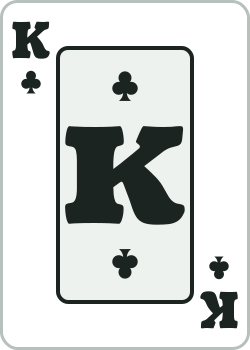
The highest club wins
South
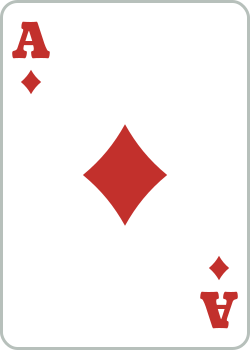
No clubs, and no point cards allowed yet
West
Scoring
Points are bad in hearts. You take them for the hearts and the queen of spades in the tricks you win, and the lowest total wins.
| In the tricks you won | Points |
|---|---|
| Each heart | 1 |
| The queen of spades | 13 |
| Any other card | 0 |
| All 13 hearts and the queen of spades (shooting the moon) | 0 for you, and 26 for every other player |
- In the one-deck game, add up each hand’s points as a check. Without a moon they come to 26. When someone shoots the moon they come to 26 for each other player, which is 78 with 4 players.
- If two or more players tie for the lowest total when the game ends, the main rules do not settle it. Some groups play more hands until one player is lowest alone.
The game ends after the hand in which any player reaches 100 points or more. The player with the lowest total wins.
Give each player a column. After each hand, write the points each player took and their new total. Note which way the next pass goes, so nobody forgets.
A worked example: two hands, with a moon
Four players, Ana, Ben, Cara and Dev, play two hands. In the second hand Cara wins every heart and the queen of spades. After two hands the totals are Ana 30, Ben 41, Cara 5 and Dev 28. Cara leads by a long way, because the lowest total is winning.
| What happened | Goes to | Points |
|---|---|---|
| Hand 1: Ana wins 4 hearts | Ana | 4 |
| Hand 1: Ben wins the queen of spades and 2 hearts | Ben | 15 |
| Hand 1: Cara wins 5 hearts | Cara | 5 |
| Hand 1: Dev wins 2 hearts | Dev | 2 |
| Hand 2: Cara shoots the moon and scores 0 | Cara | 0 |
| Hand 2: Ana scores 26 from Cara’s moon | Ana | 26 |
| Hand 2: Ben scores 26 from Cara’s moon | Ben | 26 |
| Hand 2: Dev scores 26 from Cara’s moon | Dev | 26 |
| Ana | 30 | |
| Ben | 41 | |
| Cara | 5 | |
| Dev | 28 |
Scorekeeper
Enter the points each player took in a hand, and it checks that they add up to 26. Mark a moon and it scores it for you. Before the game, choose the moon rule: 26 to everyone else, or 26 off the shooter. It ends the game when someone reaches 100 and shows the lowest total. It is set up for one deck, so it does not suit Cancellation Hearts or the jack of diamonds rule. It works in this browser, keeps the game if the page reloads, and needs no account.
Other ways to play
Hearts for 3 players
Take out the 2 of diamonds and deal 17 cards each. Pass 3 cards to the left on the first hand and to the right on the second. Nobody passes on the third hand. Then the cycle repeats. Some groups skip the no-pass hand and alternate left and right. The 2 of clubs still leads the first trick, and every other rule stays the same. Another way keeps all 52 cards: deal 17 each and set 1 card face down as a kitty partway through the deal, not as the last card. Whoever wins the first trick adds the kitty to their tricks, points and all. If the 2 of clubs is in the kitty, the lowest club in anyone’s hand leads.
Hearts for 5 players
Take out the 2 of clubs and the 2 of diamonds and deal 10 cards each. The player holding the 3 of clubs leads it to the first trick. Pass 3 cards. A simple cycle is left, right, then a hand with no pass, and repeat. Some groups alternate left and right with no hold hand. Others go left, right, two seats to the left, two seats to the right, then no pass. Everything else is the same as the 4-player game. Another way keeps all 52 cards: deal 10 each and put 2 cards face down as a kitty for the winner of the first trick. Then the 2 of clubs leads, or the lowest club in anyone’s hand if the 2 is in the kitty.
Cancellation Hearts for 6 to 10 players
Shuffle two 52-card decks together and deal out as many cards as you can, so everyone has the same number. The leftovers go face down as a kitty, which the winner of the first trick takes. The player on the dealer’s left leads first and may lead any card. When two identical cards land in the same trick, they cancel: neither can win it, but their points still count. The trick goes to the highest card of the suit led that was not cancelled. If every card of that suit was cancelled, the cards stay in the middle, the same player leads again, and the next trick’s winner takes both. If the last trick has no winner, its cards go to the winner of the trick before it. The rules we checked do not cover passing for this version.
House rules and other versions
- Moon: take 26 off the shooter
- The player who shoots the moon has 26 points taken off their total, and nobody else scores for that hand.
- Moon: the shooter chooses
- The shooter picks one: take 26 off their own total, or add 26 to every other player’s total.
- Moon: add 26 unless it hands someone the game
- Everyone else gets 26 as usual. If that would end the game with one of them winning, take 26 off the shooter’s total instead.
- Points allowed on the first trick
- A player with no clubs may play a heart or the queen of spades on the first trick, like any other trick.
- The queen of spades breaks hearts
- Hearts count as broken once the queen of spades has been played, as well as once a heart has been played.
- Hearts may be led at any time
- There is no breaking rule. Whoever has the lead may lead a heart.
- Dealer’s left leads first
- The player on the dealer’s left leads the first trick in place of the holder of the 2 of clubs, and may lead any card. Groups that also limit leading hearts make it any card but a heart.
- Get rid of the queen at once
- You must play the queen of spades at the first safe chance, such as the first time you cannot follow suit.
- Jack of diamonds (Omnibus Hearts)
- Whoever wins the jack of diamonds takes 10 points off their score. Some groups use the 10 of diamonds instead. A moon still needs every heart and the queen of spades. The jack’s 10 points come off for whoever took it, the shooter included.
- Shooting the sun
- Winning every trick in a hand, not only every point card, counts as 52 points in place of 26. It is scored the same way as a moon.
- Exactly 100
- A player whose total is exactly 100 at the end of a hand drops back to 50, or to 0 in some groups.
- Shorter game
- Play to 50 points instead of 100.
- Other passing cycles
- Some groups play left, right and across with no hold hand. Others replace the hold hand with a scatter, where each player passes 1 card to each of the others.
- Kitty of 4 cards
- Deal 12 cards each and put the last 4 face down as a kitty. The first player to win a heart or the queen of spades in a trick also takes the kitty, with any points in it.
- Partnership Hearts
- Four players form two teams, with partners across from each other. Each team scores the points in both partners’ tricks. A team that wins every point card gives the other team 26, or takes 26 off its own score. Some partnerships pass 3 cards to each other on every hand instead of the usual pass.
Rule questions
How many cards do you get in hearts?
13 each with 4 players, because the whole 52-card deck is dealt. With 3 players, take out the 2 of diamonds and deal 17 each. With 5 players, take out the 2 of clubs and the 2 of diamonds and deal 10 each.
Which way do you pass in hearts?
Left on the first hand, right on the second, across the table on the third, and no pass on the fourth. Then start again with left. Each pass is 3 cards, and you put yours down before looking at the cards passed to you.
Can you play a heart or the queen of spades on the first trick?
No, unless your hand holds nothing else. A player with no clubs on the first trick must play a diamond or a spade other than the queen. Some groups allow point cards on the first trick, so agree on it before you play.
When can you lead hearts?
Once hearts are broken, which means a heart has been played on an earlier trick. Before that you may lead a heart only if every card in your hand is a heart.
Does playing the queen of spades break hearts?
It depends on your group, because the rule sources we checked disagree. In one, only a heart breaks hearts. In the other, the queen of spades does too. Settle it before the first hand.
What if hearts are not broken and I hold only hearts and the queen of spades?
Under the strict rule you must lead the queen, because your hand is not all hearts. Many groups let you lead a heart instead.
Can you lead the queen of spades?
Yes, on any trick after the first. You also never have to play her at the first chance. You may hold her until you choose to play her, unless spades are led and she is your only spade.
How do you score shooting the moon?
The shooter scores 0 for the hand and every other player scores 26. Some groups take 26 off the shooter’s total instead, and some let the shooter pick either way. Agree on it before the game.
What are the rules for hearts with 3 players?
Take out the 2 of diamonds and deal 17 cards each. Pass 3 cards left, then right, then hold, and repeat. The 2 of clubs leads, and everything else is played and scored as usual.
When does a game of hearts end?
After the hand in which anyone reaches 100 points or more. The player with the lowest total wins. Some groups play to 50 for a shorter game.
What happens if two players tie for the lowest score?
The main rules do not say. Some groups play more hands until one player has the lowest total alone.
Words used in Hearts
- Trick
- One round in which each player plays one card. With 4 players a hand has 13 tricks.
- Lead
- To play the first card of a trick.
- Follow suit
- To play a card of the same suit as the card that was led.
- Void
- Having no cards of a suit. When you are void in the suit led, you may play any card.
- Point cards
- The 13 hearts and the queen of spades. Also called penalty cards.
- Pass
- Giving 3 cards face down to another player before a hand is played.
- Hold hand
- A hand with no pass. With 4 players, every fourth hand.
- Breaking hearts
- Playing the first heart of a hand. After that, hearts may be led.
- Shooting the moon
- Winning all 13 hearts and the queen of spades in one hand. Also called a slam.
- Kitty
- Spare cards set face down during the deal. Who takes them depends on the version, often the winner of the first trick.
- Scatter
- A pass where each player gives cards to every other player, in place of all to one player.
- Omnibus Hearts
- Hearts in which the jack of diamonds, or in some groups the 10 of diamonds, takes 10 points off the score of whoever wins it.
What you need
- A standard deck of playing cardsAll 52 cards are used with 4 players. Cancellation Hearts for 6 or more needs two decks.Find it on Amazon (A standard deck of playing cards, opens in a new tab)
- A score padOptional. Plain paper works, and so does the free printable score sheet.Find it on Amazon (A score pad, opens in a new tab)
As an Amazon Associate, we earn from qualifying purchases. How the site is paid for.
Checked against
These rules are written in our own words from Bicycle Cards and checked against Pagat. Sources last checked on October 12, 2026.
- First source: Bicycle Cards, Hearts. The 52-card pack, no trump, 13 cards each, the deal for 3 players, the 2 of clubs lead, following suit, no point cards on the first trick, the queen of spades led at any time and not forced out, points for hearts and the queen, 26 to every other player for a moon, the game to 100 or 50 and the lowest score winning.
- Second source: Pagat, Hearts. Card ranks, the 3-card pass and its cycle, passing before looking, the rule on leading hearts, leading a heart from a hand of only hearts, spades led after the first trick, the shooter’s choice, the game to 100, the 3-player and 5-player deals and passing, Cancellation Hearts, the tie rule and all other variants.
Where the sources differ (13)
| Topic | Bicycle Cards | Pagat | This page |
|---|---|---|---|
| Passing | Mentions the pass once, as happening before the opening lead. Gives no number of cards and no direction. | 3 cards: left, right, across, then no pass, and the cycle repeats. You pass before you look at the cards you receive. | Follows Pagat. |
| Point cards on the first trick | A player with no clubs on the first trick may not discard a heart or the queen of spades. | Allowed in the main rules. Banning them is a variation, which lets a player with nothing but point cards play one. | Bicycle’s ban is the main rule, with Pagat’s exception for a hand that holds nothing else. Allowing points is a variant. |
| What breaks hearts | Hearts may be led once a heart or the queen of spades has been discarded. | Hearts may be led once a heart has been played on an earlier trick. The queen breaking hearts is a variation. | A heart breaks hearts, which both sources agree on. The queen of spades is named as a point groups should settle, in the play step, a variant and a rule question. |
| Leading from a hand of only hearts | Not covered. | Allowed, and it breaks hearts. A variation lets a player holding only hearts and the queen lead a heart instead of the queen. | Follows Pagat, with the variation in the notes and a rule question. |
| Playing the queen of spades | She does not have to be discarded at the first opportunity and can be led at any time. | Spades may be led on any trick after the first. A variation makes some players get rid of the queen at the first safe chance. | She may be led on any trick after the first and need not be played early. The other rule is a variant. |
| Shooting the moon | The shooter scores 0 and every opponent scores 26. No choice is offered. | The shooter chooses: 26 off their own score or 26 added to everyone else. Fixed versions of each, and an exception for adding 26 when it would make another player win, are variations. | 26 to every other player is the main rule, as in Bicycle and one of Pagat’s fixed versions. The other three ways are variants. |
| Points to end the game | Usually 100, and some play to 50. | 100. | 100, with 50 as a variant. |
| Ties for the lowest score | Not covered. | A variation: more hands are played until there is a clear winner. | Says the main rules do not settle it and gives Pagat’s fix. |
| 3 players | Remove the 2 of diamonds and deal 17 each. The play section then says the 3 of clubs leads if the 2 was removed for 3 players, which clashes with its own deal. | Remove the 2 of diamonds and deal 17 each, so the 2 of clubs still leads. Or keep all 52 cards with a 1-card kitty. Passing goes left, right, hold, or left, right. | Remove the 2 of diamonds, the 2 of clubs leads, with the kitty as the other way. Pagat’s passing. |
| 5 players | Remove the 2 of clubs and deal 10 each. That leaves 1 of the 51 cards unaccounted for. | Remove the 2 of clubs and the 2 of diamonds and deal 10 each. The 3 of clubs leads. Or keep all 52 cards with a 2-card kitty. | Follows Pagat, whose count adds up. |
| 6 or more players | Lists 5+ players but gives no rules beyond 5. | Cancellation Hearts, with two decks, for 6 to 10 players. | Cancellation Hearts as a version. |
| Card ranks | Not stated, beyond the highest card of the suit led winning. | Ace high, 2 low. | Follows Pagat. |
| Age | 13 and up. | Not stated. | No age line. Hearts is a traditional game with no publisher to set one. |
What on this page is our own
- The playing time of about 1 hour is our estimate.
- Neither source says how the first dealer is chosen or that the deal moves left after each hand. Both are our reading of Pagat’s statement that deal and play go clockwise.
- The example trick, the two-hand scoring example and the players’ names are our own.
- The 26 points in every hand, the 78 points in a 4-player moon hand, the 51 and 50 card counts and the statement that the removed 2s are never point cards are our arithmetic.
- With 5 players Pagat lists passing cycles but not the number of cards. The page says 3, the number used in the main game. For 3 players the 3-card pass rests on Pagat’s mention of passing 4 cards instead of 3.
- The Cancellation Hearts deal sizes for 6 to 10 players are our arithmetic from 104 cards dealt as far as they will go.
- That the queen of spades wins only when spades are led and no king or ace of spades is played follows from the rules of play. Neither source says it in those words.
- Two points follow from the rules of play without being spelled out: you never have to beat the cards already played, and a card of another suit never wins a trick.
- The term hold hand comes from Pagat’s passing cycles. The term void comes from Bicycle.
- The notes under What you need describe products and are not rules.
- The pieces pictured at the top of the page are our own example.
- That each player keeps the tricks they win face down in front of them until the hand is scored is our description of usual practice.
Spotted a mistake? Email contact@familygamerules.com and we'll check it against the sources.