Gin Rummy rules
Gin rummy is a rummy game for 2 players. Each player holds 10 cards and draws and discards to build sets and runs, keeping them hidden in the hand. You do not need a perfect hand to end play. You can knock as soon as your loose cards add up to 10 points or less.
Also called Gin.
- Players
- 2. Versions for 3 or 4 are further down.
- You need
- A standard 52-card deck with no jokers, plus paper and a pencil for the score
- Deal
- 10 cards each. The next card is turned face up, and the other 31 form the stock.
- Each turn
- Take 1 card from the stock or the discard pile, then discard 1 card
- Goal
- Form sets and runs in your hand, then knock with 10 points or less of unmatched cards, or go gin with none
- Game ends
- When a player reaches 100 points. End-of-game bonuses are then added.
- Playing time
- About 30 to 45 minutes for a game to 100
Quick start
- Deal 10 cards each to 2 players. Turn the next card face up to start the discard pile. The rest go face down as the stock.
- On your turn, take the top card of the stock or of the discard pile. Then discard one card face up. Keep all your cards in your hand.
- Build melds: sets of 3 or 4 cards of one rank, and runs of 3 or more in one suit. The ace is low. Cards outside your melds are deadwood.
- Deadwood counts 10 for face cards, 1 for aces and the number for the rest. You may knock when it is 10 points or less after your discard. Going gin is knocking with none.
- To knock, discard face down and lay out your hand. Your opponent lays out theirs and may add cards to your melds, unless you went gin. Lower deadwood wins.
- A winning knocker scores the deadwood difference. A tie or lower count beats the knocker and scores the difference plus 10. Gin scores 20 plus the opponent’s deadwood. Play to 100.
Rule sheet and score sheet
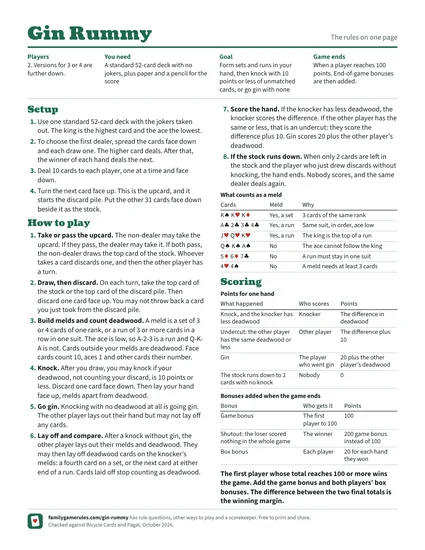
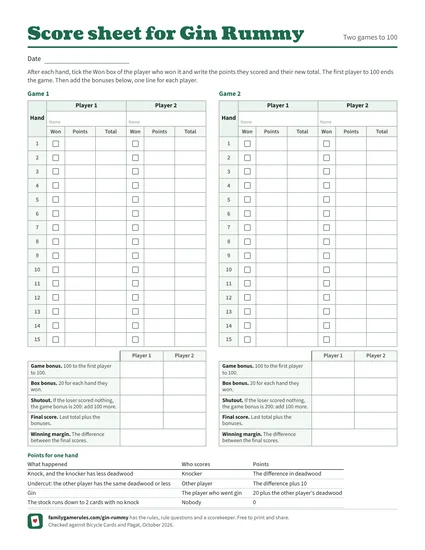
Print the whole game on one page, and a score sheet made for Gin Rummy. Both are free PDFs for Letter paper.
Setup
2 players. Ways for 3 or 4 people to play are further down.
You need: One standard 52-card deck with the jokers taken out.
| In the set | Count | Worth when scoring |
|---|---|---|
| Aces | 4 | 1 point each |
| Number cards, 2 through 10 | 36 | The number on the card |
| Jacks, queens and kings | 12 | 10 points each |
| Total | 52 |
- The points are what a card counts when it is left out of your melds at the end of a hand.
- A second deck helps. One player shuffles it while the other deals.
- Use one standard 52-card deck with the jokers taken out. The king is the highest card and the ace the lowest.
- To choose the first dealer, spread the cards face down and each draw one. The higher card deals. After that, the winner of each hand deals the next.
- Deal 10 cards to each player, one at a time and face down.
- Turn the next card face up. This is the upcard, and it starts the discard pile. Put the other 31 cards face down beside it as the stock.
Your hand
Stock
The other 31 cards, face down
Upcard
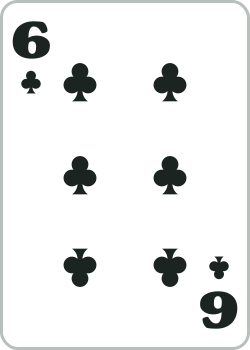
Starts the discard pile
Other player’s hand
- Some players pick the first dealer the other way round, so the lower card deals.
- Rule books differ on who deals after the first hand. See Who deals next under house rules.
How to play
Players take turns drawing a card and discarding a card. Nobody lays anything on the table during play. The hand ends when a player knocks, or when the stock runs down to 2 cards with no knock.
-
Take or pass the upcard
The non-dealer may take the upcard. If they pass, the dealer may take it. If both pass, the non-dealer draws the top card of the stock. Whoever takes a card discards one, and then the other player has a turn.
- A player who passes the upcard does not discard.
- If the non-dealer takes the upcard, the dealer plays next. If the dealer takes it, the non-dealer plays next.
-
Draw, then discard
On each turn, take the top card of the stock or the top card of the discard pile. Then discard one card face up. You may not throw back a card you just took from the discard pile.
- A card you draw from the stock may be discarded straight away.
- Keep all your cards in your hand during play, melds included. They go on the table only when someone knocks.
-
Build melds and count deadwood
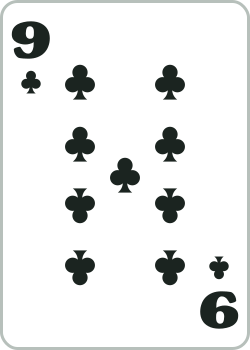
A meld is a set of 3 or 4 cards of one rank, or a run of 3 or more cards in a row in one suit. The ace is low, so A-2-3 is a run and Q-K-A is not. Cards outside your melds are deadwood. Face cards count 10, aces 1 and other cards their number.
- A card can be in only one meld at a time. The 8 of hearts cannot count in a set of 8s and in a heart run together.
- You choose how to group your cards. Pick the grouping that leaves the least deadwood.
A set
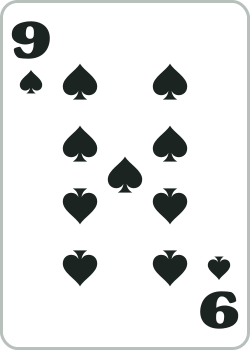
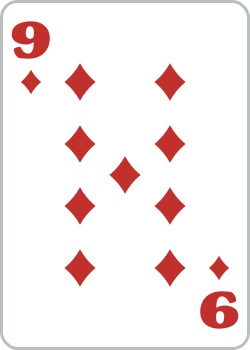
A run
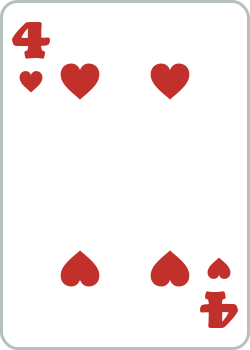
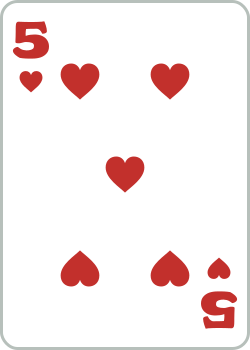
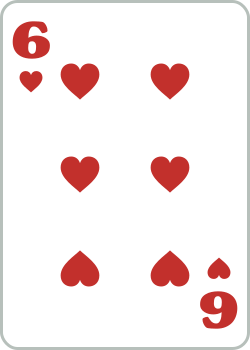
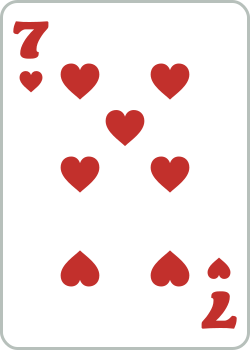
Same suit, in order
Deadwood
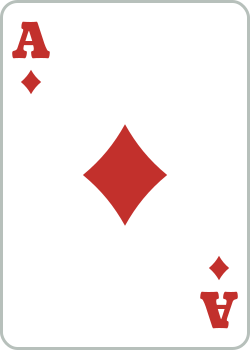
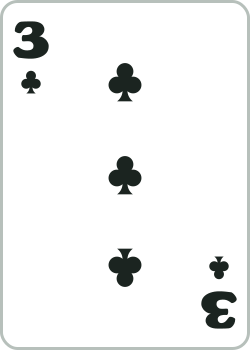
1 + 2 + 3 = 6 points. Mixed suits, so not a run
A 10-card hand with 6 points of deadwood, low enough to knock. -
Knock
After you draw, you may knock if your deadwood, not counting your discard, is 10 points or less. Discard one card face down. Then lay your hand face up, melds apart from deadwood.
- You never have to knock.
- You may knock on any turn, the first one included.
- The face-down discard is not part of your hand. Only the 10 cards you lay out count.
- Knocking ends play. Nobody draws again in that hand.
-
Go gin
Knocking with no deadwood at all is going gin. The other player lays out their hand but may not lay off any cards.
- Gin cannot be beaten. Even an opponent with no deadwood does not undercut a gin hand.
- Two runs of 5 cards each make a gin hand too.
-
Lay off and compare
After a knock without gin, the other player lays out their melds and deadwood. They may then lay off deadwood cards on the knocker’s melds: a fourth card on a set, or the next card at either end of a run. Cards laid off stop counting as deadwood.
- The knocker never lays off cards on the other player’s melds.
- Cards can be laid off only on melds, never on the knocker’s deadwood.
-
Score the hand
If the knocker has less deadwood, the knocker scores the difference. If the other player has the same or less, that is an undercut: they score the difference plus 10. Gin scores 20 plus the other player’s deadwood.
-
If the stock runs down
When only 2 cards are left in the stock and the player who just drew discards without knocking, the hand ends. Nobody scores, and the same dealer deals again.
- The player who draws the third-to-last card can still knock on that turn as usual.
| Cards | Meld | Why |
|---|---|---|
| K♠ K♥ K♦ | Yes, a set | 3 cards of the same rank |
| A♣ 2♣ 3♣ 4♣ | Yes, a run | Same suit, in order, ace low |
| J♥ Q♥ K♥ | Yes, a run | The king is the top of a run |
| Q♠ K♠ A♠ | No | The ace cannot follow the king |
| 5♦ 6♦ 7♣ | No | A run must stay in one suit |
| 4♥ 4♠ | No | A meld needs at least 3 cards |
Example: a knock, and the other player lays off
You draw, discard face down and knock. Your hand is a run of the 4, 5 and 6 of hearts, three 9s, a run of the 10, jack and queen of clubs, and the 2 of diamonds. Your deadwood is 2. Sam lays out three kings and a run of the 5, 6 and 7 of spades. Sam’s other cards are the 7 and 9 of hearts, the 3 of clubs and the ace of diamonds, which make 20 points. Sam lays off the 7 of hearts on your heart run and the 9 of hearts on your 9s. That leaves Sam with 4 points of deadwood. Your 2 is still lower, so you win the hand and score 4 minus 2, which is 2 points.
Your melds
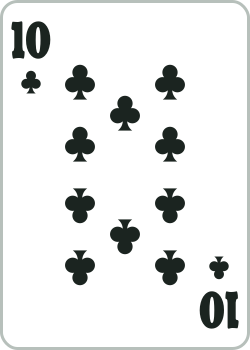
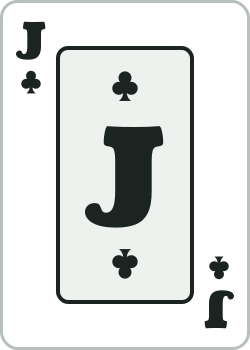
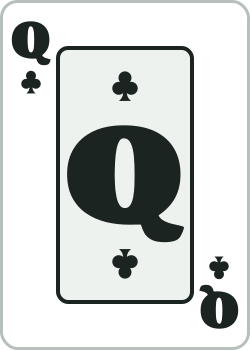
Sam adds the 7♥ to the run and the 9♥ to the set
Your deadwood
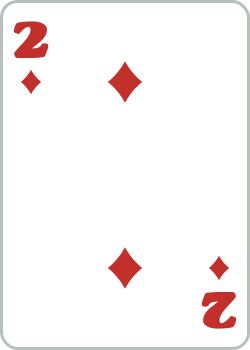
2 points
Sam’s melds
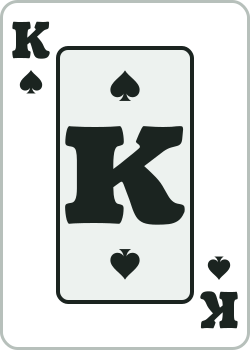
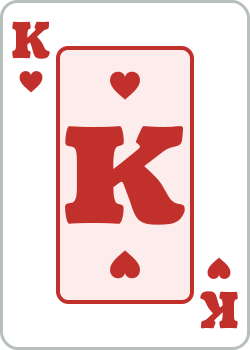
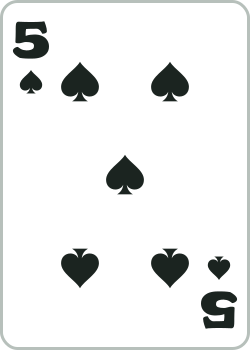
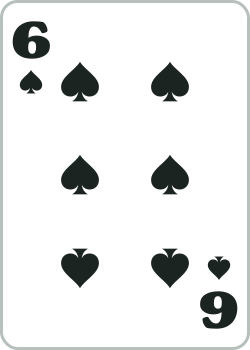
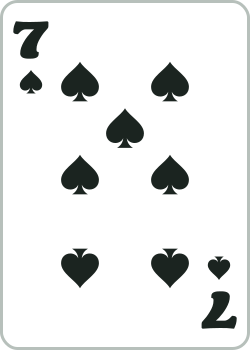
Sam’s deadwood
20 points, then 4 after laying off
Scoring
Only one player scores in each hand. The score is the gap between the two deadwood counts, plus a bonus for gin or an undercut. More bonuses are added when the game ends.
| What happened | Who scores | Points |
|---|---|---|
| Knock, and the knocker has less deadwood | Knocker | The difference in deadwood |
| Undercut: the other player has the same deadwood or less | Other player | The difference plus 10 |
| Gin | The player who went gin | 20 plus the other player’s deadwood |
| The stock runs down to 2 cards with no knock | Nobody | 0 |
| Bonus | Who gets it | Points |
|---|---|---|
| Game bonus | The first player to 100 | 100 |
| Shutout: the loser scored nothing in the whole game | The winner | 200 game bonus instead of 100 |
| Box bonus | Each player | 20 for each hand they won |
- Box bonuses are added only after the game ends. They do not count toward the 100 points needed to win.
- A hand that ends with nobody scoring, when the stock runs down, is not a hand won by anyone.
- When the two counts are equal, the knocker is undercut. The other player wins the hand and scores 0 plus the 10-point bonus.
The first player whose total reaches 100 or more wins the game. Add the game bonus and both players’ box bonuses. The difference between the two final totals is the winning margin.
Use a sheet with a column for each player. After each hand, write the points under the winner and keep a running total. Mark a box for each hand a player wins, so the box bonuses are easy to count at the end.
A worked example: a game of five hands
You play Sam. In hand 3 you knock with 8 but Sam has 6, so Sam undercuts you. After hand 5 your total is 103, so you win. You won 3 hands and Sam won 2. Your final score is 263 and Sam’s is 86, so you win by 177.
| What happened | Goes to | Points |
|---|---|---|
| Hand 1: you knock with 3, Sam has 25 | You | 22 |
| Hand 2: Sam goes gin, you have 14 (20 + 14) | Sam | 34 |
| Hand 3: you knock with 8, Sam has 6, an undercut (2 + 10) | Sam | 12 |
| Hand 4: you go gin, Sam has 31 (20 + 31) | You | 51 |
| Hand 5: you knock with 5, Sam has 35. Your total is now 103 | You | 30 |
| Game bonus for reaching 100 first | You | 100 |
| Box bonus: 3 hands won, 20 each | You | 60 |
| Box bonus: 2 hands won, 20 each | Sam | 40 |
| You | 263 | |
| Sam | 86 |
Scorekeeper
After each hand, enter who knocked and both deadwood counts after any laying off. The scorekeeper decides whether it was a knock, gin or undercut and gives the points to the winner. When a player reaches 100, it adds the 100 game bonus, 20 for every hand each player won, and 100 more if the loser never scored. It works in this browser, keeps the game if the page reloads, and needs no account.
Other ways to play
Gin rummy for 3 players
Only 2 people play each hand. The dealer deals to the other two and sits that hand out. The loser of each hand deals the next, so the winner stays in and plays the player who just dealt. The rules for play do not change. The rule source that gives this version does not say how to keep score, so agree on it before you start.
Gin rummy for 4 players (two teams)
Play in 2 teams of 2. Each player plays an ordinary two-player hand against one player from the other team. Partners take turns facing each opponent but always stay on the same team. If both partners win their hands, the team scores both results added together. If each team wins one hand, the team with more points scores the difference. The first team to reach 125 points wins. The rules we checked do not say whether the game and box bonuses apply, so agree on it.
House rules and other versions
- Bigger gin and undercut bonuses
- Some groups give 25 for gin and 20 for an undercut. Others make the gin bonus, the undercut bonus and the box bonus 25 points each. Agree on the figures before the first deal.
- Doubling for a shutout
- Instead of a 200 game bonus, some groups double the winner’s whole score when the loser scored nothing. In another version, a winner who won every hand doubles the points from each hand before adding the box bonuses.
- Who deals next
- Some rule books have the loser of each hand deal the next one. Others have the two players take turns dealing.
- No upcard
- The non-dealer gets 11 cards and the dealer 10, and no card is turned face up. The non-dealer starts play by discarding one card.
- A last chance at the end of the stock
- When a player leaves 2 cards in the stock and discards without knocking, the other player may take that discard and knock with it. If they cannot, the hand ends with no score.
- Throwing a discard straight back
- Some tournament rules let you take the top discard and discard the same card on that turn. The player who threw it away first may not take it back unless they knock on that turn.
- Oklahoma Gin
- The first upcard sets the knock limit for the hand. A 7 means you may knock with 7 or less, and face cards count 10. Some play that an ace upcard means you may knock only with gin. A spade upcard doubles that hand’s score, bonuses included. The game usually goes to 150.
- Extra boxes in Oklahoma Gin
- Some Oklahoma players give 1 extra box for an undercut and 2 for gin, or 2 and 4 when the upcard is a spade. Extra boxes do not count toward the target. At the end each is worth 20 or 25 points, like the box for each hand won.
- Big Gin
- If all 11 cards form melds after you draw, you may lay out all 11 without discarding. This is Big Gin. It scores 31 points plus the other player’s deadwood. Some groups give 50 instead of 31.
- Hollywood scoring
- Keep three games at once in three sets of columns. Each player’s first hand win is written in game 1 only, the second in games 1 and 2, and each win after that in every game still open. A game ends with its bonuses when a player reaches the agreed target. Play on until all three are done, then add them up.
Rule questions
How many cards do you deal in gin rummy?
10 cards each. Use one standard 52-card deck with no jokers. After the deal, turn the next card face up to start the discard pile. The other 31 cards are the stock.
Can you pick up the discard and throw the same card back?
No. If you take the top discard, you must discard a different card that turn. A card drawn from the stock may be thrown away at once. Some tournament rules allow throwing the discard straight back, so agree on it if you play that way.
How much deadwood can you knock with?
10 points or less, counted after your face-down discard. Face cards count 10, aces 1 and other cards their number. In Oklahoma Gin the value of the first upcard is the limit for that hand.
Do you have to knock as soon as you can?
No. Knocking is always your choice. You can keep playing to lower your deadwood or to try for gin. You may also knock on your very first turn if your hand allows it.
Can you lay off cards when the other player goes gin?
No. Laying off is allowed only after a knock without gin. Against gin, every card left outside your melds counts as deadwood, and the gin player scores 20 plus that total.
Can the knocker lay off on the other player’s melds?
No. Only the player who did not knock lays off, and only on the knocker’s melds.
What happens if both players have the same deadwood?
The knocker loses. Equal counts are an undercut, so the other player scores the difference, which is 0, plus the 10-point undercut bonus.
Is the ace high or low in gin rummy?
Low. A-2-3 of one suit is a run, but Q-K-A is not. An ace in your deadwood counts 1 point.
What happens when the stock runs out?
The hand ends when 2 cards are left in the stock and the player who just drew discards without knocking. Nobody scores and the same dealer deals again. Some groups first let the other player take that last discard and knock.
What is the box bonus, and does it count toward 100?
The box bonus, also called the line bonus, is 20 points for each hand you won. Both players add theirs when the game ends. It does not count toward the 100 needed to win.
What is a shutout in gin rummy?
A game the loser ends without scoring a single point. The winner’s game bonus is then 200 instead of 100. Some groups double the winner’s whole score instead.
Who deals the next hand?
The winner of the hand just played. After a hand where the stock ran down and nobody scored, the same dealer deals again. Some rule books have the loser deal next, or have the players take turns.
Words used in Gin Rummy
- Meld
- A set or a run. In gin rummy melds stay in your hand until someone knocks.
- Set
- 3 or 4 cards of the same rank, such as three queens.
- Run
- 3 or more cards of one suit in order, such as the 6, 7 and 8 of spades. The ace is low.
- Deadwood
- The cards in a hand that are not part of a meld. Also called unmatched cards. Their points are your count.
- Upcard
- The card turned face up after the deal. It starts the discard pile.
- Stock
- The face-down pile of cards left after the deal.
- Knock
- To end the hand when your deadwood is 10 points or less, by discarding face down and laying out your hand.
- Gin
- A hand with no deadwood at all. Knocking with one is going gin.
- Lay off
- To add a deadwood card to the knocker’s set or run after a knock, so it stops counting against you.
- Undercut
- When the player who did not knock has the same deadwood as the knocker or less. They win the hand and a 10-point bonus.
- Game bonus
- The 100 points the first player to reach 100 gets when the game ends.
- Box bonus
- 20 points for each hand a player won, added when the game ends. Also called the line bonus.
- Shutout
- Winning a game while the other player scores nothing. The game bonus is then 200.
What you need
- A standard deck of playing cardsOne 52-card deck is all the game needs. Take the jokers out.Find it on Amazon (A standard deck of playing cards, opens in a new tab)
- A second deckOptional. One deck is shuffled while the other is dealt. Decks are often sold two to a box.Find it on Amazon (A second deck, opens in a new tab)
- A gin rummy score padAny paper works. A printed pad has the columns and boxes ready.Find it on Amazon (A gin rummy score pad, opens in a new tab)
As an Amazon Associate, we earn from qualifying purchases. How the site is paid for.
Checked against
These rules are written in our own words from Bicycle Cards and checked against Pagat. Sources last checked on October 12, 2026.
- First source: Bicycle Cards, Gin Rummy. The deck, the 10-card deal, choosing the first dealer, the upcard on the first turn, the turn, knocking with 10 or less, gin, the undercut on equal counts, the gin and undercut bonuses, the game to 100, the game bonus, 20 for each hand won and 100 extra for winning every hand.
- Second source: Pagat, Gin Rummy. Card values, sets of 3 or 4, the low ace, one meld per card, who deals each hand, the face-down knock discard, knocking on any turn, laying off and the ban on laying off against gin, the end of the stock, all hand and game scoring, the 200 shutout bonus, 3 and 4 players, Oklahoma Gin and most house rules.
Other sources we used (1)
- Wikipedia, Gin rummy. Big Gin and its 31 or 50 points, how Hollywood scoring keeps three games, the 25-point bonus figures, doubling each hand’s points for a shutout, taking turns to deal, the spade upcard doubling, and a third reading of the gin and end-of-stock rules.
Where the sources differ (11)
| Topic | Bicycle Cards | Pagat | This page |
|---|---|---|---|
| Choosing the first dealer | Each player draws from the spread deck. The highest card chooses a seat and deals. | Each player draws a card. The lower card deals. | Follows Bicycle: the higher card deals. The lower-card way is a setup note. Wikipedia allows any agreed method. |
| Who deals each later hand | “The player who wins the previous game” deals. Bicycle calls hands partial games, so it is unclear whether this means each hand or each game. | The winner of the previous hand. Some books have the loser deal, and some alternate. | The winner of each hand. Loser deals and taking turns are a variant. Wikipedia has the players take turns. |
| Laying off against gin | The opponent may combine cards with those shown by the player who knocked “or announced Gin”. Nothing forbids laying off on gin. | Not allowed: a player facing gin may not lay off any cards. | Not allowed, as Pagat and Wikipedia say. |
| The knocking discard | Not stated. | The knocker discards one card face down. | Face down. |
| When the stock runs down | Not covered. | With 2 cards left in the stock, if the player who drew discards without knocking, the hand is cancelled with no score and the same dealer deals again. A last chance to take that discard and knock is a variation. | Follows Pagat. Wikipedia also ends the hand as a draw at 2 cards. The last chance is a variant. |
| The ace | Ranks lowest and joins a run with the 2, not the king. No point value is written. | Always low, 1 point. | Low, 1 point. |
| Size of a set | Three or more cards of the same rank. | 3 or 4 cards of the same rank. | 3 or 4. A single deck has only 4 cards of each rank, so the two say the same thing. |
| Gin and undercut bonuses | Gin 20. Undercut 10, kept when the counts are equal. | Gin 20, undercut 10. Variations: gin 25 and undercut 20, or gin, undercut and box bonus all 25. | Gin 20, undercut 10. The other figures are a variant. Wikipedia gives 25 for both, and notes smaller undercut bonuses in other and older rule sets. |
| Box bonus | 20 points for each partial game won. Does not say whether it counts toward 100. | 20 for each hand won, for both players, not counted toward the 100. | 20 a hand, not counted toward 100. Wikipedia gives 25 a hand, which is covered by the bigger-bonus variant. |
| Shutout | 100 extra points for winning every hand of a game while the opponent wins none. Nothing is doubled. | If the loser scored nothing, the game bonus is 200 instead of 100. Doubling the winner’s whole score is a variation. | The 200 game bonus, which is the same total as Bicycle’s extra 100. Whole-score doubling and Wikipedia’s doubling of each hand’s points are a variant. |
| The final result | Not stated beyond the game ending at 100 and the bonuses. | After the bonuses, the lower total pays the higher an amount in proportion to the difference. | The winning margin is the difference between the two final totals. |
What on this page is our own
- The playing time of about 30 to 45 minutes is our estimate.
- The example knock, the meld diagram and the five-hand scoring example are our own, and so is their arithmetic.
- The stock of 31 cards is our arithmetic: 52 cards, less 20 dealt and 1 turned up.
- That melds stay in the hand during play is not said in one sentence by either main source. Both have cards shown only when a player knocks.
- That a card drawn from the stock may be discarded at once follows from the sources banning only the throw-back of a card taken from the discard pile.
- That only the 10 cards laid out count after the face-down discard, and that nobody draws after a knock, follow from how the sources describe the knock.
- That a hand ended by the stock running down is not a hand won by anyone follows from it scoring nothing.
- The advice to pick the grouping with the least deadwood, and the note on equal counts scoring 0 plus 10, are our own wording of the rules.
- Hollywood scoring is shown without a target figure, because the one source that explains it gives 200 inside a paragraph that also changes other rules.
- In Hollywood scoring, writing later wins only in games still open is our reading. Wikipedia says later wins go in all three games and that a finished game takes its bonuses while play goes on.
- The notes under What you need describe products and are not rules.
- The pieces pictured at the top of the page are our own example.
Spotted a mistake? Email contact@familygamerules.com and we'll check it against the sources.