Crazy Eights rules
Crazy Eights is a card game for 2 to 8 players with a standard deck. On your turn you play a card that matches the top card of the pile in suit or rank. Every 8 is wild and lets you name the next suit. The first player to run out of cards wins the hand.
Also called Swedish Rummy, Rockaway.
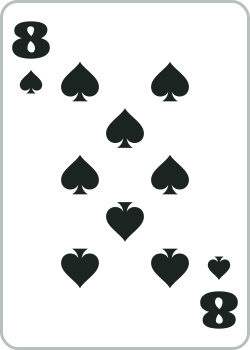
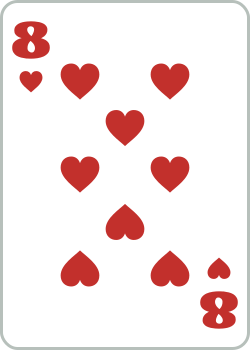
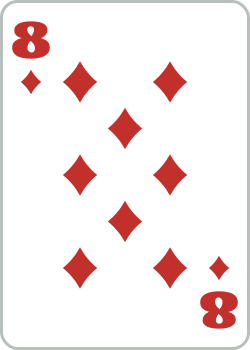
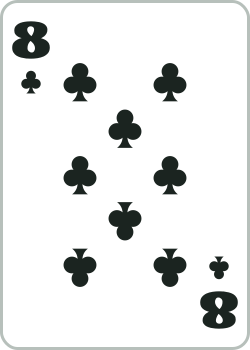
- Players
- 2 to 8. Use two decks with 6 or more.
- You need
- A standard 52-card deck, or two decks for 6 or more players. Paper and a pencil if you keep score.
- Deal
- 7 cards each for 2 players, 5 each for 3 or more. The top card of the rest is turned face up.
- Goal
- Be the first to play every card in your hand
- Game ends
- A hand ends when one player is out of cards. In a scored game, the first to 50 points for each player wins: 100 with 2 players, 200 with 4.
- Playing time
- About 5 to 10 minutes a hand
Quick start
- Deal 7 cards each for 2 players, or 5 each for 3 or more. Stack the rest face down as the stock and turn its top card face up to start the pile.
- If that first card is an 8, bury it in the middle of the stock and turn up the next card. The player on the dealer’s left goes first.
- On your turn, play 1 card that matches the top card of the pile in suit or in rank. On the 6 of hearts you can play any heart or any 6.
- 8s are wild. Play an 8 on any card and name a suit. The next player must play a card of that suit or another 8.
- If you cannot play, draw from the stock until you can, then play. You may also draw when you could play. Once the stock is empty, a player who cannot play passes.
- The first player out of cards wins the hand and collects for cards left in other hands: 8s 50, 10s and face cards 10, aces 1, others their number.
Rule sheet and score sheet
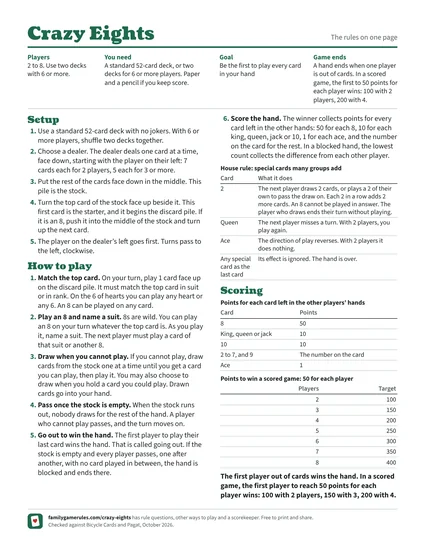
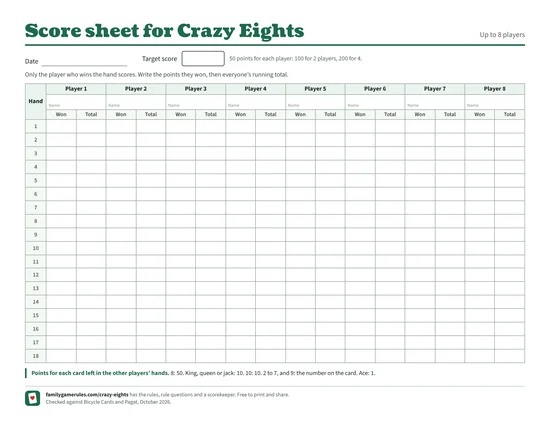
Print the whole game on one page, and a score sheet made for Crazy Eights. Both are free PDFs for Letter paper.
Setup
2 to 8 players, each playing alone. One deck is enough for up to 5. With 6 or more, shuffle two decks together. Notes for 2 players and for big groups are further down.
You need: One standard 52-card deck with the jokers taken out.
| In the set | Count | Worth when scoring |
|---|---|---|
| 8s | 4 | 50 points each |
| Kings, queens and jacks | 12 | 10 points each |
| 10s | 4 | 10 points each |
| Number cards 2 to 7, and 9s | 28 | The number on the card |
| Aces | 4 | 1 point each |
| Total | 52 |
- The points show what a card is worth to the winner of a hand when it is caught in another player’s hand.
- With 6 or more players, shuffle two decks together for 104 cards. Two decks hold two copies of every card, so there are eight 8s.
- Use a standard 52-card deck with no jokers. With 6 or more players, shuffle two decks together.
- Choose a dealer. The dealer deals one card at a time, face down, starting with the player on their left: 7 cards each for 2 players, 5 each for 3 or more.
- Put the rest of the cards face down in the middle. This pile is the stock.
- Turn the top card of the stock face up beside it. This first card is the starter, and it begins the discard pile. If it is an 8, push it into the middle of the stock and turn up the next card.
- The player on the dealer’s left goes first. Turns pass to the left, clockwise.
| Players | Each player gets | Notes |
|---|---|---|
| 2 | 7 cards | 1 card is turned face up and 37 form the stock. |
| 3 | 5 cards | 1 card is turned face up and 36 form the stock. |
| 4 | 5 cards | 1 card is turned face up and 31 form the stock. |
| 5 | 5 cards | 1 card is turned face up and 26 form the stock. |
| 6 to 8 | 5 cards | Two decks, 104 cards. 1 card is turned face up and 63 to 73 form the stock. |
Each player’s hand
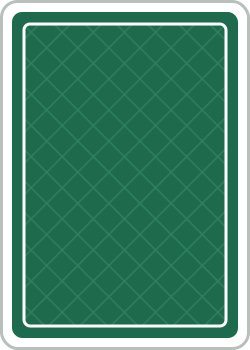
Stock
The 31 cards left over, face down
Starter
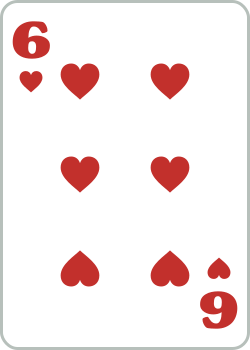
Face up. It starts the discard pile.
- Some rule books deal 5 cards each even with 2 players, and some groups deal 8 each. Agree on the deal before you start.
- The rule sources we checked do not say how to pick the first dealer. Drawing cards or any other fair way works. For the next hand, pass the deal to the left.
How to play
Turns go clockwise, starting on the dealer’s left. On your turn you play 1 card onto the discard pile, or you draw from the stock.
-
Match the top card
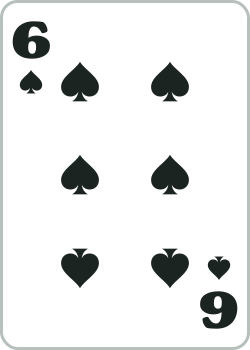
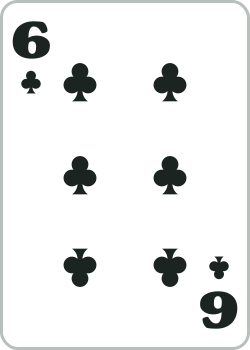
On your turn, play 1 card face up on the discard pile. It must match the top card in suit or in rank. On the 6 of hearts you can play any heart or any 6. An 8 can be played on any card.
- Rank means the number or the face on the card: a 6, a jack, an ace.
- You play 1 card a turn. Some groups let you play two or more cards of the same rank together. See the house rules.
Top of the discard pile
Same suit
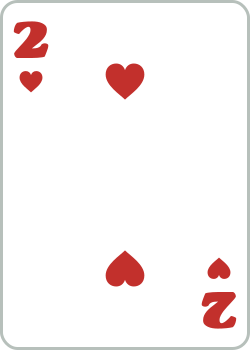
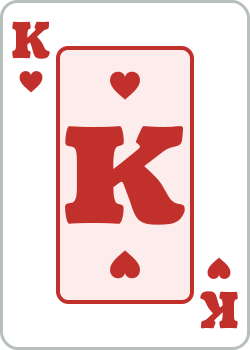
Same rank
An 8
Wild. It goes on anything.
What can be played on the 6 of hearts. -
Play an 8 and name a suit
8s are wild. You can play an 8 on your turn whatever the top card is. As you play it, name a suit. The next player must play a card of that suit or another 8.
- You name a suit only, never a rank.
- Any of the four suits can be named, including the suit of the 8 itself.
- After an 8, the suit printed on the 8 does not count. Only the named suit does.
- An 8 can go on another 8. The player who plays the second 8 names a suit again.
-
Draw when you cannot play
If you cannot play, draw cards from the stock one at a time until you get a card you can play, then play it. You may also choose to draw when you hold a card you could play. Drawn cards go into your hand.
- When you draw by choice, the rules we checked do not say how many cards you may take or whether you must then play. Agree on it before you start. Some groups draw only 1 card and end the turn, or stop at a number they agreed on. See the house rules.
- Some groups also say you must play if you can, and may draw only when you cannot.
-
Pass once the stock is empty
When the stock runs out, nobody draws for the rest of the hand. A player who cannot play passes, and the turn moves on.
- Some groups let a player pass at this point even when they could play.
- Some rule books shuffle the discard pile into a new stock instead. See the house rules.
-
Go out to win the hand
The first player to play their last card wins the hand. That is called going out. If the stock is empty and every player passes, one after another, with no card played in between, the hand is blocked and ends there.
- Your last card can be an 8. The hand ends at once, so the suit you name does not matter.
-
Score the hand
The winner collects points for every card left in the other hands: 50 for each 8, 10 for each king, queen, jack or 10, 1 for each ace, and the number on the card for the rest. In a blocked hand, the lowest count collects the difference from each other player.
- Only the winner scores in a hand. The other totals stay the same.
- In a blocked hand, everyone adds up the cards in their own hand. The player with the lowest count wins the hand. From each other player they collect that player’s count minus their own. The rules we checked do not settle a tie for the lowest count.
| Card | What it does |
|---|---|
| 2 | The next player draws 2 cards, or plays a 2 of their own to pass the draw on. Each 2 in a row adds 2 more cards. An 8 cannot be played in answer. The player who draws ends their turn without playing. |
| Queen | The next player misses a turn. With 2 players, you play again. |
| Ace | The direction of play reverses. With 2 players it does nothing. |
| Any special card as the last card | Its effect is ignored. The hand is over. |
Example: what the next player can play after an 8
The top card is the 4 of clubs. You have no clubs and no 4s, so you play the 8 of diamonds and name spades. The next player holds the 6 of diamonds, the 3 of spades, the 8 of hearts and the 4 of clubs. They may play the 3 of spades, because spades were named, or the 8 of hearts, which is wild. The 6 of diamonds matches the 8’s suit, but that no longer counts. The 4 of clubs matched the card under the 8, which no longer counts either.
Top card before your turn
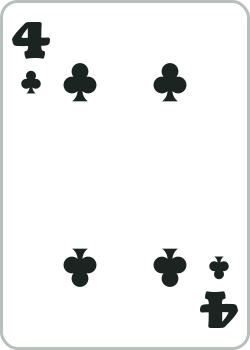
You play
You name spades
Next player’s hand
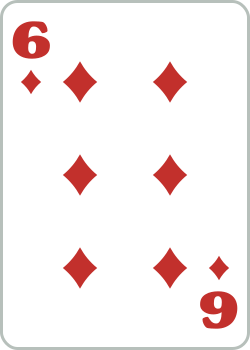
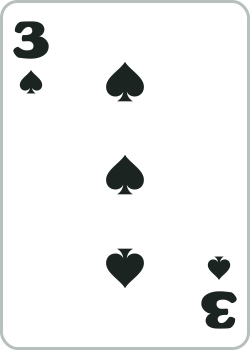
Cards they can play
The named suit, or another 8
Not allowed
Neither is a spade
Scoring
Keeping score is optional. Without it, the first player out of cards wins. For a longer game, the winner of each hand collects points for the cards still held by everyone else. Nobody else scores in that hand.
| Card | Points |
|---|---|
| 8 | 50 |
| King, queen or jack | 10 |
| 10 | 10 |
| 2 to 7, and 9 | The number on the card |
| Ace | 1 |
| Players | Target |
|---|---|
| 2 | 100 |
| 3 | 150 |
| 4 | 200 |
| 5 | 250 |
| 6 | 300 |
| 7 | 350 |
| 8 | 400 |
- An 8 still in your hand is costly. Each one hands the winner 50 points.
- In a blocked hand, the player with the lowest count collects the difference from each other player. With counts of 12, 20 and 31, the player on 12 collects 8 and 19, for 27 points.
The first player out of cards wins the hand. In a scored game, the first player to reach 50 points for each player wins: 100 with 2 players, 150 with 3, 200 with 4.
Write each player’s name at the top of a sheet. After each hand, add the points to the winner’s running total. The other totals stay the same.
A worked example: scoring one hand
Four people are playing. You play your last card and go out. The other three players show the cards left in their hands, and you add them up. You score 93 points for the hand. In a 4-player game to 200, you need 107 more.
Player on your left
50 + 10 = 60
Player across from you
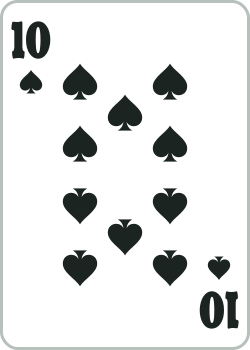
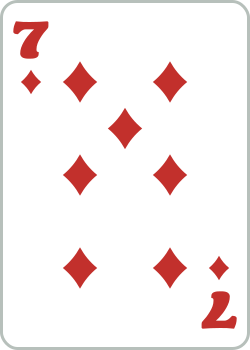
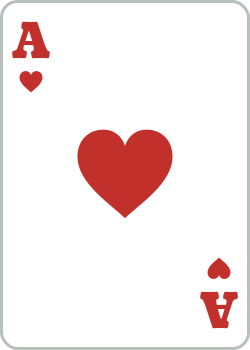
10 + 7 + 1 = 18
Player on your right
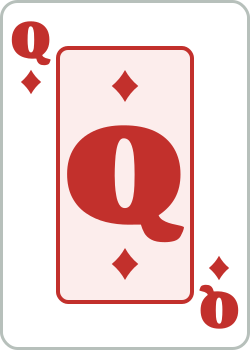
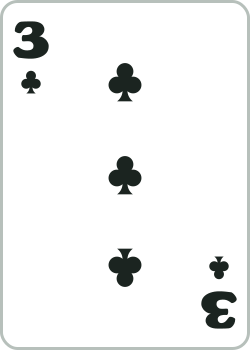
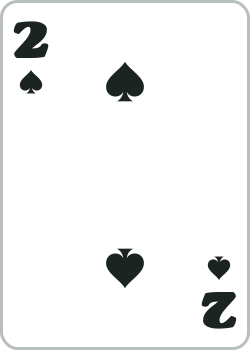
10 + 3 + 2 = 15
| What happened | Points |
|---|---|
| Player on your left: the 8 of clubs | 50 |
| Player on your left: the king of hearts | 10 |
| Player across from you: the 10 of spades | 10 |
| Player across from you: the 7 of diamonds | 7 |
| Player across from you: the ace of hearts | 1 |
| Player on your right: the queen of diamonds | 10 |
| Player on your right: the 3 of clubs and the 2 of spades | 5 |
| Your points for the hand | 93 |
Scorekeeper
For 2 to 8 players. After each hand, enter the points the winner collected from the other hands. Set the target before you start: 50 points for each player, so 100 for 2 players and 200 for 4. It works in this browser, keeps the game if the page reloads, and needs no account.
Other ways to play
Crazy Eights for 2 players
Deal 7 cards each instead of 5. The player who did not deal goes first. Everything else is the same. The winner of a hand collects for the cards left in the other player’s hand, and a scored game goes to 100 points. If you add the special cards, a queen means you play again at once and an ace does nothing. Some rule books deal 5 cards each even with 2 players.
Crazy Eights for 6 to 8 players (two decks)
With more than 5 players, shuffle two standard decks together, which makes 104 cards. Deal 5 cards each. Play and card values do not change. Two decks hold two copies of every card, so there are eight 8s. A scored game goes to 50 points for each player: 300 with 6, 350 with 7 and 400 with 8.
House rules and other versions
- A first 8 names the suit
- If the first card turned up is an 8, do not bury it. Treat it as if the dealer had played it. The dealer names a suit, and the first player must play that suit or another 8.
- Reshuffle the discard pile
- When the stock runs out, keep the top card of the discard pile where it is. Shuffle the rest, turn them face down as a new stock and play on. Drawing goes on as before.
- Draw 1 card only
- If you do not play, draw just 1 card from the stock, and your turn is over. Some groups that play this way let you play the drawn card at once if it matches.
- Draw up to a limit
- Agree before the game on the most cards a player may draw in one turn. If you still cannot play after that many, or do not want to, your turn passes.
- Play if you can
- You may draw only when you hold no card you can play. If you can play, you must.
- Last card
- When you are down to 1 card, say “Last card” to warn the others. If you have not said it by the time the next player takes their turn, draw 2 cards from the stock as a penalty.
- Special cards
- Many groups give other cards a job as well. A 2 makes the next player draw 2 cards unless they answer with a 2. A queen makes the next player miss a turn. An ace reverses the direction of play. The table with the play steps has the details.
- Equal cards together
- You may play two or more cards of the same rank in one turn, as long as the first one is a legal play. If they are special cards, each one takes effect.
- Limits on 8s
- Some groups play that an 8 must match the suit or rank of the card under it, like any other card. Others let an 8 go anywhere but have no suit named, so the next player matches the 8’s own suit or plays another 8.
- A different wild card
- Some groups make jacks or aces the wild cards that change the suit, in place of 8s.
- Penalty points
- Instead of the winner collecting, every player who did not go out adds the points in their own hand to their own total. A low total is good with this way of scoring. Agree before you start on when the game ends.
- Crazy Eights Countdown
- Everyone starts with a score of 8 and is dealt 8 cards. When you go out, take 1 off your score and get a new hand of that many cards, while the others play on. Your wild card is the rank of your score: 8s first, then 7s, down to aces. The first player to reach 0 wins.
Rule questions
How many cards do you deal in Crazy Eights?
5 cards each when 3 or more play, and 7 each when 2 play. The rest of the deck is the stock, and its top card is turned face up. Some rule books deal 5 cards each even for 2 players.
How many decks do you need for Crazy Eights?
One standard 52-card deck for 2 to 5 players. With 6 or more, shuffle two decks together for 104 cards and still deal 5 each.
After an 8, can the next player follow the suit of the 8 itself?
Only if that suit was named. Once an 8 is played, the next player must play the suit that was named or another 8. The suit printed on the 8 does not count.
Can you play an 8 on an 8?
Yes. An 8 can be played on any card, another 8 included. When you play it, you name a suit of your own for the next player.
What happens if the first card turned up is an 8?
Push it into the middle of the stock and turn up the next card. Some groups play it as if the dealer had played the 8. The dealer names a suit, and the first player must follow it or play an 8.
Do you have to play a card if you can?
No. Under the main rules you may draw from the stock even when you hold a card you could play. Some groups say you must play if you can, and may draw only when you cannot.
How many cards do you draw when you cannot play?
As many as it takes. Keep drawing until you get a card you can play, then play it. If the stock runs out first, you pass. Some groups draw only 1 card and end the turn, or stop at a limit they agreed on.
What happens when the draw pile runs out?
Nobody draws again that hand. A player who cannot play passes. If every player passes, one after another, with no card played in between, the hand is blocked, and the player with the lowest count collects the difference from each other player. Some rule books shuffle the discard pile into a new stock instead, all but its top card.
Can you go out on an 8?
Yes. An 8 can be played at any time on your turn, so it can be your last card. The hand ends at once, so the suit you name does not matter.
Do you have to say last card in Crazy Eights?
Not under the main rules on this page. Some rule books make you say “Last card” when you are down to 1 card. If you have not said it by the time the next player takes their turn, you draw 2 cards as a penalty.
How many points do you need to win Crazy Eights?
50 points for each player in the game: 100 with 2 players, 150 with 3, 200 with 4. Without keeping score, the first player out of cards wins.
What is a 10 worth in Crazy Eights?
10 points, the same as a king, queen or jack. An 8 is worth 50, an ace 1, and every other card the number on it.
Words used in Crazy Eights
- Stock
- The face-down pile of cards left after the deal. You draw from it.
- Starter
- The first card turned face up from the stock. It starts the discard pile.
- Discard pile
- The face-up pile where cards are played. You match its top card.
- Suit
- Spades, hearts, diamonds or clubs.
- Rank
- The number or face on a card, such as a 6 or a jack, whatever its suit.
- Wild card
- A card that can be played on anything. In Crazy Eights the 8s are wild.
- Name a suit
- What you do when you play an 8: say which suit the next player must play.
- Face card
- A king, queen or jack. Each is worth 10 points.
- Going out
- Playing your last card. The first player to go out wins the hand.
- Blocked hand
- A hand where the stock is empty and every player passes, one after another, with no card played in between. It ends with no one going out.
- Pass
- To end your turn without playing or drawing. Under the main rules you pass only once the stock is empty.
What you need
- A standard deck of playing cardsOne 52-card deck is enough for 2 to 5 players. Take the jokers out.Find it on Amazon (A standard deck of playing cards, opens in a new tab)
- A second deckOnly for 6 or more players. Decks are often sold two to a box.Find it on Amazon (A second deck, opens in a new tab)
- A score pad and pencilFor a scored game. Plain paper works, and so does our printable score sheet.Find it on Amazon (A score pad and pencil, opens in a new tab)
As an Amazon Associate, we earn from qualifying purchases. How the site is paid for.
Checked against
These rules are written in our own words from Bicycle Cards and checked against Pagat. Sources last checked on October 12, 2026.
- First source: Bicycle Cards, Crazy Eights. The deal for 3 or more, the stock and starter, burying a first 8, matching suit or rank, wild 8s and naming a suit, drawing until you can play, drawing by choice, passing when the stock is empty, going out and the card values the winner collects.
- Second source: Pagat, Crazy Eights. 2 to 8 players, 7 cards each for 2 players, the second deck for big groups, clockwise play, card values, the last-card call, special 2s, queens and aces, and the house rules on the deal, drawing, 8s, the empty stock, penalty points and Countdown.
Other sources we used (1)
- Wikipedia, Crazy Eights. Two decks for more than 5 players, the target of 50 points for each player, and the payout for the lowest count when the cards run out.
Where the sources differ (10)
| Topic | Bicycle Cards | Pagat | This page |
|---|---|---|---|
| Deal for 2 players | 5 cards each, whatever the number of players. | 7 cards each for 2 players, 5 each otherwise. Wikipedia agrees. Pagat adds that some deal 8 each. | 7 for 2 players and 5 for more. Bicycle’s 5 each and the 8-card deal are in the setup notes and the 2-player version. |
| Players and the second deck | 2 to 5 or more players, one 52-card pack. No second deck. | 2 to 8 players. A second pack if there are a lot of players, with no count given. | 2 to 8 players, with two decks for 6 or more. The count of 6 comes from Wikipedia, which brings in the second deck with more than 5 players. |
| First card is an 8 | Bury it in the middle of the pack and turn the next card. | It counts as the dealer’s play. The dealer names a suit. | Follows Bicycle. Pagat’s rule is a house rule and a rule question. |
| Drawing | Draw until you can play or the stock is gone. You may draw even when you could play. | The basic game says to play or draw a card. It lists draw until you can play, draw up to a limit, play the drawn card and play if you can as variations. | Follows Bicycle, which Wikipedia matches. The others are house rules. |
| When the stock runs out | A player who cannot play passes. No reshuffle. | The basic game reshuffles the discards, all but the top card, into a new stock. A variation, which Pagat says most books use, plays on without drawing, and a player who cannot or does not want to play passes. | Follows Bicycle. The reshuffle, which Wikipedia also gives, is a house rule. |
| Blocked hand | Not covered. | In the no-reshuffle variation, if everyone passes, play stops and each player scores penalty points for their own cards. | Uses Wikipedia’s rule: the lowest count collects the difference from each other player. It fits the main scoring, where the winner collects. |
| Who scores | The winner collects from each other player the value of the cards in that player’s hand. | The other players score penalty points for the cards left in their own hands. The winner scores nothing. | The winner collects, which Wikipedia also gives. Penalty points are a house rule. The card values are the same in both. |
| Target score | None. The first player out of cards wins the game. | None. | The first player out wins a hand. For a scored game the page gives Wikipedia’s target of 50 points for each player. |
| Saying last card | Not mentioned. | Part of the basic game: say it with 1 card left or draw 2 as a penalty. Notes that some groups need no warning. | A house rule and a rule question. |
| Special 2s, queens and aces | Not mentioned. | Usually played: a 2 makes the next player draw 2 unless they play a 2, a queen skips the next player, an ace reverses play. | A house rule, with a table in the play section. |
What on this page is our own
- The playing time of about 5 to 10 minutes a hand is our estimate.
- The 6 of hearts diagram, the example after an 8, the blocked-hand figures and the scoring example are our own, and so is their arithmetic.
- The stock counts for each number of players, the target of 400 for 8 players and the eight 8s in two decks are our arithmetic.
- Passing the deal to the left after each hand is our suggestion. No source we used says who deals next or how to pick the first dealer.
- That any suit may be named after an 8, including its own suit, and that the player of a second 8 names a suit again, are our reading of the rule that every 8 names a suit. No source limits the choice.
- That a player who draws until they can play then plays that card, and that the suit named on a last 8 does not matter, are our reading of the rules.
- Using Wikipedia’s payout, written for when the cards in the deck run out, for a blocked hand is our reading. Wikipedia gives no rule for a blocked hand by name.
- In the Draw 1 card house rule, that the turn ends after the one card is our reading of Pagat’s basic game, which says to draw a card and implies the turn then passes.
- In the penalty-points house rule, that a low total is good, and the advice to agree on when the game ends, are ours. Pagat calls the points penalty points and sets no end.
- That the player on the dealer’s left is the non-dealer with 2 players, and so goes first, follows from the main rules.
- Keeping score is optional because both main sources end the game when the first player goes out. The target comes from Wikipedia.
- The notes under What you need describe products and are not rules. The score sheet and scorekeeper are our own design.
- The pieces pictured at the top of the page are our own example.
Spotted a mistake? Email contact@familygamerules.com and we'll check it against the sources.