Euchre rules
Euchre is a quick trick-taking card game for four players in two teams. It uses only 24 cards, and each hand lasts five tricks. Its special twist is the trump suit, where the jack becomes the highest card and the other jack of the same color becomes the second highest.
- Players
- 4, in 2 teams of 2
- You need
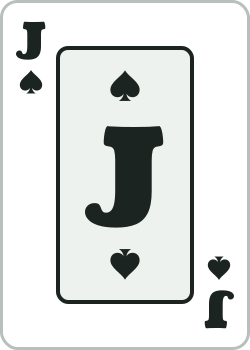
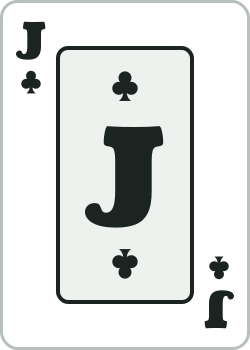
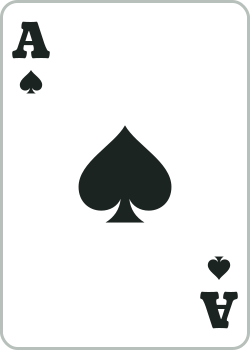
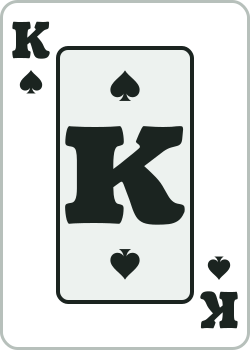
- 24 cards: the 9, 10, jack, queen, king and ace of each suit
- Deal
- 5 cards each. 4 are left over, and the top one is turned face up.
- Goal
- Win at least 3 of the 5 tricks in each hand
- Game ends
- The first team to 10 points wins
- Playing time
- About 30 minutes
Quick start
- Four players split into two teams, and partners sit across from each other. Use 24 cards: the 9 through ace of each suit.
- Deal 5 cards to each player. Put the other 4 in the middle and turn the top one face up.
- Starting on the dealer’s left, each player can pass or have the dealer pick that card up. Picking it up makes its suit trump, and the dealer discards a card.
- If everyone passes, go around again. This time each player can pass or name any other suit as trump.
- Play 5 tricks, following suit if you can. The highest trump wins, or the highest card of the suit led. The jack of trump is the top card, then the other jack of that color.
- The team that chose trump scores 1 point for 3 or 4 tricks and 2 for all 5. If it wins fewer, the other team scores 2. First to 10 wins.
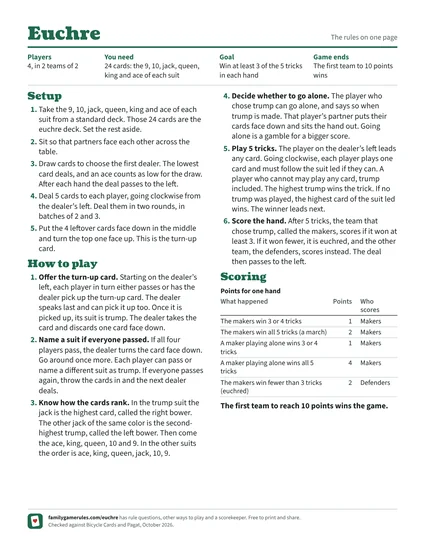
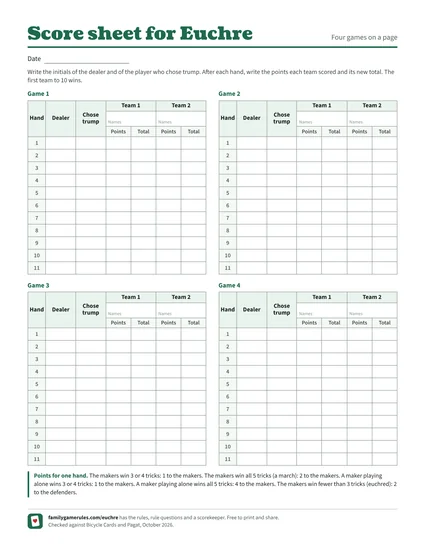
Rule sheet and score sheet
Print the whole game on one page, and a score sheet made for Euchre. Both are free PDFs for Letter paper.
Setup
4 players in 2 teams of 2. Versions for 2 and 3 players are further down.
You need: 24 cards taken from a standard 52-card deck.
| In the set | Count |
|---|---|
| 9s | 4 |
| 10s | 4 |
| Jacks | 4 |
| Queens | 4 |
| Kings | 4 |
| Aces | 4 |
| Total | 24 |
- Leave out the 2s through 8s. Four of those spare cards, 2 for each team, can be used to keep score.
- Take the 9, 10, jack, queen, king and ace of each suit from a standard deck. Those 24 cards are the euchre deck. Set the rest aside.
- Sit so that partners face each other across the table.
- Draw cards to choose the first dealer. The lowest card deals, and an ace counts as low for the draw. After each hand the deal passes to the left.
- Deal 5 cards to each player, going clockwise from the dealer’s left. Deal them in two rounds, in batches of 2 and 3.
- Put the 4 leftover cards face down in the middle and turn the top one face up. This is the turn-up card.
Each player’s hand
Middle of the table
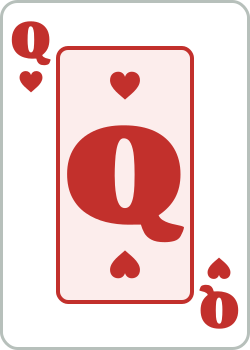
The turn-up card is on top
- The dealer can give 3 cards then 2, or 2 then 3, and should keep to one pattern for the whole deal. In Canada the cards are often dealt one at a time.
- Some groups pick the first dealer by dealing cards face up, one to each player in turn, until a black jack turns up. Whoever gets it deals.
How to play
A hand has two parts. First the players settle which suit is trump. Then they play 5 tricks.
-
Offer the turn-up card
Starting on the dealer’s left, each player in turn either passes or has the dealer pick up the turn-up card. The dealer speaks last and can pick it up too. Once it is picked up, its suit is trump. The dealer takes the card and discards one card face down.
- Telling the dealer to pick the card up is called ordering it up. In the United States the dealer’s partner may order it up, and the two then play the hand together as usual.
- The makers are the team of the player who settled trump: the one who ordered the card up, picked it up as dealer or named the suit. The other team is the defenders. When an opponent of the dealer orders it up, the dealer still picks up the card, but the dealer’s team defends.
-
Name a suit if everyone passed
If all four players pass, the dealer turns the card face down. Go around once more. Each player can pass or name a different suit as trump. If everyone passes again, throw the cards in and the next dealer deals.
- The suit of the card that was turned down cannot be named.
- As soon as one player names a suit, the choosing is over and play begins.
-
Know how the cards rank
In the trump suit the jack is the highest card, called the right bower. The other jack of the same color is the second-highest trump, called the left bower. Then come the ace, king, queen, 10 and 9. In the other suits the order is ace, king, queen, jack, 10, 9.
- The left bower belongs to the trump suit for the whole hand. If hearts are trump, the jack of diamonds counts as a heart. It follows a heart lead and cannot be used to follow a diamond lead.
- That gives the trump suit 7 cards. The other suit of the same color has 5, and the two remaining suits have 6 each.
Spades (trump)
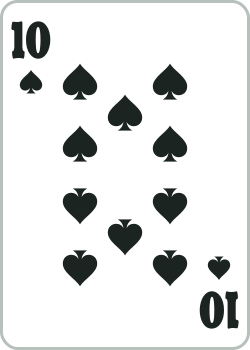
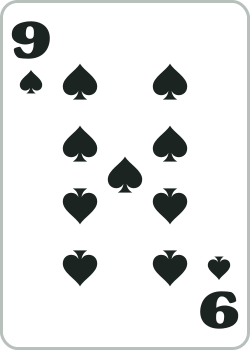
Right bower, then left bower
Clubs
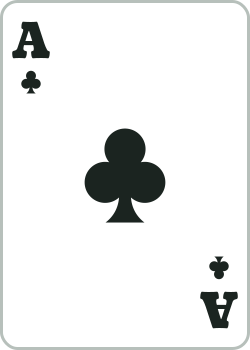
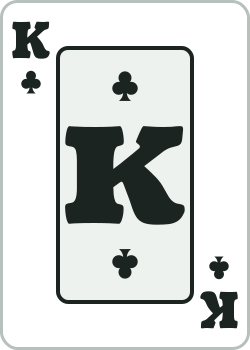
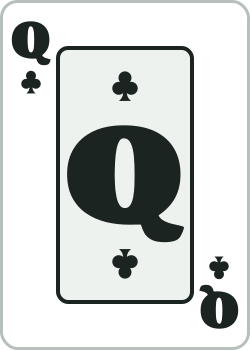
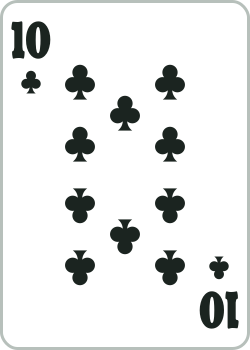
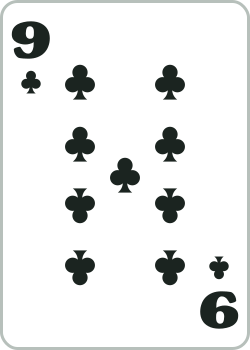
Its jack has joined the trump suit
Hearts or diamonds
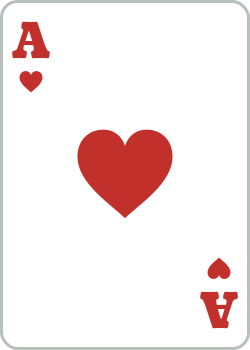
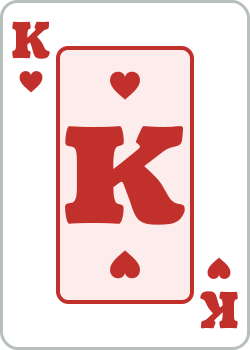
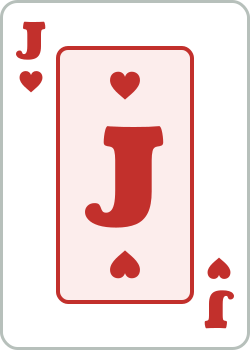
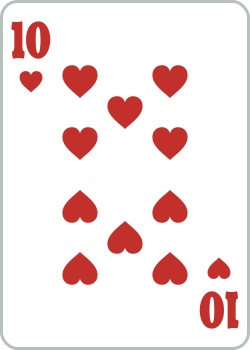
Card order when spades are trump, highest on the left. -
Decide whether to go alone
The player who chose trump can go alone, and says so when trump is made. That player’s partner puts their cards face down and sits the hand out. Going alone is a gamble for a bigger score.
- A lone player who wins all 5 tricks scores 4 points instead of 2.
-
Play 5 tricks
The player on the dealer’s left leads any card. Going clockwise, each player plays one card and must follow the suit led if they can. A player who cannot may play any card, trump included. The highest trump wins the trick. If no trump was played, the highest card of the suit led wins. The winner leads next.
- You never have to play a trump or beat the cards already played. The only duty is to follow suit when you can.
- When someone goes alone, the player on the dealer’s left still leads. If that player is the partner sitting out, the player across from the dealer leads.
-
Score the hand
After 5 tricks, the team that chose trump, called the makers, scores if it won at least 3. If it won fewer, it is euchred, and the other team, the defenders, scores instead. The deal then passes to the left.
Example: the left bower wins a trick
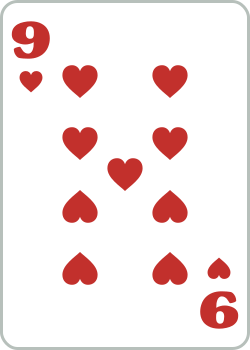
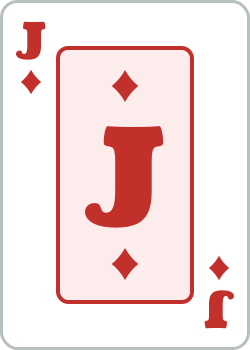
Hearts are trump. South leads the king of clubs and West plays the ace of clubs. North has no clubs and plays the 9 of hearts, a trump. East has no clubs either and plays the jack of diamonds. Because hearts are trump, that jack is the left bower, the second-highest trump. It beats the 9 of hearts, so East wins the trick and leads next.
South leads
West
North
A trump
East
The left bower wins
Scoring
Only one team scores in each hand. The makers need at least 3 of the 5 tricks.
| What happened | Points | Who scores |
|---|---|---|
| The makers win 3 or 4 tricks | 1 | Makers |
| The makers win all 5 tricks (a march) | 2 | Makers |
| A maker playing alone wins 3 or 4 tricks | 1 | Makers |
| A maker playing alone wins all 5 tricks | 4 | Makers |
| The makers win fewer than 3 tricks (euchred) | 2 | Defenders |
- A euchre is worth the same 2 points whether the maker had a partner or played alone.
The first team to reach 10 points wins the game.
Each team can keep score with two spare low cards, such as a 6 and a 4 or two 5s. One card covers the other, and you uncover one more suit symbol for each point you score.
A worked example: four hands
This is how a score builds up over four hands. After them, your team leads 7 to 2.
| What happened | Goes to | Points |
|---|---|---|
| Hand 1: your team names trump and wins 4 tricks | Your team | 1 |
| Hand 2: the other team names trump but wins only 2 tricks, so it is euchred | Your team | 2 |
| Hand 3: your partner names trump, goes alone and wins all 5 tricks | Your team | 4 |
| Hand 4: the other team names trump and wins all 5 tricks | Other team | 2 |
| Your team | 7 | |
| Other team | 2 |
Scorekeeper
Two teams racing to 10. Quick buttons add 1, 2 or 4 points. It works in this browser, keeps the game if the page reloads, and needs no account.
Other ways to play
Euchre for 3 players (cutthroat)
Each player keeps their own score. Use the same 24 cards and deal 5 to each player. Turn up the next card and choose trump the usual way. The player who chooses trump plays alone against the other two, who work together for that hand. The maker scores 1 point for 3 or 4 tricks and 3 points for all 5. If the maker wins fewer than 3 tricks, each of the other two players scores 2. Play to 10.
Euchre for 2 players: the simple version
Two-player euchre is played in more than one way, so agree on a version first. The simplest is the regular game played one against one. Deal 5 cards each, turn up a card, and choose trump the usual way. The maker scores 1 point for 3 or 4 tricks and 2 points for all 5. A maker who is euchred gives the other player 2 points. There is no going alone, since there are no partners. The rule-book version uses 32 cards (add the 7s and 8s) and plays to 5 points. Agree on the deck and the target before you start.
Euchre for 2 players: the 12-trick version
This version puts all 24 cards in play. Each player gets 4 cards in hand and 4 face-down cards on the table, with a face-up card on top of each. The non-dealer may name trump or pass. If they pass, the dealer must name it. The non-dealer leads. Play from your hand or your face-up cards, and follow suit if you can. When a face-up card is played, turn over the card under it after the trick. Each trick is worth 1 point to the player who wins it. The player who named trump needs 7 of the 12 tricks. If they fall short, the other player scores all 12 points. Play to 31.
House rules and other versions
- Stick the dealer
- If everyone passes in both rounds, the dealer must name a suit and the hand is played. Also called screw the dealer. It saves time because no hand is thrown in.
- Shorter games
- Play to 5 or 7 points instead of 10.
- 32 cards
- Add the 7s and 8s as the two lowest cards of each suit.
- Joker
- Add a joker as the highest trump, above the right bower. British euchre is played this way, with 25 cards and a game to 11 points.
- Defending alone
- Some groups let a defender go alone too. A lone defender who euchres the makers scores 4 points instead of 2.
- Lead from the lone player’s left
- Some groups have the player on the lone player’s left lead the first trick, wherever the dealer sits.
- Dealer’s partner must go alone
- In Canada, England and Australia, a dealer’s partner who orders the card up has to play the hand alone.
- Super-euchre
- If the makers win no tricks at all, some groups give the defenders 4 points instead of 2.
Rule questions
How many cards do you use in euchre?
24. Use the 9, 10, jack, queen, king and ace of each suit. Each of the 4 players gets 5 cards, which leaves 4 in the middle. The top one of those is turned face up.
Is the left bower a trump or its own suit?
It is a trump. For that hand the left bower belongs to the trump suit in every way. If trump is led and it is your only trump, you must play it. You cannot use it to follow a lead of the suit printed on it.
What happens if everyone passes twice?
The hand is thrown in. Everyone hands back their cards, and the deal passes to the next dealer. Some groups play stick the dealer instead, where the dealer has to name a suit.
What happens when the card is ordered up?
Its suit is trump for that hand. The dealer takes the turn-up card and discards one card face down, so the dealer still holds 5 cards. This happens whichever player ordered it up.
Can the dealer’s partner order up the card?
Yes, in the United States. The partner orders it up and the two play the hand together. In Canada, England and Australia, a partner who orders it up must play alone.
When can you go alone, and what is it worth?
The player who chooses trump can go alone, and says so when trump is made. Winning all 5 tricks alone scores 4 points. Winning 3 or 4 scores 1, the same as with a partner. Being euchred gives the other team 2.
Who leads first when someone goes alone?
The player on the dealer’s left, as usual. If that player is the partner sitting out, the player across from the dealer leads. Some groups have the player on the lone player’s left lead instead.
What is a renege, and what is the penalty?
A renege, also called a revoke, is failing to follow suit when you could have. The two main rule sources we checked set no penalty. The usual one is 2 points: either the other team gains 2 or the team that reneged loses 2. Agree on it before you play.
Can you lead trump on the first trick?
Yes. Any card can be led at any time, trump included.
How do you keep score in euchre?
Each team takes two spare low cards, such as a 6 and a 4 or two 5s. One card covers the other, and you uncover one more suit symbol for each point. Ten symbols showing means 10 points and the game.
How many points do you need to win at euchre?
10 in the usual American game. Shorter games to 5 or 7 are also played, and British euchre goes to 11.
Words used in Euchre
- Trump
- The suit chosen for the hand. Any trump beats any card of another suit.
- Trick
- One round in which each player plays one card. A hand has 5 tricks.
- Right bower
- The jack of the trump suit. It is the highest card in the hand.
- Left bower
- The other jack of the same color as trump. It counts as a trump and ranks second.
- Turn-up
- The card turned face up after the deal. Its suit is offered as trump.
- Kitty
- The 4 cards left over after the deal, including the turn-up.
- Order up
- To have the dealer pick up the turn-up card, which makes its suit trump.
- Assist
- What the dealer’s partner says to order up the card.
- Makers and defenders
- The makers are the team that chose trump. The defenders are the other team.
- Next and crossing
- Naming the other suit of the turn-up’s color is making it next. Naming a suit of the opposite color is crossing it.
- Going alone
- Playing a hand without your partner for a chance at 4 points. A hand strong enough to try it is called a loner.
- March
- Winning all 5 tricks. Also called a sweep.
- Euchred
- What the makers are when they win fewer than 3 tricks.
- Renege
- Failing to follow suit when you could have. Also called a revoke.
- At the bridge
- In a game to 5, having 4 points while the other team has 2 or fewer.
- In the barn
- Having 9 points, one short of winning. Heard in Indiana and Ohio.
What you need
- A standard deck of playing cardsYou use 24 of the 52 cards and can keep score with 4 of the rest.Find it on Amazon (A standard deck of playing cards, opens in a new tab)
- A euchre deckSold with only the 24 cards you need, often two decks to a box.Find it on Amazon (A euchre deck, opens in a new tab)
- A euchre scoreboardOptional. A small peg or flip board that counts each team to 10.Find it on Amazon (A euchre scoreboard, opens in a new tab)
As an Amazon Associate, we earn from qualifying purchases. How the site is paid for.
Checked against
These rules are written in our own words from Bicycle Cards and checked against Pagat. Sources last checked on October 11, 2026.
- First source: Bicycle Cards, Euchre. The deal, choosing trump, card ranks, going alone, play, scoring and the first lead.
- Second source: Pagat, Euchre. North American rules: 24 cards, game to 10, the left bower as a trump, score cards, regional rules and variants.
Other sources we used (4)
- Wikipedia, Euchre. The usual 2-point renege penalty, the 4-card kitty and the term in the barn.
- Wikipedia, Euchre variants. Scoring for the 3-player cutthroat game and the simple 2-player game.
- Joe Chellman, Euchre for Two Players. The 12-trick game for 2 players. Pagat links to this page for two-player rules..
- Euchre.com, Three-Handed Euchre. The 3-player scoring and the game to 10. Its version also deals a spare hand to the empty seat, which the page leaves out..
Where the sources differ (8)
| Topic | Bicycle Cards | Pagat | This page |
|---|---|---|---|
| Deck size | Lists decks of 32, 28 or 24 cards, with an optional joker as the highest trump. | North American euchre uses 24 cards and no joker. | 24 cards. The 32-card deck and the joker are listed as variants. |
| Points to win | 5, 7 or 10 points, as agreed. | 10 points in North America, 11 in Britain. | 10 points, with 5 and 7 listed as shorter games. |
| First lead when someone goes alone | The player on the dealer’s left leads. If that player’s partner is playing alone, the player across from the dealer leads. | The player on the lone player’s left leads. | Follows Bicycle. Pagat’s rule is listed as a variant and in the rule questions. |
| Who can go alone, and when | The player who sets trump, when naming it. | Any player, maker or defender, after trump is settled and before the first lead. Groups differ on whether defenders may. | The maker, when trump is made. Defending alone is listed as a variant. |
| Dealing pattern | 3 cards then 2, or 2 then 3, keeping the same pattern all the way round. | Batches of two and three. In Canada the cards are often dealt one at a time. | Batches of 2 and 3 in one fixed pattern, with a note that one at a time is also played. |
| Renege penalty | Not stated. | Not stated. | Gives the common 2-point penalty from Wikipedia and says to agree on it first. |
| Choosing the first dealer | Draw cards. The lowest card deals, with the ace low for the draw. | A common method is to deal the cards around until a black jack appears. | Draw cards, lowest deals. The black jack method is given in the setup notes. |
| Turning the card down | The dealer slides the turn-up card, still face up, partly under the pack. | The turn-up card is turned face down. | Follows Pagat. |
What on this page is our own
- The playing time of about 30 minutes is our estimate.
- The example trick and the four-hand scoring example are our own.
- The counts of 7, 5 and 6 cards per suit once trump is named are our arithmetic from the bower rule.
- The notes under What you need describe products and are not rules.
- For 3 players, using the 24-card deck with nothing dealt to the empty seat is our reading of Wikipedia’s description, which gives 5 cards each without naming the deck.
- The remarks that two-player euchre has no single standard and that nobody goes alone in it are our own. They follow from the differing versions in the sources.
- That ten suit symbols showing means 10 points is our arithmetic.
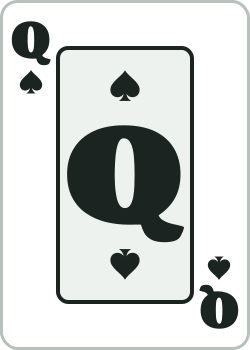
- The pieces pictured at the top of the page are our own example.
Spotted a mistake? Email contact@familygamerules.com and we'll check it against the sources.