Pinochle rules
Pinochle is a trick-taking card game for four players in two teams. Its 48-card deck has two of every card, and the 10 ranks above the king. Points come from meld, the sets of cards you show before play, and from the aces, 10s and kings you win in tricks.
Also called Partnership pinochle, Four-handed pinochle.
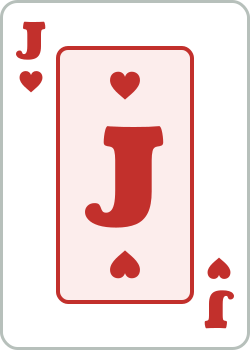
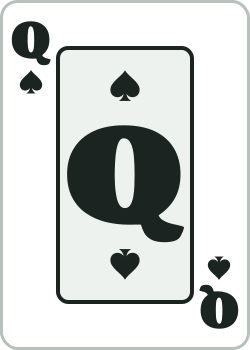
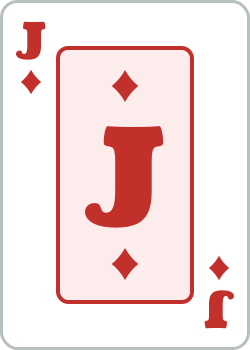
- Players
- 4, in 2 teams of 2
- You need
- A 48-card pinochle deck, plus paper and a pencil for the score
- Deal
- 12 cards each. The whole deck is dealt.
- Goal
- When your team wins the bidding, make at least your bid from meld and counters
- Game ends
- The first team to 1,500 points wins
- Playing time
- About 1 to 2 hours
Quick start
- Four players form two teams, with partners sitting across. Use the 48-card pinochle deck, where the 10 ranks between the ace and the king. Deal 12 cards each.
- Bid from the dealer’s left, starting at 250 and going up by 10s. A bid is the points your team will make. If the other three pass, the dealer takes it at 250.
- The high bidder names trump. Their partner passes them 4 cards, and the bidder passes 4 back.
- Everyone lays down their meld: the sets of cards that score on the meld chart. Each team writes down its meld total. Then pick the cards back up.
- The bidder leads. Follow suit and beat the winning card if you can. If you cannot follow suit, you must trump. Aces, 10s and kings won are worth 10 each.
- Bidders whose meld plus counters reach the bid score both, or else lose the bid. The other team scores counters, and its meld if it took a counter or the last trick. First to 1,500 wins.
Rule sheet and score sheet
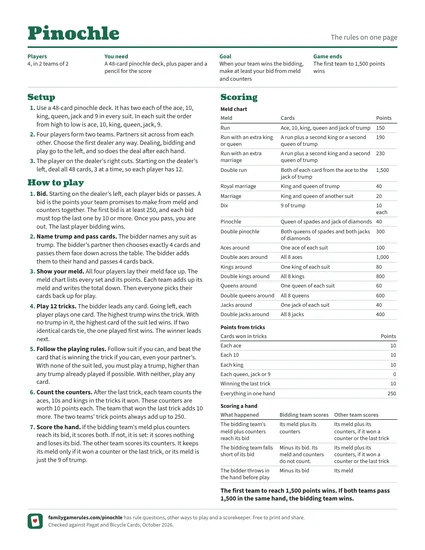
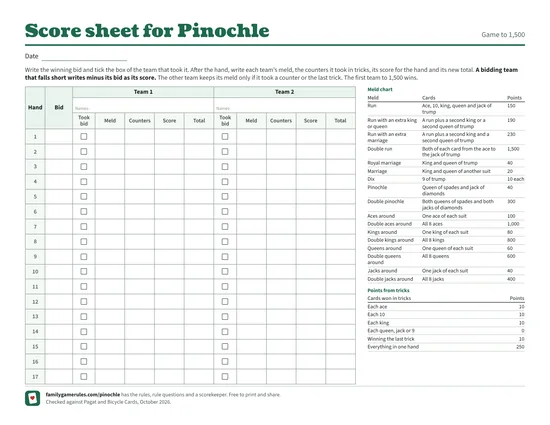
Print the whole game on one page, and a score sheet made for Pinochle. Both are free PDFs for Letter paper.
Setup
4 players in 2 teams of 2. Versions for 2 and 3 players, and double-deck pinochle for 4, are further down.
You need: A pinochle deck: 2 of each ace, 10, king, queen, jack and 9 in all four suits.
| In the set | Count | Worth when scoring |
|---|---|---|
| Aces | 8 | 10 each when won in a trick |
| 10s | 8 | 10 each when won in a trick |
| Kings | 8 | 10 each when won in a trick |
| Queens | 8 | 0 |
| Jacks | 8 | 0 |
| 9s | 8 | 0 |
| Total | 48 |
- Each suit has 12 cards. In every suit the order from high to low is ace, 10, king, queen, jack, 9.
- You can make a pinochle deck from two standard decks. Keep the 9s through aces of both and set the 2s through 8s aside.
- Double-deck pinochle uses 80 cards: two pinochle decks with all the 9s taken out.
- Use a 48-card pinochle deck. It has two each of the ace, 10, king, queen, jack and 9 in every suit. In each suit the order from high to low is ace, 10, king, queen, jack, 9.
- Four players form two teams. Partners sit across from each other. Choose the first dealer any way. Dealing, bidding and play go to the left, and so does the deal after each hand.
- The player on the dealer’s right cuts. Starting on the dealer’s left, deal all 48 cards, 3 at a time, so each player has 12.
| Players | Each player gets | Notes |
|---|---|---|
| 4 | 12 cards | The whole deck is dealt. Nothing is left over. |
| 3 | 15 cards | 3 cards go face down to a widow for the high bidder. |
| 2 | 12 cards | The next card is turned up for trump. The other 23 cards are the stock. |
| 4, double deck | 20 cards | 80 cards with no 9s. The whole deck is dealt. |
Each player’s hand
12 cards. Your partner sits across from you.
- Any batch size works for the deal, as long as everyone ends up with 12 cards. The dealer gets the last cards.
- With 2 or 3 players, and in double-deck pinochle, the deal is different. See the versions further down.
How to play
A hand has four parts: bidding, passing cards, showing meld and playing 12 tricks. Meld is a set of cards that scores just for being in your hand, such as the king and queen of one suit. Counters are the aces, 10s and kings, which score when you win them in tricks.
-
Bid
Starting on the dealer’s left, each player bids or passes. A bid is the points your team promises to make from meld and counters together. The first bid is at least 250, and each bid must top the last one by 10 or more. Once you pass, you are out. The last player bidding wins.
- If the other three players all pass, the dealer is stuck with the bid at 250. The hand is played.
- Every bid is a multiple of 10. You may jump by 20 or more.
- The player who wins the bidding is the bidder, also called the declarer. That player’s partnership is the bidding team.
-
Name trump and pass cards
The bidder names any suit as trump. The bidder’s partner then chooses exactly 4 cards and passes them face down across the table. The bidder adds them to their hand and passes 4 cards back.
- The other team does not pass cards.
-
Show your meld
All four players lay their meld face up. The meld chart lists every set and its points. Each team adds up its meld and writes the total down. Then everyone picks their cards back up for play.
- One card can count in two melds of different kinds. Runs, marriages and the 9 of trump are one kind. Pinochles are a second kind, and arounds a third. So the queen of spades can be in a pinochle and in a marriage in spades at the same time.
- Within one kind, use the combined values in the meld chart, such as 190 for a run with an extra king of trump.
- A run counts only in the trump suit. In any other suit its king and queen count only as a marriage, worth 20.
- If the bidding team sees it cannot make its bid, the bidder may throw in the hand before play. The bidding team loses the amount of its bid, the other team scores its meld, and no tricks are played.
-
Play 12 tricks
The bidder leads any card. Going left, each player plays one card. The highest trump wins the trick. With no trump in it, the highest card of the suit led wins. If two identical cards tie, the one played first wins. The winner leads next.
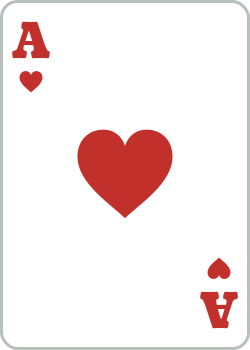
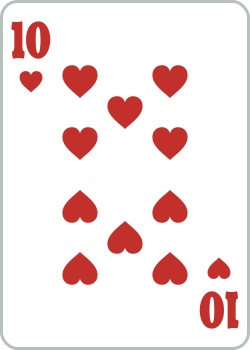
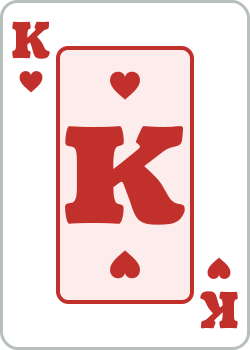
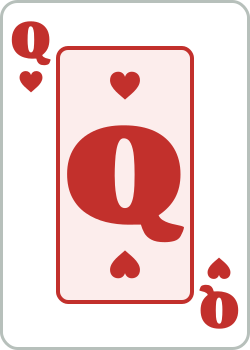
Hearts
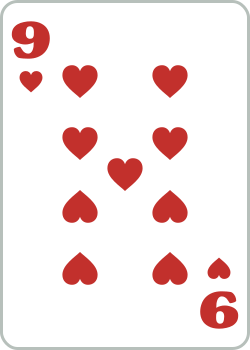
The 10 ranks between the ace and the king
One suit from high to low. Every card comes twice. -
Follow the playing rules
Follow suit if you can, and beat the card that is winning the trick if you can, even your partner’s. With none of the suit led, you must play a trump, higher than any trump already played if possible. With neither, play any card.
- Once someone has trumped a trick, a player who still has the suit led may play any card of that suit. None of them can win it.
- If you have none of the suit led and cannot beat a trump already played, you still have to play a trump.
- These are the strict older rules, which many groups still play. Many others play looser rules, where you have to beat only a trump lead. See the variants.
-
Count the counters
After the last trick, each team counts the aces, 10s and kings in the tricks it won. These counters are worth 10 points each. The team that won the last trick adds 10 more. The two teams’ trick points always add up to 250.
- Queens, jacks and 9s won in tricks are worth nothing.
-
Score the hand
If the bidding team’s meld plus counters reach its bid, it scores both. If not, it is set: it scores nothing and loses its bid. The other team scores its counters. It keeps its meld only if it won a counter or the last trick, or its meld is just the 9 of trump.
- Winning the last trick saves the other team’s meld even with no counters in it. Any other trick with no aces, 10s or kings does not.
- So if the other team’s only meld is the 9 of trump, or both 9s, it keeps those points even without winning a counter.
- The bidding team has no such rule. Its meld counts whenever its meld and counters together reach the bid.
- Scores can go below zero.
| What is happening | What you must play |
|---|---|
| Trump is led and you have a trump | A trump that beats the highest trump so far, if you can. Otherwise any trump. |
| Another suit is led, nobody has trumped yet, and you have that suit | A card of that suit that beats the winning card, if you can. Otherwise any card of that suit. |
| Another suit is led, someone has trumped it, and you have that suit | Any card of that suit |
| You have none of the suit led, but you have a trump | A trump that beats any trump already played, if you can. Otherwise any trump. |
| You have neither the suit led nor a trump | Any card |
Example: counting the meld in one hand
Hearts are trump. This hand holds the ace, 10, queen and jack of hearts and both kings of hearts. That is a run with an extra king, worth 190. The 9 of hearts is the 9 of trump, worth 10. The queen of spades and jack of diamonds make a pinochle, worth 40. The same queen of spades also goes with the king of spades for a marriage, worth 20, because a pinochle and a marriage are different kinds of meld. The ace of clubs and 10 of diamonds score nothing as meld. The hand’s meld is 260.
Run with an extra king
190
9 of trump
10
Pinochle
40
Marriage in spades
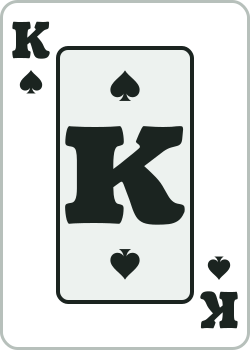
20. The same queen of spades counts again
No meld
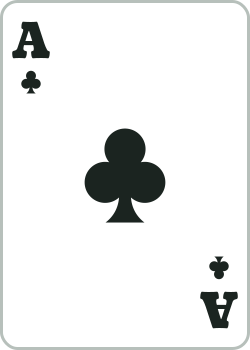
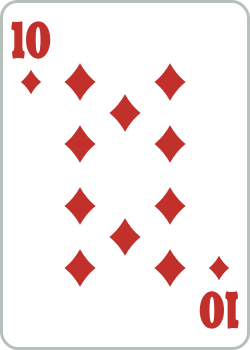
Total meld: 260
Scoring
Points come from two places: meld shown before play and counters won in tricks. The bidding team must reach its bid with the two together, or it loses the amount it bid.
| Meld | Cards | Points |
|---|---|---|
| Run | Ace, 10, king, queen and jack of trump | 150 |
| Run with an extra king or queen | A run plus a second king or a second queen of trump | 190 |
| Run with an extra marriage | A run plus a second king and a second queen of trump | 230 |
| Double run | Both of each card from the ace to the jack of trump | 1,500 |
| Royal marriage | King and queen of trump | 40 |
| Marriage | King and queen of another suit | 20 |
| Dix | 9 of trump | 10 each |
| Pinochle | Queen of spades and jack of diamonds | 40 |
| Double pinochle | Both queens of spades and both jacks of diamonds | 300 |
| Aces around | One ace of each suit | 100 |
| Double aces around | All 8 aces | 1,000 |
| Kings around | One king of each suit | 80 |
| Double kings around | All 8 kings | 800 |
| Queens around | One queen of each suit | 60 |
| Double queens around | All 8 queens | 600 |
| Jacks around | One jack of each suit | 40 |
| Double jacks around | All 8 jacks | 400 |
| Cards won in tricks | Points |
|---|---|
| Each ace | 10 |
| Each 10 | 10 |
| Each king | 10 |
| Each queen, jack or 9 | 0 |
| Winning the last trick | 10 |
| Everything in one hand | 250 |
| What happened | Bidding team scores | Other team scores |
|---|---|---|
| The bidding team’s meld plus counters reach its bid | Its meld plus its counters | Its meld plus its counters, if it won a counter or the last trick |
| The bidding team falls short of its bid | Minus its bid. Its meld and counters do not count. | Its meld plus its counters, if it won a counter or the last trick |
| The bidder throws in the hand before play | Minus its bid | Its meld |
| Meld | Single | Double | Triple | Quadruple |
|---|---|---|---|---|
| Run in trump | 15 | 150 | 225 | 300 |
| Royal marriage | 4 | 8 | 12 | 16 |
| Marriage in another suit | 2 | 4 | 6 | 8 |
| Pinochle | 4 | 30 | 60 | 90 |
| Aces around | 10 | 100 | 150 | 200 |
| Kings around | 8 | 80 | 120 | 160 |
| Queens around | 6 | 60 | 90 | 120 |
| Jacks around | 4 | 40 | 60 | 80 |
- Tens around score nothing.
- The other team keeps its meld only if it wins at least one counter or the last trick. If its only meld is the 9 of trump, it keeps that anyway.
- The double-deck meld chart is for the double-deck version further down. Its numbers are smaller, and there each counter is worth 1 point.
The first team to reach 1,500 points wins. If both teams pass 1,500 in the same hand, the bidding team wins.
One player keeps score with a column for each team. Before play, write the bid, which team took it and each team’s meld. After play, write each team’s counters and its score for the hand, then the running total. For a team that was set, write minus its bid.
A worked example: the bidding team is set
On the first hand of a game, your team wins the bidding at 300 and names trump. Your team’s meld is aces around, a pinochle and a marriage: 100, 40 and 20, for 160. The other team melds kings around and the 9 of trump, for 90. In play your team wins 110 points in counters. The other team wins 140, including 10 for the last trick. Your team’s 160 plus 110 makes 270, which is 30 short of the bid. The score after the hand is minus 300 to 230.
| What happened | Goes to | Points |
|---|---|---|
| Your team bid 300 but made only 270, so it is set and loses its bid | Your team | −300 |
| The other team’s meld: kings around and the 9 of trump | Other team | 90 |
| The other team’s counters, with 10 for the last trick. Winning counters also saves its meld | Other team | 140 |
| Your team | −300 | |
| Other team | 230 |
Scorekeeper
Two teams playing to 1,500. Each hand, tap the team that took the bid and enter the bid, each team’s meld and the bidding team’s counters. It fills in the other team’s counters, checks whether the bid was made, applies the rule for saving meld and keeps the totals. It can also keep score for double-deck pinochle, to 500. It works in this browser, keeps the game if the page reloads, and needs no account.
Other ways to play
Two-handed pinochle: the deal and the first 12 tricks
Two players use the 48-card deck with no bidding. Deal 12 cards each, 3 or 4 at a time. Turn the next card face up for trump and lay the rest face down across it as the stock. If that card is a 9, the dealer scores 10. The non-dealer leads. While the stock lasts you may play any card, with no need to follow suit or trump. The winner of a trick may lay down one meld face up and score it at once. Then the winner draws the top card of the stock and the other player draws the next. A player who shows the 9 of trump after winning a trick scores 10 and may swap it for the face-up trump card. Melded cards stay face up and can still be played.
Two-handed pinochle: meld, the last 12 tricks and scoring
Each new meld needs a card from your hand. A melded card can count again only in another kind of meld or a bigger one of its kind. Only the double pinochle (300) earns a bonus. Other melds held twice score twice, so 8 aces make 200. After the 12th trick, its winner may meld and takes the last face-down card. The other takes the face-up card, and both take their melds back. In the last 12 tricks, follow suit, trump if you cannot, and beat a trump lead if you can. Count tricks as ace 11, 10 10, king 4, queen 3, jack 2 and 10 for the last trick, rounded to tens with 7 or more going up.
Two-handed pinochle: winning the game
One deal can be a game, or play to 1,000. If both players reach 1,000 on the same hand, play on to 1,250, and if both pass that, to 1,500, and so on. At any time during play, a player may declare out. Play stops and that player’s tricks are counted. If they have reached the target, they win, even if the other player has more. If not, they lose.
Pinochle for 3 players
Each player plays alone. Deal 15 cards each and 3 face down as a widow. Starting on the dealer’s left, each player bids at least 250, in steps of 10, or passes for good. If all three pass, the next player deals. The high bidder shows the widow, adds it to their hand and discards any 3 cards face down. Counters among them count for the bidder. The bidder names trump and everyone shows meld. The bidder may give up now, losing the bid while the other two score their meld. Otherwise the bidder leads 15 tricks. Follow suit and play higher if you can, or else trump, beating any trump already played if you can. Score as in the 4-player game, but each opponent needs at least one counter to keep their meld. First to 1,500 wins.
Double-deck pinochle: cards and bidding
Four players in two teams use 80 cards: two pinochle decks with the 9s taken out. That leaves four of every ace, 10, king, queen and jack. Deal 20 cards each. Starting on the dealer’s left, each player bids or passes for good. The first bid is at least 50. Bids go up by 1 to 60, then in steps of 5. If the other three pass, the dealer must bid 50. The bidder names trump and must hold a king and queen of that suit. Without one the hand is not played, the bidding team loses its bid and nobody scores meld. In the standard game no cards are passed. Everyone shows meld from the double-deck meld chart in the scoring section. A run outside trump counts only as a marriage, and tens score nothing.
Double-deck pinochle: play and scoring
The bidder leads. Follow suit and beat the winning card if you can. With none of the suit led, play a trump, beating any trump already played if you can. Once a trick is trumped, any card of the suit led will do. Aces, 10s and kings won are worth 1 point each, and the last trick 2 more, for 50 in all. If the bidding team’s meld plus trick points reach its bid, both teams score their meld and trick points. If not, the bidding team scores nothing and loses its bid. The other team scores as usual and needs no trick to keep its meld. Before play the bidder may throw in, losing the bid while the other team scores its meld. First to 500 wins. If both reach 500 on one hand, the bidding team wins.
House rules and other versions
- Looser playing rules
- Most card books since 1945 give looser rules. When trump is led, you must still play a higher trump if you can. When another suit is led, follow suit if you can and trump if you cannot, but you never have to beat the cards already played.
- Older card values
- Some groups count cards won in tricks as ace 11, 10 10, king 4, queen 3 and jack 2, with 9s worth nothing. Others count aces and 10s at 10 and kings and queens at 5. The last trick still adds 10, and the total is still 250.
- Dropping the zeros
- Some groups divide every value by 10. A counter is then worth 1 point, the last trick 1, a pinochle 4 and a run 15.
- No bonus for an extra king or queen
- Some groups give nothing extra for a single king or queen of trump added to a run. A run with an extra king and queen then scores 190, as a run plus a royal marriage.
- Lower opening bid
- Some groups open the bidding at 150, or at another amount agreed before the game, in place of 250.
- Passing fewer cards
- Depending on the group, partners pass 2, 3 or 4 cards each way after trump is named.
- Game to 1,000
- Many groups play to 1,000 points in place of 1,500.
- Two-handed: game to 1,200
- Another common target for two players is 1,200 points. Some play to 1,500.
- Two-handed: always try to win
- In the last 12 tricks of the two-handed game, some players must win every trick they can, not only when trump is led.
- Two-handed: meld after drawing
- Some players draw from the stock first and then meld. Some also allow more than one meld after a trick.
- Three-handed: other opening bids
- Some groups playing with 3 open the bidding at 100, 200 or 300 in place of 250.
- Double deck: passing cards
- A common double-deck rule has the bidder and partner each pass 3 cards face down. Some groups pass anything from 1 to 4.
- Double deck: 20 to score
- Meld counts only if it is worth at least 20, and a team must win 20 points in tricks to score anything for the hand. A bidding team with under 20 in meld loses its bid without play, and the other team scores its meld if worth 20 or more. A bidding team that wins under 20 in tricks fails its bid.
- Double deck with bigger numbers
- Some groups play double deck with the larger single-deck numbers, and the lowest bid is then 500.
Rule questions
How many cards are in a pinochle deck?
48. There are two each of the ace, 10, king, queen, jack and 9 in all four suits, so each suit has 12 cards. You can make one from two standard decks by keeping the 9s through aces. Double-deck pinochle uses 80 cards: two pinochle decks with the 9s taken out.
Is the 10 higher than the king in pinochle?
Yes. In every suit the ace is highest, then the 10, then the king, queen, jack and 9. The 10 is also a counter, worth 10 points when you win it in a trick.
Can one card count in two melds?
Yes, if the melds are different kinds. Runs, marriages and the 9 of trump are one kind. Pinochles are another, and arounds a third. So the queen of spades can be in a pinochle and a marriage, and a king can count in kings around and a marriage. Within one kind, use the chart’s combined values, such as 190 for a run with an extra king.
What happens if everyone passes?
The dealer takes the bid at 250. When the other three players pass, the dealer is stuck with the lowest bid, names trump and plays the hand.
Do you have to take a trick to save your meld?
The other team does. It keeps its meld only if it wins at least one counter or the last trick. A trick with no aces, 10s or kings is not enough, unless it is the last trick. If its only meld is the 9 of trump, it keeps that anyway. The bidding team has no such rule. Its meld counts whenever its meld and counters reach the bid.
Do you have to beat your partner’s card?
Yes, under the main rules. When you follow suit, you must beat the card winning the trick if you can, even if your partner played it. Many groups play looser rules, where you have to beat only a trump lead. Agree on one before you start.
Do you have to play a trump if you cannot follow suit?
Yes. With none of the suit led, you must play a trump if you have one. If a trump is already in the trick, play a higher one if you can. If you cannot beat it, you still have to play a trump. Only with no cards of the suit and no trumps may you play anything.
What happens if the bidding team does not make its bid?
It loses the amount it bid and scores nothing for its meld or counters that hand. The other team scores as usual. Bid 300 and make only 270, and your team’s score drops by 300.
Can the bidder give up without playing the hand?
Yes. Before play starts, a bidder who sees no way to make the bid may throw in the hand. The bidding team loses its bid. The other team scores its meld, and no tricks are played.
What if both teams pass 1,500 in the same hand?
The bidding team wins, whatever the two scores are.
Is a run in a suit that is not trump worth anything?
Not as a run. A run counts only in the trump suit. Its king and queen still make a marriage, worth 20.
What is a marriage in every suit worth?
240 in all. A king and queen of each suit also makes kings around (80) and queens around (60). Add one royal marriage (40) and three other marriages (60), and the total is 240. Some players call this a roundhouse.
Words used in Pinochle
- Meld
- A set of cards that scores points just for being in your hand, such as a marriage or aces around. Meld is shown face up before the tricks are played.
- Counters
- The aces, 10s and kings. Each one won in a trick is worth 10 points.
- Trick
- One round in which each player plays one card. A hand has 12 tricks in the 4-player game.
- Trump
- The suit the bidder names. Any trump beats any card of another suit.
- Bid
- The fewest points a team promises to make from meld and counters together.
- Bidder
- The player who wins the bidding. The bidder names trump and leads the first trick. Also called the declarer.
- Run
- The ace, 10, king, queen and jack of trump, worth 150. Also called a flush, a sequence or a rope.
- Marriage
- The king and queen of one suit, worth 20. In trump it is a royal marriage, worth 40.
- Pinochle
- The queen of spades with the jack of diamonds, worth 40. Both pairs together are a double pinochle, worth 300.
- Dix
- The 9 of trump, worth 10 as meld. Said and sometimes spelled deece.
- Around
- One card of the same rank in each suit, such as an ace of every suit. All 8 of a rank is a double around.
- Set
- What happens to a bidding team that falls short of its bid. It loses the amount it bid.
- Saving your meld
- In the 4-player game, winning a counter or the last trick, which the other team must do to keep its meld. A meld of only the 9 of trump is kept anyway. Other versions have their own rule.
- Throw in
- To give up a hand before play when the bid cannot be made. The bidding team loses its bid.
- Roundhouse
- A king and queen of every suit, worth 240 in all.
- Stock
- In two-handed pinochle, the face-down pile players draw from after each trick.
- Widow
- In three-handed pinochle, the 3 cards dealt face down for the high bidder. Also called the kitty or cat.
What you need
- A pinochle deck48 cards: two of each card from 9 to ace in every suit.Find it on Amazon (A pinochle deck, opens in a new tab)
- A second pinochle deckOnly for double-deck pinochle, which uses two decks with the 9s taken out.Find it on Amazon (A second pinochle deck, opens in a new tab)
- A pinochle score padOptional. Plain paper works, and so does the free printable score sheet.Find it on Amazon (A pinochle score pad, opens in a new tab)
As an Amazon Associate, we earn from qualifying purchases. How the site is paid for.
Checked against
These rules are written in our own words from Pagat and checked against Bicycle Cards. Sources last checked on October 12, 2026.
- First source: Pagat, Single Deck Partnership Pinochle. The main game: partners, the deal, bidding from 250, the stuck dealer, passing 4 cards, the meld chart with run extras and doubled melds, which melds can share a card, the strict trick rules, counters, saving meld, scoring, throwing in, the game to 1,500, and the looser rules, extra-king and divide-by-10 variants.
- Second source: Bicycle Cards, Pinochle. The 48-card deck and the order of cards with the 10 above the king, the single meld values and the double pinochle, the older 11-10-4-3-2 card values, and the two-handed game: deal, stock, one meld per trick, the dix, the last 12 tricks, rounding and the targets.
Other sources we used (4)
- Pagat, Two-player Pinochle. A check on the two-handed game, doubled melds counting twice, taking melds back when the stock runs out, the game to 1,200 and the two-handed variants.
- Pagat, Three player Pinochle. The three-handed game, making a pinochle deck from two standard decks, and the roundhouse at 240.
- Pagat, Double deck Pinochle. The double-deck game: 80 cards, 20 each, bidding from 50, the forced dealer, the trump marriage rule, the double-deck meld chart, 1-point counters, play, scoring, the game to 500 and its variants. Also the throw-in rule and a non-trump run counting as a marriage.
- Wikipedia, Pinochle. The deal passing to the left, the 80-card double deck, the meld chart as a check, all counting systems, pre-1945 and post-1945 trick rules, the 150 opening bid, passing 2 to 4 cards, the game to 1,000, the 500 double-deck bid and the 240 roundhouse.
Where the sources differ (12)
| Topic | Pagat | Bicycle Cards | This page |
|---|---|---|---|
| Main game | The main page is four-handed partnership pinochle with bidding. | Describes only the two-handed game, with no bidding. | The partnership game is the main text. Two-handed pinochle is a version, from both sources. |
| Card values in tricks | Aces, 10s and kings are counters worth 10 each, with 10 for the last trick. A variant counts aces and 10s at 10 and kings and queens at 5. Both total 250. | Ace 11, 10 10, king 4, queen 3, jack 2, with 10 for the last trick. | 10 per counter in the main game. The older values are a variant and are used in the two-handed version. |
| Doubled melds | Double run 1,500, double pinochle 300 and double arounds at 1,000, 800, 600 and 400. Pagat’s two-handed page says only the double pinochle gets a bonus there, and other melds count twice. | Lists only the double pinochle, at 300. | The partnership values are in the meld chart. The two-handed version follows Pagat’s two-handed page. |
| Extra king or queen with a run | The meld table gives 190 for one extra and 230 for an extra marriage. A variation gives no bonus for a single extra king or queen. | Not covered. | The meld table values. The other way is a variant. |
| Trick rules in the partnership game | The author’s game uses the strict older rules: beat the winning card if you can, even a partner’s. The looser rules of most books since 1945 are a variation. Wikipedia gives both. | Not covered for four players. | Strict rules in the main text. The looser rules are a variant and appear in a rule question. |
| Opening bid, cards passed and target | Opening bid 250, 4 cards passed each way, game to 1,500. Wikipedia gives an opening bid of typically 150, 2 to 4 cards passed, and games to 1,000 or 1,500. | Not covered. | Follows Pagat. Wikipedia’s numbers are listed as variants. |
| Which way the deal moves | Not stated on the partnership page. Pagat’s double-deck page says deal and play are clockwise, and Wikipedia says the deal rotates clockwise. | Not stated for four players. | The deal passes to the left. |
| Two-handed: when to meld | Not covered on the partnership page. Pagat’s two-handed page melds after drawing with no limit, and notes that the book rule is before drawing and that some books limit it to one meld per trick. | One meld per turn, made after winning a trick and before drawing. | Follows Bicycle. Melding after drawing is a variant. |
| Two-handed: the last 12 tricks | Not covered on the partnership page. Pagat’s two-handed page says you must win the trick whenever you can, with trump-lead-only as a variant. | Follow suit, trump if you cannot, and beat a trump lead if you can. | Follows Bicycle. Pagat’s rule is a variant. |
| Two-handed: target and rounding | Not covered on the partnership page. Pagat’s two-handed page plays to 1,200, with 1,000 or 1,500 as variations. It gives no rounding and does not mention the dealer turning up a 9. | One deal can be a game, or play to 1,000. Trick points are rounded to tens, 7 or more going up. The dealer scores 10 for turning up a 9. If both players have 1,000 or more after a hand, the game goes on to 1,250, then 1,500, and so on. A player may declare out during play. | Follows Bicycle in the version, with 1,200 as a variant. |
| Double-deck opening bid | Not covered on the partnership page. Pagat’s double-deck page uses small numbers, with the opening bid at 50. Wikipedia gives a minimum bid of 500. | Not covered. | Follows Pagat. Wikipedia’s 500 is a variant with bigger numbers. |
| Saving meld | The partnership page needs a counter or the last trick, with the 9 of trump saving itself. The three-handed page needs a counter. The double-deck page needs nothing, with a variation needing 20 points in tricks. | Not covered. | Each version states its own rule. |
What on this page is our own
- The playing time of about 1 to 2 hours is our estimate.
- The meld example, the scoring example and the pieces pictured at the top of the page are our own.
- The table of what you must play to a trick is our arrangement of Pagat’s strict rules.
- That the two teams’ counters always add up to 250 is stated by Pagat. The 260 in the meld example, the 270 and 230 in the scoring example and the 23 cards in the two-handed stock are our arithmetic.
- That the dealer stuck at 250 plays the hand, with no redeal, is our reading of Pagat’s rule that the dealer has taken the bid at 250.
- That the other team passes no cards is our reading of Pagat, which describes passing only between the bidder and partner.
- That a non-trump run still scores as a marriage is stated on Pagat’s double-deck page. For the single-deck game it follows from the meld chart.
- The roundhouse total of 240 is given by Wikipedia and Pagat’s three-handed page, and matches our arithmetic from the meld chart.
- Scores going below zero follows from subtracting a failed bid. No source spells it out.
- The score-keeping method is our suggestion, built from Pagat’s order of play.
- The notes under What you need describe products and are not rules.
- Choosing the first dealer any way you like is our suggestion. The partnership rules do not say how.
- Linking Wikipedia’s double-deck minimum bid of 500 to the larger single-deck numbers is our reading.
Spotted a mistake? Email contact@familygamerules.com and we'll check it against the sources.