Canasta rules
Canasta is a rummy game for 4 players in 2 teams, played with two decks and four jokers. Partners share their melds and race to build canastas, melds of 7 or more cards of one rank. Jokers and 2s are wild, red threes are bonus cards, and the discard pile can be taken whole.
Also called Classic Canasta.
- Players
- 4, in 2 teams of 2
- You need
- 2 standard decks and 4 jokers, 108 cards in all, plus paper and a pencil for the score
- Deal
- 11 cards to each player
- Each turn
- Draw from the stock or take the whole discard pile, lay down melds if you want, then discard 1 card
- Goal
- Meld cards of the same rank, build canastas of 7 or more cards, and outscore the other team
- Game ends
- The first team to reach 5,000 points wins
- Playing time
- About 1 to 2 hours for a game to 5,000
Quick start
- Play in 2 teams of 2, partners facing. Shuffle 2 decks with 4 jokers. Deal 11 cards each and turn the top card of the stock face up to start the discard pile.
- Jokers and 2s are wild. A red three you are dealt or draw from the stock goes face up on the table, and you draw a card to replace it. Each one is worth 100 points.
- On your turn, draw the top card of the stock. Or, when the rules allow it, take the whole discard pile by melding its top card. Lay down melds if you want, then discard 1 card.
- A meld is 3 or more cards of one rank, with at least 2 natural cards and no more than 3 wild cards. Your team’s first meld must reach a minimum point count.
- A meld of 7 or more cards is a canasta, worth 500 with no wild cards or 300 with some. To go out, your team needs a canasta, which may be finished on that same turn.
- When someone goes out, each team adds up its bonuses and the cards it melded, then takes off the cards left in its hands. The first team to 5,000 wins.
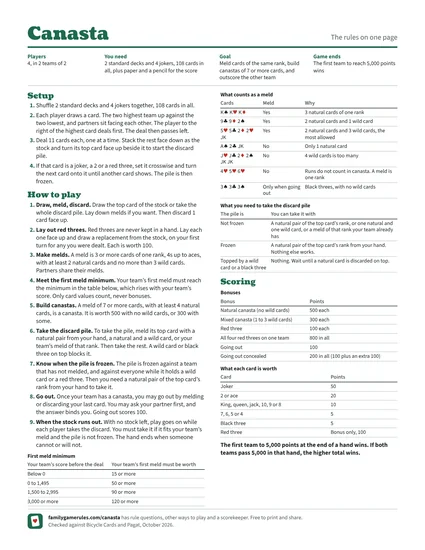
Rule sheet and score sheet
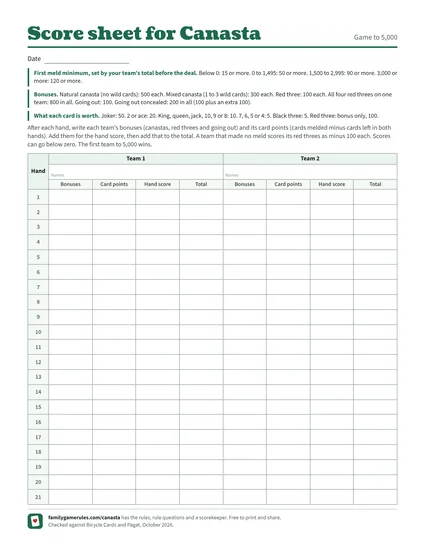
Print the whole game on one page, and a score sheet made for Canasta. Both are free PDFs for Letter paper.
Setup
4 players in 2 teams of 2, with partners sitting across from each other. Versions for 2, 3 and 6 players are further down.
You need: Two standard 52-card decks shuffled together with 4 jokers.
| In the set | Count | Worth when scoring |
|---|---|---|
| Jokers (wild) | 4 | 50 each |
| 2s (wild) | 8 | 20 each |
| Aces | 8 | 20 each |
| Kings, queens, jacks, 10s, 9s and 8s | 48 | 10 each |
| 7s, 6s, 5s and 4s | 32 | 5 each |
| Black threes (spades and clubs) | 4 | 5 each |
| Red threes (hearts and diamonds) | 4 | A 100-point bonus each |
| Total | 108 |
- A card’s points count for your team when it is melded and against your team when it is still in a hand at the end.
- Natural cards are the 4s up to the aces. Wild cards and threes are not natural cards.
- Shuffle 2 standard decks and 4 jokers together, 108 cards in all.
- Each player draws a card. The two highest team up against the two lowest, and partners sit facing each other. The player to the right of the highest card deals first. The deal then passes left.
- Deal 11 cards each, one at a time. Stack the rest face down as the stock and turn its top card face up beside it to start the discard pile.
- If that card is a joker, a 2 or a red three, set it crosswise and turn the next card onto it until another card shows. The pile is then frozen.
| Players | Each player gets | Notes |
|---|---|---|
| 4 | 11 cards | 64 cards are left. The top one starts the discard pile and the rest are the stock. |
| 2 | 15 cards | 78 cards are left. Each player draws 2 cards from the stock on a turn. |
| 3 | 13 cards | 69 cards are left. Each player draws 2 cards from the stock on a turn. |
| 6 | 13 cards | Uses 3 decks and 6 jokers. 84 cards are left. |
Each player’s hand
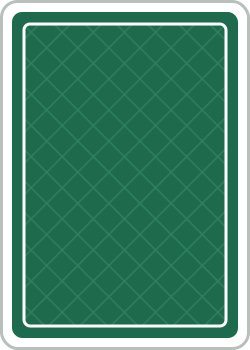
Stock
The cards left after the deal, face down
Discard pile
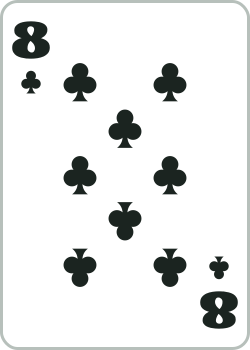
Starts with one face-up card
- For the draw, aces are high and suits rank spades, hearts, diamonds, clubs. A joker or a tie means drawing again.
- Some groups choose the first dealer at random instead of drawing.
- Rule books differ on a black three as the first upcard. One covers it with another card, the same as a wild card, and counts the pile as frozen. Others leave it on top as the first discard. Nobody can take it while it is on top either way.
How to play
Turns go clockwise, starting with the player on the dealer’s left. Partners play as one side: they share their melds, their bonuses and their score.
-
Draw, meld, discard
Draw the top card of the stock or take the whole discard pile. Lay down melds if you want. Then discard 1 card face up.
- Taking the discard pile has its own rules, set out below. When you take it, you meld the top card at once and pick up all the other cards in the pile.
- You discard from your hand, never from a meld. The one turn with no discard is the turn you go out by melding every card.
-
Lay out red threes
Red threes are never kept in a hand. Lay each one face up and draw a replacement from the stock, on your first turn for any you were dealt. Each is worth 100.
- A red three that you pick up with the discard pile also goes face up, but you do not draw a card to replace it.
- If your team has all four red threes, they are worth 800 in all.
- Red threes count against your team instead, 100 each, if your team has not made a single meld when the hand ends.
- A red three is not a meld, and it does not help you reach the first meld minimum.
-
Make melds
A meld is 3 or more cards of one rank, 4s up to aces, with at least 2 natural cards and no more than 3 wild cards. Partners share their melds.
- Your team can have only one meld of each rank. Extra cards of that rank go onto the meld you already have.
- The other team may meld a rank that your team has melded. You can never add cards to the other team’s melds.
- Wild cards cannot be melded on their own. Each one stands for a card of the rank it is melded with.
- Black threes can be melded only on the turn you go out: 3 or 4 of them, with no wild cards.
- Only cards laid on the table count for you. A complete meld still in your hand counts against you.
-
Meet the first meld minimum
Your team’s first meld must reach the minimum in the table below, which rises with your team’s score. Only card values count, never bonuses.
- You may lay down several melds at once to reach the minimum.
- If you take the discard pile to make the first meld, its top card counts toward the minimum. The other cards in the pile do not, even if you meld them in the same turn.
- Bonuses never count toward the minimum, so red threes and canastas do not help.
- Any legal meld is worth at least 15, so a team below zero can meld anything.
-
Build canastas
A meld of 7 or more cards, with at least 4 natural cards, is a canasta. It is worth 500 with no wild cards, or 300 with some.
- Square up a finished canasta with a red card on top if it is natural, or a black card on top if it is mixed.
- You can keep adding natural cards to a canasta. Each one adds its points but does not change the bonus.
- A wild card added to a natural canasta turns it into a mixed canasta, worth 300. A canasta can never hold more than 3 wild cards.
-
Take the discard pile
To take the pile, meld its top card with a natural pair from your hand, a natural and a wild card, or your team’s meld of that rank. Then take the rest. A wild card or black three on top blocks it.
- Nobody may take the pile while its top card is a wild card or a black three. A black three blocks only the next player. Once another card covers it, the pile can be taken as usual.
- Show the cards from your hand before you touch the pile.
- After you take the pile, you may meld any of its cards in the same turn, then discard.
- A player holding only 1 card may not take a pile that has only 1 card in it.
-
Know when the pile is frozen
The pile is frozen against a team that has not melded, and against everyone while it holds a wild card or a red three. Then you need a natural pair of the top card’s rank from your hand to take it.
- A frozen pile cannot be taken with a wild card, and its top card cannot be added to a meld already on the table. You lay the pair down with the top card. If your team already has that rank, they all go onto that meld.
- Set a discarded wild card crosswise so it still shows when cards are piled on top.
- The pile stays frozen until someone takes it. Your team’s first meld lifts only the freeze against your team.
- For a team that has not melded, the pair and the top card can be part of the first meld, along with any other cards from hand needed to reach the minimum.
-
Go out
Once your team has a canasta, you may go out by melding or discarding your last card. You may ask your partner first, and the answer binds you. Going out scores 100.
- You may complete the canasta on the same turn you go out.
- Before you go out you may ask your partner, “May I go out?” Their yes or no is binding. You do not have to ask. Ask before you lay down any melds that turn. Rule books differ on whether you may still ask after taking the discard pile.
- Going out concealed means melding your whole hand in one turn, with at least 1 canasta in it, when you have not melded anything earlier in the hand or added to your partner’s melds. It scores 200 instead of 100.
- If your team has not melded and you go out concealed after drawing from the stock, you do not need the first meld minimum. If you took the discard pile, you do.
-
When the stock runs out
With no stock left, play goes on while each player takes the discard. You must take it if it fits your team’s meld and the pile is not frozen. The hand ends when someone cannot or will not.
- If the last card of the stock is a red three, lay it face up. The hand then ends at once, and that player may not meld or discard.
| Your team’s score before the deal | Your team’s first meld must be worth |
|---|---|
| Below 0 | 15 or more |
| 0 to 1,495 | 50 or more |
| 1,500 to 2,995 | 90 or more |
| 3,000 or more | 120 or more |
| Cards | Meld | Why |
|---|---|---|
| K♠ K♥ K♦ | Yes | 3 natural cards of one rank |
| 9♣ 9♦ 2♠ | Yes | 2 natural cards and 1 wild card |
| 5♥ 5♣ 2♦ 2♥ JK | Yes | 2 natural cards and 3 wild cards, the most allowed |
| A♠ 2♣ JK | No | Only 1 natural card |
| J♥ J♣ 2♦ 2♠ JK JK | No | 4 wild cards is too many |
| 4♥ 5♥ 6♥ | No | Runs do not count in canasta. A meld is one rank |
| 3♠ 3♣ 3♠ | Only when going out | Black threes, with no wild cards |
| The pile is | You can take it with |
|---|---|
| Not frozen | A natural pair of the top card’s rank, or one natural and one wild card, or a meld of that rank your team already has |
| Frozen | A natural pair of the top card’s rank from your hand. Nothing else works. |
| Topped by a wild card or a black three | Nothing. Wait until a natural card is discarded on top. |
Example: a frozen pile
Your team has already melded and has three 9s on the table. Earlier, a player discarded a joker, which lies crosswise in the pile, so the pile is frozen for both teams. The top card is now the 9 of spades. You hold one 9 and a 2. If the pile were not frozen, you could add the 9 of spades to your meld of 9s, or meld it with your 9 and your 2. A frozen pile allows neither, so you draw from the stock instead. To take this pile you need two natural 9s in your hand. You would lay them down with the top card, put all three on your team’s meld of 9s and pick up the pile.
Discard pile
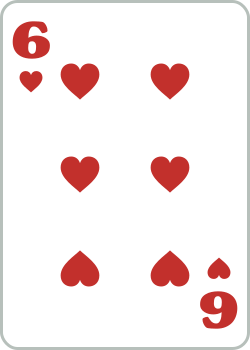
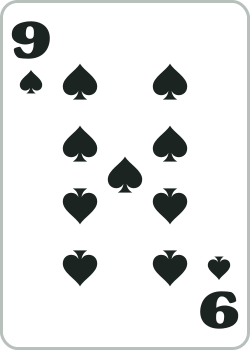
The joker freezes it. The 9♠ is on top.
Your team’s meld
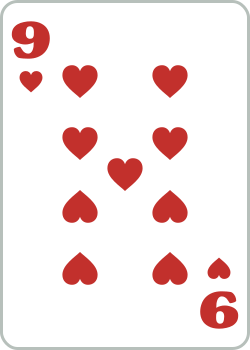
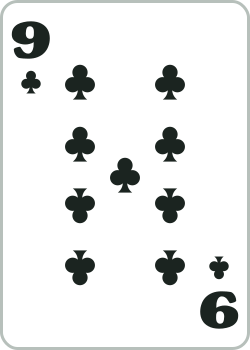
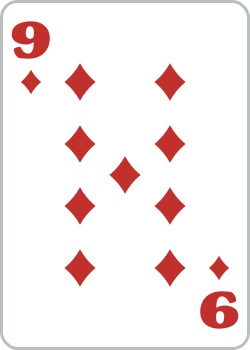
The 9♠ cannot be added to it
Your hand
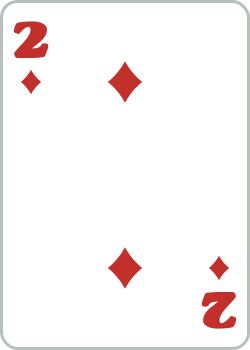
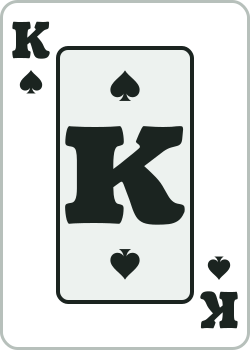
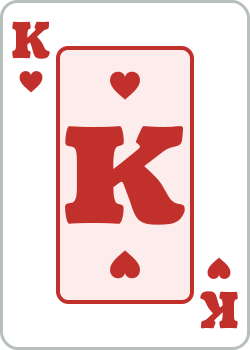
One 9 is not enough, and the 2 cannot help
Scoring
Both teams score at the end of every hand. Each team adds its bonuses to the points of the cards it melded, then takes off the points of the cards left in its two hands.
| Bonus | Points |
|---|---|
| Natural canasta (no wild cards) | 500 each |
| Mixed canasta (1 to 3 wild cards) | 300 each |
| Red three | 100 each |
| All four red threes on one team | 800 in all |
| Going out | 100 |
| Going out concealed | 200 in all (100 plus an extra 100) |
| Card | Points |
|---|---|
| Joker | 50 |
| 2 or ace | 20 |
| King, queen, jack, 10, 9 or 8 | 10 |
| 7, 6, 5 or 4 | 5 |
| Black three | 5 |
| Red three | Bonus only, 100 |
- Cards melded count for your team. Cards left in both partners’ hands count against it, even if they would make a meld.
- A team that made no meld scores its red threes as minus 100 each, or minus 800 for all four.
- A hand score can be below zero, and so can a running total. A team below zero needs only 15 for its first meld.
- There is no extra bonus for winning the game.
The first team to 5,000 points at the end of a hand wins. If both teams pass 5,000 in that hand, the higher total wins.
Use a sheet with a column for each team. After each hand, write each team’s bonuses and its card points, add them for the hand total, then add that to the running total. Check the running total before each deal, because it sets the team’s first meld minimum.
A worked example: one team’s hand
Your partner goes out by melding every card, not concealed. Your team has the melds and red threes shown, and you are left holding a queen, a 6 and a 2. Your team scores 1,315 for the hand.
Natural canasta
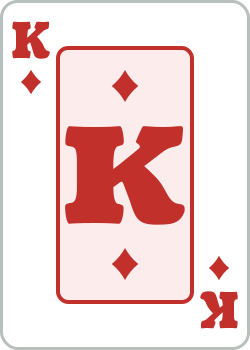
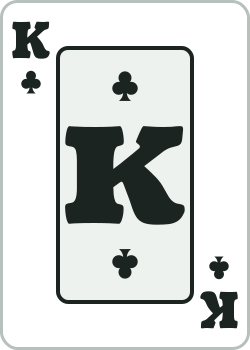
7 kings: 500 bonus, 70 in cards
Mixed canasta
300 bonus. Cards: 50 + 20 + 50 = 120
Meld of aces
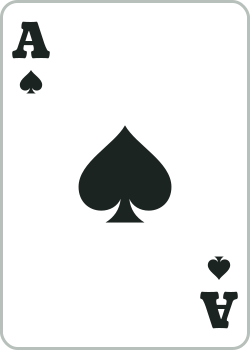
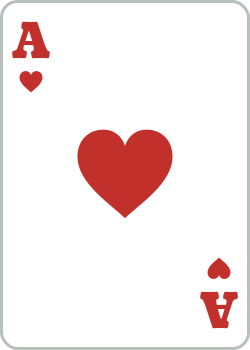
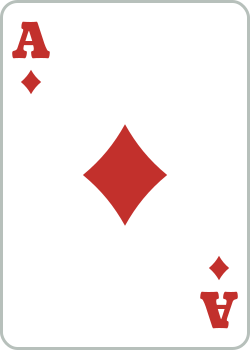
20 + 20 + 20 = 60
Red threes
100 each
Left in your hand
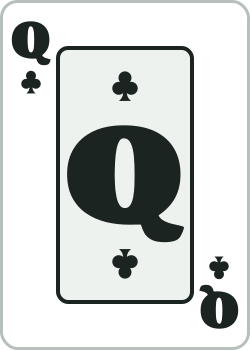
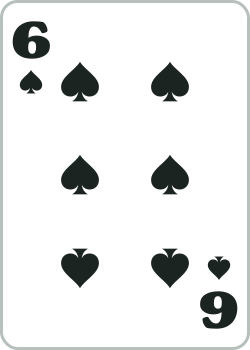
10 + 5 + 20 = 35 against you
| What happened | Points |
|---|---|
| Natural canasta of kings | 500 |
| Mixed canasta of 9s | 300 |
| Two red threes, 100 each | 200 |
| Going out | 100 |
| Cards in the canasta of kings: 7 kings at 10 each | 70 |
| Cards in the canasta of 9s: five 9s, a 2 and a joker | 120 |
| Cards in the meld of aces: 3 aces at 20 each | 60 |
| Cards left in your hand: a queen, a 6 and a 2 | −35 |
| Your team’s score for the hand | 1,315 |
Scorekeeper
Two teams playing to 5,000. After each hand, enter each team’s score for the hand, which can be below zero. Each team’s column shows the first meld minimum for its current total, so you can check it before the next deal. For the 3-player and 6-player versions, add a third side if you need one and change the target to 7,500 or 10,000. It works in this browser, keeps the game if the page reloads, and needs no account.
Other ways to play
Canasta for 2 players
Deal 15 cards to each player. When you draw from the stock, take the top 2 cards, but still discard only 1. You need 2 canastas before you can go out. Everything else follows the 4-player game, including the first meld minimums and the 5,000 target. If only 1 card is left in the stock, drawing it counts as a full draw. A red three drawn as one of the last 2 cards is not replaced. A red three drawn as the very last card ends the hand at once, with no meld or discard, and so do two red threes drawn as the last 2 cards.
Canasta for 3 players
Deal 13 cards each. Some groups deal 11. Draw the top 2 cards from the stock and discard 1. Each player keeps their own score. The first player to take the discard pile plays alone, and the other two become partners for the rest of the hand. Partners share melds, but each scores their own red threes. The partnership’s points for cards and canastas go to both partners. The partner who melds first must meet the minimum for their own score. If someone goes out before anyone takes the pile, that player is the lone player. If the stock runs out first, everyone scores alone. Play to 7,500, and the highest score wins.
Canasta for 6 players
Use 3 decks and 6 jokers. Deal 13 cards each. Play as 3 teams of 2, with partners across from each other, or as 2 teams of 3, with each player sitting between two opponents. A team needs 2 canastas before going out. Red threes count differently: 4 of them are worth 400 in all, 5 are worth 1,000 and 6 are worth 1,200. Three teams play to 7,500. Two teams of three play to 10,000, and a team with 7,000 or more needs 150 for its first meld. The draw is not changed.
House rules and other versions
- A black three freezes the pile
- One rule book lists a discarded black three as freezing the pile, the same as a wild card. Once it is covered, the pile can be taken only with a natural pair of the top card’s rank. Under the main rules here, a black three blocks only the next player.
- The pile is always frozen
- The discard pile counts as frozen at all times. You can take it only with a natural pair of the top card’s rank from your hand.
- Two naturals to take the pile
- To take a pile that is not frozen, you must use 2 natural cards from your hand. One natural card and one wild card is not enough.
- No taking the pile for a finished canasta
- You may not take a pile that is not frozen just to add its top card to a canasta that is already complete.
- Wild card melds
- Some groups allow melds made only of 2s and jokers. A canasta of wild cards then earns a large bonus, typically 2,000 points. A team that has begun a wild card meld usually may not use wild cards in its other melds. In some groups, a team that starts a wild card meld and does not finish it loses 1,000 points.
- Red threes laid out at the deal
- Players put down any red threes they were dealt as soon as the deal ends, and draw replacements then, before the first turn.
Rule questions
How many cards are in a canasta deck?
108. Shuffle 2 standard 52-card decks together with 4 jokers. With 4 players, each gets 11 cards. That leaves 64 for the stock and the first card of the discard pile.
What do you need to take a frozen discard pile?
Two natural cards from your hand of the same rank as the top card. Wild cards do not help, and you cannot add the top card to a meld already on the table. Lay the pair down with the top card, then pick up the rest of the pile.
When is the discard pile frozen?
It is frozen against your team until your team makes its first meld. It is frozen for both teams while a wild card lies in it, or a red three that was turned up at the start. It stays frozen until someone takes it.
Can you pick up the pile when a black three is on top?
No. Nobody can take the pile while its top card is a black three or a wild card. A black three blocks only the next player. Once a card is discarded on top of it, the pile can be taken as usual. One rule book also counts a discarded black three as freezing the pile.
When can you meld black threes?
Only on the turn you go out. You may then meld 3 or 4 black threes, with no wild cards. Until then they stay in your hand or get discarded. A black three left in your hand counts 5 points against your team.
What counts toward the first meld minimum?
Only the point values of the cards you meld that turn. You may lay down several melds to reach it. Red threes and canasta bonuses never count. If you take the discard pile, its top card counts but the rest of the pile does not.
Can you go out without a canasta?
No. Your team needs at least 1 canasta first, though you may finish it on the turn you go out. You do not have to discard to go out. You may meld every card, or meld all but one and discard it. The 2-player and 6-player versions need 2 canastas.
What is going out concealed?
Going out by melding your whole hand in one turn, with at least 1 canasta, when you have not melded anything earlier in the hand or added to your partner’s melds. It scores 200 instead of 100. If your team had not melded and you drew from the stock, you do not need the first meld minimum.
Do red threes ever count against you?
Yes, if your team has not made a single meld when the hand ends. Each red three then counts 100 against you, and all four count 800 against you. Once your team has melded anything, they count for you.
What happens when the stock runs out?
Play goes on as long as each player takes the discard. You must take it if its top card fits one of your team’s melds and the pile is not frozen. The hand ends when a player cannot take it or chooses not to. If the last stock card is a red three, the hand ends at once.
Can you add cards to the other team’s melds?
No. You may add only to your own team’s melds, including ones your partner started. Each team may have just one meld of a rank, but both teams may meld the same rank.
Can you take the pile when you hold only 1 card?
Not if the pile also holds only 1 card. A player with 1 card in hand may not take a 1-card discard pile. When the pile is bigger, the usual rules apply.
Words used in Canasta
- Meld
- 3 or more cards of the same rank laid face up on the table. To meld is to lay one down.
- Natural card
- Any card from 4 up to ace. Jokers, 2s and threes are not natural cards.
- Wild card
- A joker or a 2. It can stand for any natural card in a meld.
- Canasta
- A meld of 7 or more cards with at least 4 natural cards.
- Natural canasta
- A canasta with no wild cards, worth 500. Also called a red canasta. A red card goes on top to mark it.
- Mixed canasta
- A canasta with 1 to 3 wild cards, worth 300. Also called a dirty or black canasta.
- Stock
- The face-down pile of cards left after the deal. Players draw from it.
- Discard pile
- The face-up pile where every turn ends. It can be taken whole.
- Upcard
- The card turned face up after the deal to start the discard pile.
- Frozen pile
- A discard pile that can be taken only with a natural pair of the top card’s rank from your hand.
- Red three
- The 3 of hearts or diamonds. It is laid face up as a 100-point bonus and never melded.
- Black three
- The 3 of spades or clubs. On top of the pile it blocks the next player from taking it.
- First meld minimum
- The points a team’s first meld must be worth. It rises as the team’s score rises. Also called the minimum count.
- Going out
- Getting rid of the last card in your hand. It ends the hand and scores 100.
- Going out concealed
- Melding your whole hand in one turn, including a canasta, without having melded before in that hand. It scores 200.
What you need
- Two standard decks of playing cards with jokersYou need 2 decks and 4 jokers. Canasta sets come with all 108 cards, and some add a card tray.Find it on Amazon (Two standard decks of playing cards with jokers, opens in a new tab)
- A card tray or discard holderOptional. Keeps the stock and the discard pile tidy, since the pile can grow large.Find it on Amazon (A card tray or discard holder, opens in a new tab)
- A score pad and pencilScores reach the thousands, so a printed pad with team columns helps.Find it on Amazon (A score pad and pencil, opens in a new tab)
- Card holdersOptional. A hand can grow large after you take the discard pile.Find it on Amazon (Card holders, opens in a new tab)
As an Amazon Associate, we earn from qualifying purchases. How the site is paid for.
Checked against
These rules are written in our own words from Bicycle Cards and checked against Pagat. Sources last checked on October 12, 2026.
- First source: Bicycle Cards, Canasta. Partnerships and the draw for seats, the 11-card deal, the first upcard, wild cards, red threes, melds, canastas and their bonuses, the first meld minimums, freezing and taking the pile, going out, asking permission, going out concealed, the stock running out, the one-card pile rule, card values and scoring to 5,000.
- Second source: Pagat, Canasta (Classic Canasta). The 108-card deck, the classic rules checked point by point, black threes as a stop card for the next player only, the higher total winning when both teams pass 5,000, the versions for 2, 3 and 6 players, and the variants.
Other sources we used (1)
- Wikipedia, Canasta. Confirms that a black three is a stop card and does not freeze the pile, that a black three can start the discard pile, and the deal sizes for 2 and 3 players. It gives 108 or 110 cards, depending on the jokers..
Where the sources differ (11)
| Topic | Bicycle Cards | Pagat | This page |
|---|---|---|---|
| Deck size | Not stated. Jokers and 2s are wild, but the number of decks and jokers is not given. | Two 52-card decks and four jokers, 108 cards. | 108 cards, as Pagat and Wikipedia both say. |
| Choosing partners and the first dealer | Players draw cards. The highest chooses seats, plays first and partners the second highest. The player on the highest card’s right deals. | The first dealer is chosen at random. | Follows Bicycle. Choosing at random is in the setup notes. |
| A black three as the first upcard | Any three, like a joker or a 2, is covered by more cards until a natural card shows, and the pile counts as frozen. | Names only a wild card or a red three as cards to cover. Wikipedia says a black three stays as the first upcard. | The setup step names the joker, the 2 and the red three, which all sources agree on. The black three difference is given in the setup notes. |
| A discarded black three | Its freezing sentence lists a black three discarded along with a wild card. It also says a natural card must be discarded on a black three before the pile can be taken. | A stop card for the next player only. It does not freeze the pile, and once covered it has no effect. Wikipedia says the same. | Follows Pagat and Wikipedia. Bicycle’s reading is a variant and is mentioned in a rule question. |
| When dealt red threes are laid out | On the player’s first turn, with a replacement drawn from the stock. | Immediately, at the deal, with replacements drawn then. | Follows Bicycle. Laying them out at the deal is a variant. |
| When you may ask to go out | Before or after drawing, but not after melding any card or after showing you mean to take the pile. | Only right after drawing or taking the pile, before any meld other than the one that takes the pile. | Says to ask before laying down melds that turn, which both allow, and that rule books differ on asking after taking the pile. |
| Both teams passing 5,000 in the same hand | Not stated. The last hand is played out, and the margin is the difference in totals. | The team with the higher total wins. | Follows Pagat. |
| First meld for a team below zero | 15 points. | 15 points, described as no minimum at all. | 15, with a note that any legal meld reaches it. |
| A 1-card hand taking a 1-card pile | Not allowed. | Not covered in the classic rules. The Viennese version allows it. | Follows Bicycle. |
| Versions for 2, 3 and 6 players | Not covered. The page is for 4 players. | 2 players: 15 cards, draw 2, 2 canastas to go out. 3 players: 13 cards (or 11), draw 2, a lone player against a temporary partnership, game to 7,500. 6 players: 3 decks and 6 jokers, 13 cards, 2 canastas, different red three values, game to 7,500 or 10,000. | Follows Pagat. Wikipedia confirms the 15-card and 13-card deals and the 2-player draw. |
| Dealing one card at a time | One at a time, clockwise, starting on the dealer’s left. | 11 cards each. Does not say one at a time for the classic game. | Follows Bicycle. |
What on this page is our own
- The playing time of about 1 to 2 hours is our estimate.
- The frozen pile example, the scoring example and its total of 1,315 are our own. The meld table examples are ours too.
- The counts of cards left after the deal (64, 78, 69 and 84) are our arithmetic from the deal sizes and deck sizes. The card counts in the equipment list are our arithmetic from two 52-card decks.
- That any legal meld is worth at least 15, so a team below zero can meld anything, is our arithmetic: 3 cards at 5 points or more each.
- That the 6-player version does not change the draw is our reading. Pagat lists the changes for 6 players and the draw is not among them.
- That partners share their melds, bonuses and score, and that the extra cards of a rank go onto the team’s one meld, follow from the sources’ rules on adding to a partner’s melds and having one meld of a rank.
- Advice on keeping score on paper and the notes under What you need are ours, not rules.
- The pieces pictured at the top of the page are our own example.
Spotted a mistake? Email contact@familygamerules.com and we'll check it against the sources.