Uno rules
Uno is a fast card game for 2 to 10 players with its own deck of colored number cards, action cards and wild cards. On your turn you match the top card of the pile by color, number or symbol. With 1 card left you must say “Uno.” The first player out of cards wins the round.
- Players
- 2 to 10
- Ages
- 7 and up
- You need
- An Uno deck. Current decks have 112 cards and older decks have 108.
- Deal
- 7 cards each. The rest is the draw pile, and its top card is turned face up to start the discard pile.
- Goal
- Be the first to play every card in your hand
- Game ends
- A round ends when one player has no cards left. If you keep score, the first player to 500 points wins.
- Playing time
- About 10 minutes a round. A game to 500 points can take an hour or more.
UNO is a trademark of Mattel, Inc. This site is not affiliated with or endorsed by Mattel.
Quick start
- Shuffle the deck and deal 7 cards to each player. Put the rest face down in the middle as the draw pile.
- Turn the top card face up to start the discard pile. If it is not a number card, turn over the next one. The player on the dealer’s left goes first.
- On your turn, play 1 card that matches the top card of the discard pile in color, number or symbol. A Wild card can be played on anything.
- If you cannot play, draw 1 card. You may play it right away if it matches. Then the turn passes to the next player.
- Skip: the next player loses a turn. Reverse: play changes direction. Draw 2: the next player draws 2 cards and loses a turn. Wild: you name the next color.
- Say “Uno” when you have 1 card left. The first player out of cards wins the round. To keep score, give them the points left in the other hands. 500 points wins.
Rule sheet and score sheet
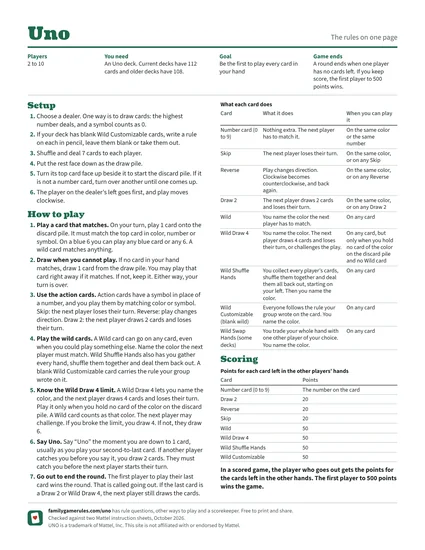
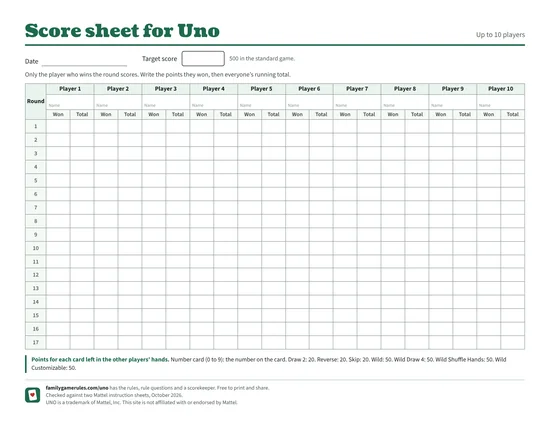
Print the whole game on one page, and a score sheet made for Uno. Both are free PDFs for Letter paper.
Setup
2 to 10 players, each playing alone. Notes for 2 players and a partners game for 4 are further down.
You need: One Uno deck. Current decks have 112 cards. Older decks have 108, and every rule on this page works with them too.
| In the set | Count | Worth when scoring |
|---|---|---|
| Number cards, 0 to 9 (19 in each of the 4 colors) | 76 | The number on the card |
| Draw 2 cards (2 in each color) | 8 | 20 |
| Reverse cards (2 in each color) | 8 | 20 |
| Skip cards (2 in each color) | 8 | 20 |
| Wild cards | 4 | 50 |
| Wild Draw 4 cards | 4 | 50 |
| Wild Shuffle Hands card | 1 | 50 |
| Wild Customizable cards (the blank wild cards) | 3 | 50 |
| Total | 112 |
- The 4 colors are red, yellow, green and blue. Each color has one 0 and two each of the numbers 1 to 9. That makes 19 number cards in a color.
- Older decks have 108 cards. They are the first six rows of this list: 76 number cards, 8 Draw 2, 8 Reverse, 8 Skip, 4 Wild and 4 Wild Draw 4.
- Some 112-card decks have a Wild Swap Hands card in place of the Wild Shuffle Hands card.
- Choose a dealer. One way is to draw cards: the highest number deals, and a symbol counts as 0.
- If your deck has blank Wild Customizable cards, write a rule on each in pencil, leave them blank or take them out.
- Shuffle and deal 7 cards to each player.
- Put the rest face down as the draw pile.
- Turn its top card face up beside it to start the discard pile. If it is not a number card, turn over another until one comes up.
- The player on the dealer’s left goes first, and play moves clockwise.
Each player’s hand
Draw pile
Face down
Discard pile
Face up
- Writing on the blank cards is optional. A blank card with no rule on it plays like a plain Wild card.
- Older rule sheets did not ignore a first card with a symbol. The card took effect. The play section has a table of that older rule.
How to play
Players take turns, starting on the dealer’s left and going clockwise. A turn is short: you play 1 card if you can, or you draw 1 card.
-
Play a card that matches
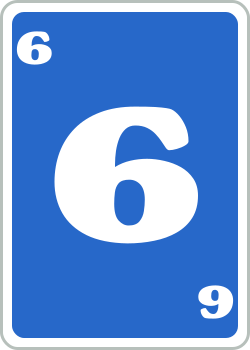
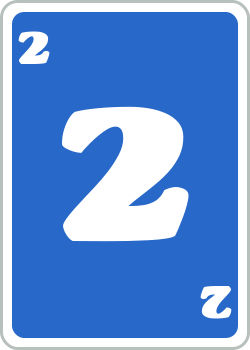
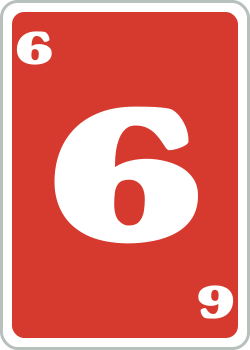
On your turn, play 1 card onto the discard pile. It must match the top card in color, number or symbol. On a blue 6 you can play any blue card or any 6. A wild card matches anything.
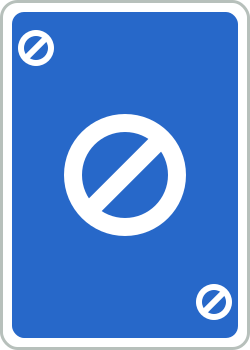
- A symbol matches the same symbol in any color. A Skip can go on a Skip, a Reverse on a Reverse and a Draw 2 on a Draw 2.
- After a wild card, the color to match is the one its player named.
- You play only 1 card in a turn, even when you hold two cards that are exactly alike.
- Older rule sheets had a penalty for playing a card that does not match. If another player notices, you take the card back, draw 2 cards and your turn ends. The same sheets make a player draw 2 cards for telling someone else what to play. The current rule sheet has neither penalty.
Top of the discard pile
Same color
Same number
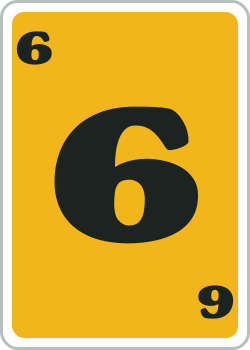
Wild
Matches anything
What can be played on a blue 6. -
Draw when you cannot play
If no card in your hand matches, draw 1 card from the draw pile. You may play that card right away if it matches. If not, keep it. Either way, your turn is over.
- You may choose to draw even when you hold a card you could play.
- After you draw, the card you drew is the only one you may play on that turn.
- You draw 1 card and no more, even if it does not match.
- If the draw pile runs out, set the top card of the discard pile aside. Shuffle the rest and turn it face down as the new draw pile.
-
Use the action cards
Action cards have a symbol in place of a number, and you play them by matching color or symbol. Skip: the next player loses their turn. Reverse: play changes direction. Draw 2: the next player draws 2 cards and loses their turn.
- A player hit by a Draw 2 draws the 2 cards and plays nothing that turn. They cannot play a Draw 2 of their own to pass the cards on. Doing that is a house rule called stacking.
- Once the 2 cards are drawn, the player after that may play a Draw 2 on the Draw 2, because the symbols match.
- After a Reverse, play goes back the way it came, so the player who went before you goes next.
- With 2 players these cards let you play again. See Uno for 2 players below.
-
Play the wild cards
A Wild card can go on any card, even when you could play something else. Name the color the next player must match. Wild Shuffle Hands also has you gather every hand, shuffle them together and deal them back out. A blank Wild Customizable card carries the rule your group wrote on it.
- You may name any color, including the one already in play.
- Wild Shuffle Hands: collect every card from every player’s hand, your own included, and shuffle them together. Starting with the player on your left, deal them all back out until none are left. Players can end up with more or fewer cards than they had. Then name the color.
- Wild Customizable: when one is played, everyone follows the rule written on it, and its player names the color. Your group makes the rules up and should agree on them before the game. The rule sheets offer ideas to start from, such as taking an extra turn, or making the next player draw 3 cards if they cannot play.
- Wild Swap Hands, found in some decks: trade your whole hand with any one player you choose, then name the color.
-
Know the Wild Draw 4 limit
A Wild Draw 4 lets you name the color, and the next player draws 4 cards and loses their turn. Play it only when you hold no card of the color on the discard pile. A Wild card counts as that color. The next player may challenge. If you broke the limit, you draw 4. If not, they draw 6.
- The color that counts is the one in play. After a wild card, that is the color its player named.
- To challenge, the player who would have to draw asks to see your hand. You show your whole hand to that player.
- If you hold a card of the color that was on the discard pile, or a Wild card, you draw 4 cards. The challenger draws nothing and takes their turn as usual.
- If you hold neither, the challenger draws 6 cards, which is the 4 plus 2 more, and loses their turn.
- Counting a Wild card as a match is part of the current rules. Older rule sheets did not say it. A card that matches only the number or the symbol never counts.
- The rule sheet does not say whether this means the plain Wild only or every kind of wild card. Agree on that before you play.
- The color you named stays in force whichever way the challenge goes.
- You can play a Wild Draw 4 against the limit as a bluff. If the next player does not challenge, it stands as a normal play and they draw 4 cards.
-
Say Uno
Say “Uno” the moment you are down to 1 card, usually as you play your second-to-last card. If another player catches you before you say it, you draw 2 cards. They must catch you before the next player starts their turn.
- Another player catches you by calling “Uno” on you before you say it yourself.
- Saying it late still counts, as long as you say it before anyone catches you.
- The current rule sheet says to call it the moment you have only 1 card in your hand.
- Older rule sheets add two details. You cannot be caught until your second-to-last card touches the discard pile. A turn has started once the next player draws a card or takes a card from their hand to play it.
- If nobody catches you in time, there is no penalty.
-
Go out to end the round
The first player to play their last card wins the round. That is called going out. If the last card is a Draw 2 or Wild Draw 4, the next player still draws the cards.
- Any card can be your last one, including an action card or a wild card.
- Cards drawn because of a last Draw 2 or Wild Draw 4 count when the round is scored.
- For another round, shuffle all the cards and deal again.
| Card | What it does | When you can play it |
|---|---|---|
| Number card (0 to 9) | Nothing extra. The next player has to match it. | On the same color or the same number |
| Skip | The next player loses their turn. | On the same color, or on any Skip |
| Reverse | Play changes direction. Clockwise becomes counterclockwise, and back again. | On the same color, or on any Reverse |
| Draw 2 | The next player draws 2 cards and loses their turn. | On the same color, or on any Draw 2 |
| Wild | You name the color the next player has to match. | On any card |
| Wild Draw 4 | You name the color. The next player draws 4 cards and loses their turn, or challenges the play. | On any card, but only when you hold no card of the color on the discard pile and no Wild card |
| Wild Shuffle Hands | You collect every player’s cards, shuffle them together and deal them all back out, starting on your left. Then you name the color. | On any card |
| Wild Customizable (blank wild) | Everyone follows the rule your group wrote on the card. You name the color. | On any card |
| Wild Swap Hands (some decks) | You trade your whole hand with one other player of your choice. You name the color. | On any card |
| First card | What happens |
|---|---|
| Draw 2 | The player on the dealer’s left draws 2 cards and loses their turn. |
| Reverse | The dealer plays first, and play moves to the right, which is counterclockwise. |
| Skip | The player on the dealer’s left is skipped. The player after them starts. |
| Wild | The player on the dealer’s left names the color and takes the first turn. |
| Wild Draw 4 | Put it back in the deck and turn over another card. |
| Wild Swap Hands or Wild Customizable | The player on the dealer’s left names the color. |
Example: the cards you can play on a green 5
The top card of the discard pile is a green 5. Your hand is a red 5, a green 9, a green Skip, a blue 2, a yellow Reverse, a Wild and a Wild Draw 4. The red 5 can be played because the number matches. The green 9 and the green Skip can be played because the color matches. The Wild can be played on anything. The blue 2 and the yellow Reverse match nothing, so they stay in your hand. The Wild Draw 4 is against the rules here, because you hold green cards and a Wild. If you played it anyway and the next player challenged, you would draw 4 cards.
Top of the discard pile
Your hand
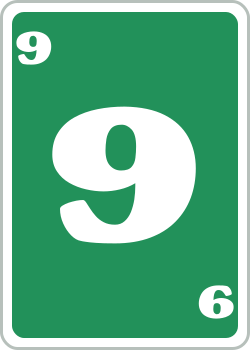
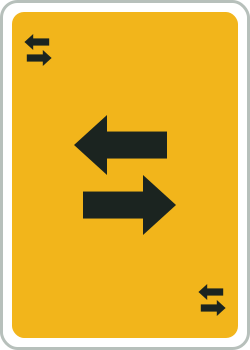
Cards you can play
Same number, same color, or a Wild
Not allowed here
You hold green cards and a Wild
Scoring
Keeping score is optional. Under the current rules the first player to go out wins, and you can stop there. For a longer game, the player who goes out scores points for every card left in the other players’ hands. Nobody else scores in that round.
| Card | Points |
|---|---|
| Number card (0 to 9) | The number on the card |
| Draw 2 | 20 |
| Reverse | 20 |
| Skip | 20 |
| Wild | 50 |
| Wild Draw 4 | 50 |
| Wild Shuffle Hands | 50 |
| Wild Customizable | 50 |
- A 0 is worth 0 points.
- If the round ended on a Draw 2 or Wild Draw 4, the next player draws those cards first, and they count in the total.
- Some rules score the newer wild cards (Wild Swap Hands, Wild Shuffle Hands and Wild Customizable) at 40 points each. The current rule sheet scores every wild card at 50. Agree on one value before you start.
- Older rule sheets give a second way to score. After each round, every player adds the points left in their own hand to their own running total. When one player reaches 500, the player with the lowest total wins.
In a scored game, the player who goes out gets the points for the cards left in the other hands. The first player to 500 points wins the game.
Keep a running total for each player on paper. After each round, add the round’s points to the total of the player who went out. The other totals stay the same.
A worked example: scoring one round
Four people are playing. You play your last card and go out. The other three players show their hands, and you add up the cards. You score 169 points for the round.
Player on your left
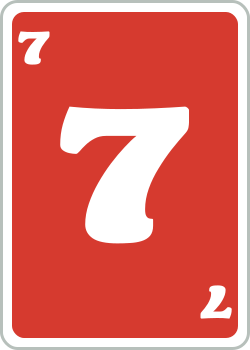
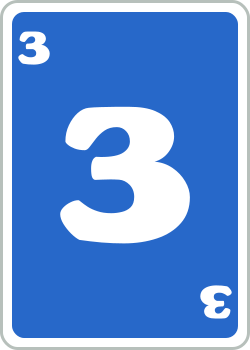
30 points
Player across from you
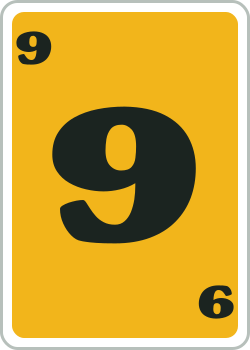
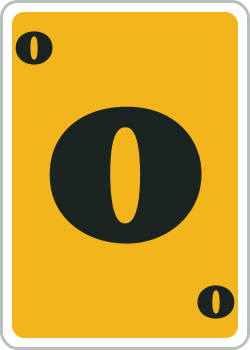
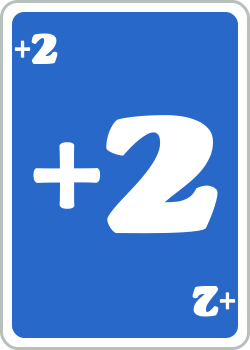
79 points
Player on your right
60 points
| What happened | Points |
|---|---|
| Player on your left: a red 7 | 7 |
| Player on your left: a blue 3 | 3 |
| Player on your left: a green Skip | 20 |
| Player across from you: a yellow 9 | 9 |
| Player across from you: a yellow 0 | 0 |
| Player across from you: a blue Draw 2 | 20 |
| Player across from you: a Wild | 50 |
| Player on your right: a red 5 and a green 5 | 10 |
| Player on your right: a Wild Draw 4 | 50 |
| Your points for the round | 169 |
Scorekeeper
For 2 to 10 players. After each round, enter the points for the player who went out. The first player to 500 wins. It works in this browser, keeps the game if the page reloads, and needs no account.
Other ways to play
Uno for 2 players
Deal 7 cards each and play by the normal rules. With only one other player, a card that costs them a turn hands the turn straight back to you. Play a Skip and you take another turn right away. A Reverse works like a Skip, so you play again after it too. Play a Draw 2 and the other player draws 2 cards, then the turn comes back to you. A Wild Draw 4 does the same with 4 cards. These rules are printed in older rule sheets. The current rule sheet has no 2-player section. Under its normal rules a Skip, a Draw 2 and a Wild Draw 4 come out the same way. Agree on the Reverse before you start, because the current sheet says only that it changes the direction of play.
Uno with partners
Four players can play as 2 teams. Partners sit across from each other. Play by the normal rules. The round ends as soon as either partner goes out. Add up the cards left in both opponents’ hands, and the winning team scores that total. This way of playing comes from older rule sheets. The current rule sheet does not mention it.
House rules and other versions
- Stacking
- A house rule, also called Progressive Uno. If a Draw 2 is played on you, you may play 1 Draw 2 of your own and pass 4 cards to the next player. The total grows until someone cannot add a card. That player draws them all and loses their turn. Wild Draw 4 cards stack the same way, but only on each other.
- Seven-O
- A house rule. When you play a 7, you trade hands with any player you choose. When anyone plays a 0, every player passes their whole hand to the next player in the direction of play.
- Jump-in
- A house rule. If you hold a card identical to the top card of the discard pile, with the same color and the same number or symbol, you may play it at once, even out of turn. Play carries on from you. An identical action card played this way cancels the first one.
- First card takes effect
- The older official rule. A first card with a symbol is not ignored. It takes effect before the first turn. The play section has a table of what each card does.
- Lowest score wins
- An older official way to score. After each round, every player adds the points left in their own hand to their own total. When one player reaches 500, the player with the lowest total wins.
- Challenge Uno
- An older official version where players drop out. Each player keeps a running total of the points left in their own hand. A player who reaches an agreed total, such as 500, is out. When 2 players are left, they play head to head by the 2-player rules. The one who reaches the total loses.
- Classic 108-card game
- Take out the Wild Shuffle Hands or Wild Swap Hands card and the 3 blank Wild Customizable cards. The 108 cards left are the classic deck.
Rule questions
How many cards are in an Uno deck?
112 in current decks. That is 76 number cards, 8 Skip, 8 Reverse, 8 Draw 2, 4 Wild, 4 Wild Draw 4, 1 Wild Shuffle Hands and 3 blank Wild Customizable cards. Older decks have 108 cards. They have no Wild Shuffle Hands card and no blank cards. Some 112-card decks have a Wild Swap Hands card where the Wild Shuffle Hands card would be.
How many cards do you get in Uno?
7 cards each, for any number of players from 2 to 10. The rest of the deck goes face down as the draw pile, and its top card is turned over to start the discard pile.
Can you stack Draw 2 or Wild Draw 4 cards in Uno?
No, not under the official rules. A player hit by a Draw 2 draws 2 cards and loses their turn, so they cannot answer with a Draw 2 of their own. A Wild Draw 4 works the same way. In 2019 the game’s official social media account said that stacking is not allowed. Stacking is a well-known house rule, and it is explained under house rules.
When can you play a Wild Draw 4?
Only when you hold no card of the color on the discard pile. Cards of another color that match the number or symbol do not stop you. Under the current rules a Wild card in your hand does count as a match. Older rule sheets did not say that. You can still play the card as a bluff. There is no penalty unless the next player challenges.
What happens when someone challenges a Wild Draw 4?
The player who played it shows their hand to the challenger. If they hold a card of the color that was on the discard pile, or a Wild card under the current rules, they draw the 4 cards and the challenger draws nothing. If they hold neither, the challenger draws 6 cards and loses their turn. Only the player who was told to draw 4 can challenge. The named color stands either way.
What happens if you forget to say Uno?
You draw 2 cards, but only if another player catches you in time. They have to call it while you hold 1 card and before the next player starts their turn. If nobody catches you by then, there is no penalty. Saying “Uno” late still saves you if you get it out before anyone catches you.
Can you go out on a Wild card or an action card?
Yes. Any card can be your last card. If it is a Draw 2 or a Wild Draw 4, the next player still draws the 2 or 4 cards, and those cards count when the round is scored. None of the rule sheets we checked stops you from finishing on a special card.
What are the blank cards in Uno for?
They are Wild Customizable cards, and newer decks have 3. Before the game, your group can write a rule of its own on each one in pencil, so it can be rubbed out later. When you play one, everyone follows the rule on it and you name the color. A card left blank plays like a plain Wild. You can also take the blank cards out of the deck.
What does the swap hands card do in Uno?
The Wild Swap Hands card lets you trade your whole hand with any one player you choose. Then you name the color. Current decks have a Wild Shuffle Hands card in its place. With that card you collect every player’s cards, shuffle them together and deal them all back out, starting with the player on your left. Either card can be played on any card.
If you cannot play, do you keep drawing until you can?
No. You draw 1 card. If it matches, you may play it right away. If it does not, you keep it and your turn ends. Some groups keep drawing until they get a card they can play. That is a house rule.
What happens if the first card turned over is not a number card?
Under the current rules you ignore it and turn over the next card. Older rule sheets had the card take effect. A Draw 2 made the first player draw 2 cards and lose their turn. A Skip skipped the first player. A Reverse let the dealer play first, with play going counterclockwise. A Wild let the first player name the color. A Wild Draw 4 went back into the deck.
How does a Reverse card work with 2 players?
It works like a Skip, so the player who plays it takes another turn right away. That rule comes from older rule sheets. The same sheets let you play again after a Skip, a Draw 2 or a Wild Draw 4 in a 2-player game. The current rule sheet has no 2-player section and says only that a Reverse changes the direction of play, so agree on this before you start.
Words used in Uno
- Draw pile
- The face-down stack of cards left after the deal. You draw from it when you cannot play.
- Discard pile
- The face-up pile where cards are played. The card on top is the one you have to match.
- Number card
- A colored card with a number from 0 to 9. It does nothing extra when played.
- Action card
- A colored card with a symbol in place of a number: Skip, Reverse or Draw 2.
- Wild card
- A card with no color of its own. It can be played on any card, and its player names the color to match next.
- Uno
- What you say out loud the moment you are down to 1 card, so the others know.
- Go out
- To play your last card. The first player to go out wins the round.
- Challenge
- Asking to see the hand of a player who played a Wild Draw 4 on you, to check that the play was allowed.
- Bluff
- Playing a Wild Draw 4 when the rules do not allow it, in the hope that nobody challenges.
- Stacking
- A house rule where a Draw 2 is answered with another Draw 2 and the cards pass to the next player. The official rules do not allow it.
- Round
- One deal, played until a player goes out. The rule sheets also call it a hand.
- House rule
- A rule a group adds for itself, such as stacking. It is not part of the official rules.
What you need
- An Uno deckCurrent decks have 112 cards. An older 108-card deck works with every rule on this page.Find it on Amazon (An Uno deck, opens in a new tab)
- A score pad and pencilFor a game to 500 points. Plain paper works, and so does our printable score sheet. The pencil also writes the rules on the blank cards.Find it on Amazon (A score pad and pencil, opens in a new tab)
As an Amazon Associate, we earn from qualifying purchases. How the site is paid for.
Checked against
These rules are written in our own words from one Mattel instruction sheet and checked against another. Sources last checked on October 11, 2026.
- First source: Mattel, UNO instruction sheet, product W2087 (sheet code HGB63-JA70_19A, copyright 2021, copy updated January 2021). The current rules: 112 cards, the deal, the first card, what may be played, drawing, every card’s effect, the Wild Draw 4 limit and challenge, saying Uno, winning, and scoring to 500.
- Second source: Mattel, UNO instruction sheet, product 42003 (sheet code 42003-0970-G1, copyright 2015). The deck listed by card type, the Wild Swap Hands card, the older first-card rules, drawing for dealer, going out on a Draw 2 or Wild Draw 4, the 40-point values and the lowest-score way of scoring.
Other sources we used (4)
- Mattel, UNO instruction sheet, 108-card deck (sheet code 52277-0822, copyright 2003). The 108-card deck, the stated 2 to 10 players and ages 7 and up, the 2-player rules, partners, Challenge Uno, the older penalties and when a turn begins.
- Mattel, UNO instruction sheet with house rules (sheet code 53874-0726 Rev 1, copyright 2001, British spelling, printed in Italy). The house rules Progressive Uno, Seven-O and Jump-In, and a second check of the 2-player rules, partners and penalties.
- Wikipedia, Uno (card game). The one 0 and two each of 1 to 9 in a color, the single Wild Shuffle Hands card in current decks, keeping the top discard aside when reshuffling, who plays after a challenge, the first turn after a first-card Wild, and the 2019 statement on stacking.
- TODAY, Uno’s Twitter account says you can’t stack cards and the internet is not happy. The 2019 statement from the game’s official account that Draw 2 and Wild Draw 4 cards cannot be stacked.
Where the sources differ (16)
| Topic | Mattel, 2021 | Mattel, 2015 | This page |
|---|---|---|---|
| The extra wild card | Has a Wild Shuffle Hands card: gather every hand, shuffle and deal the cards back out. | Has a Wild Swap Hands card: trade hands with one chosen opponent. | Uses Wild Shuffle Hands in the deck list and steps. Wild Swap Hands is in the card table and a rule question for decks that have it. |
| Deck size across editions | 112 cards, including 3 Wild Customizable cards. It prints no count for each card type. | 112 cards listed by type, with 1 Wild Swap Hands and 3 Wild Customizable. The 2001 and 2003 sheets list 108 cards, with no wild cards beyond Wild and Wild Draw 4. | 112 cards by type for the current deck, with the 108-card deck in the notes. |
| First card turned up | If it is an Action Card, ignore it and turn over the next card. | The card takes effect. Draw 2: the first player draws 2 and loses their turn. Reverse: the dealer plays first and play goes right. Skip: the first player is skipped. Wild, Wild Swap Hands or Wild Customizable: the player on the dealer’s left names the color. Wild Draw 4: back in the deck. The 2001 and 2003 sheets agree. | Follows the current sheet. The older rule is in a table, a variant and a rule question. |
| Choosing the dealer | Choose a dealer. No method is given. | Each player draws a card and the highest number deals. Cards with a symbol count as zero. | Choose a dealer, with the card draw given as one way. |
| How the game is won | The first player to play their last card wins. Keeping score to 500 is an optional method. | The winner of each round scores the cards left in the other hands, and the first player to 500 points wins. | Gives both: the first player out wins the round, and 500 points wins a scored game. |
| Points for the newer wild cards | 50 points for every wild card, Wild Shuffle Hands and Wild Customizable included. | 40 points each for Wild Swap Hands and Wild Customizable. 50 for Wild and Wild Draw 4. | 50 points in the table, with the 40-point values in a scoring note. Wikipedia also gives 40 for Wild Shuffle Hands. |
| Lowest-score way of scoring | Not included. | Each player keeps a running total of the points left in their own hand. When one player reaches 500, the lowest total wins. The 2001 and 2003 sheets have it too. | Given in a scoring note and as a variant. |
| Wild cards and the Wild Draw 4 limit | When a challenged hand is checked, Wild cards count as a match. | Does not mention Wild cards. Says matching number or Action cards do not stop the play. Wikipedia says a player may hold a Wild and still play a Wild Draw 4. | Follows the current sheet and says older sheets did not say so. |
| Last card is a Draw 2 or Wild Draw 4 | Not stated. | The next player draws the 2 or 4 cards, and they count in the scoring. | Follows the 2015 sheet. |
| Playing after you draw | You may play the card you drew. Play then passes on. | Adds that no other card from your hand may be played after the draw. | Says the drawn card is the only one you may play. |
| Rules for 2 players | No 2-player section. | No 2-player section. The 2001 and 2003 sheets have one: a Reverse acts like a Skip, and the player of a Skip, Reverse, Draw 2 or Wild Draw 4 plays again. | Gives the older 2-player rules and says the current sheet is silent. |
| Penalties for a wrong card or for advice | None. | None. The 2001 and 2003 sheets: take back a wrong card and draw 2, and draw 2 for suggesting a play to another player. | Mentions both as older rules that the current sheet dropped. |
| Customizable cards | Writing a rule in pencil before the game is optional. Lists 5 sample rules. | Use 1 or all 3. Write with a #2 pencil. Lists 10 sample rules. Take the cards out for a classic game. | Combines both: write a rule or take the cards out. |
| Stacking | Not mentioned. A Draw 2 or Wild Draw 4 makes the next player draw and lose their turn. | The same, and adds that a Draw 2 may be played on another Draw 2 as a matching card. The 2001 sheet lists stacking as a house rule called Progressive Uno. | Not allowed in the main rules. Listed as a house rule. |
| When the draw pile runs out | Reshuffle the discard pile to make a new draw pile. | Reshuffle and keep playing. Wikipedia adds that the top discard is set aside first. | Reshuffle, keeping the top card of the discard pile out. |
| Catching a missed Uno | Another player must call it before you do and before the next player begins their turn. | The same deadline. The 2001 and 2003 sheets add that a turn begins when the player draws a card or takes a card from their hand to play, and that you can be caught only once your second-to-last card is down. | Uses the shared deadline in the main text and gives the older details as extra notes. |
What on this page is our own
- The playing times, about 10 minutes a round and an hour or more for a game to 500, are our estimate.
- The blue 6 diagram, the green 5 example and the scoring example are our own, and so is their arithmetic.
- The current sheet prints no count for each card type. The deck list combines its total of 112 cards and 3 Wild Customizable cards, the 2015 sheet’s list by type, and Wikipedia’s count of 1 Wild Shuffle Hands card.
- The current sheet says to ignore an Action Card turned up first. The page applies that to every card that is not a number card, wild cards included, which is how Wikipedia reads it too.
- That a blank Wild Customizable card plays like a plain Wild is our reading of the current sheet, which makes writing a rule optional and says the card matches anything and lets its player choose the color.
- Taking the Wild Shuffle Hands card out for a 108-card game extends the 2015 sheet’s advice about the Wild Swap Hands card.
- The line that some groups keep drawing until they can play is common knowledge and comes from no source.
- The statement that a Skip, Draw 2 and Wild Draw 4 come out the same for 2 players under the current sheet is our reasoning from its normal rules.
- Playing partners with exactly 4 players in 2 teams is our simplification. The older sheets also describe changing partners from hand to hand and an 8-player version at two tables.
- The notes under What you need describe products and are not rules. The score sheet and scorekeeper are our own design.
- That the player who finally draws a stack also loses their turn follows from the house rule keeping the normal Draw 2 rule.
- The note that the rule sheet leaves open which wild cards count as a match for the Wild Draw 4 limit is our observation.
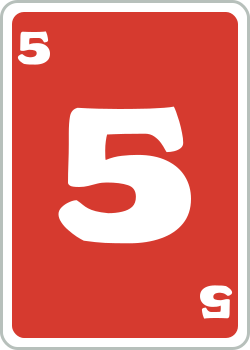
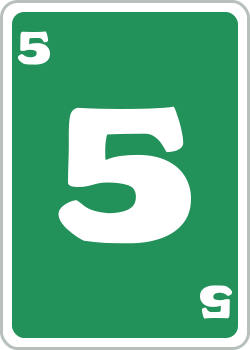
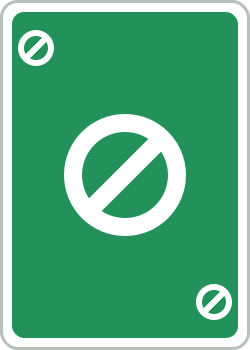
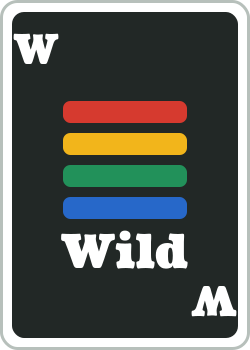
- The pieces pictured at the top of the page are our own example.
Spotted a mistake? Email contact@familygamerules.com and we'll check it against the sources.