Go Fish rules
Go Fish is a simple card game for 2 to 6 players that young children often play. You ask other players for cards to collect books. A book is all 4 cards of one kind, such as the four 7s. A player with none of the cards you ask for says “Go fish,” and you draw a card instead.
Also called Fish.
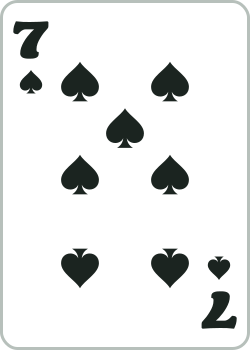
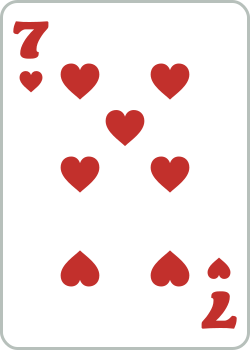
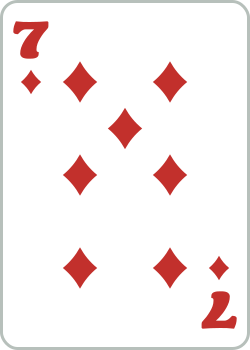
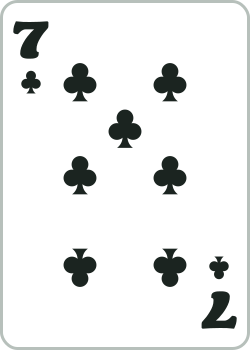
- Players
- 2 to 6. Best with 3 or more.
- You need
- A standard 52-card deck, without the jokers
- Deal
- 7 cards each with 2 or 3 players. 5 cards each with 4 or more. The rest go face down in the middle as the pool.
- Goal
- Collect the most books. A book is all 4 cards of one kind, such as the four 7s.
- Game ends
- When all 13 books have been laid down. The player with the most books wins.
- Playing time
- About 15 minutes
Quick start
- Deal 7 cards each with 2 or 3 players, or 5 cards each with 4 or more. Put the rest of the deck face down in the middle as the pool.
- The player on the dealer’s left goes first. On your turn, ask any one player for cards that match a card in your hand: “Do you have any 7s?”
- If that player has any 7s, they must give you all of them. You then take another turn and can ask anyone again.
- If they have none, they say “Go fish.” Draw the top card of the pool. If it is a 7, show it and take another turn. If not, your turn ends.
- When you hold all 4 cards of one kind, such as the four 7s, show them and lay them face up in front of you. That set is called a book.
- If you run out of cards, draw 1 from the pool on your turn and ask for its rank. Play until all 13 books are down. The most books wins.
Rule sheet and score sheet
Print the whole game on one page, and a score sheet made for Go Fish. Both are free PDFs for Letter paper.
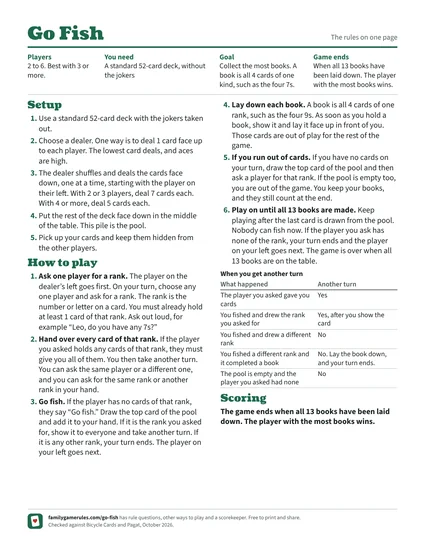
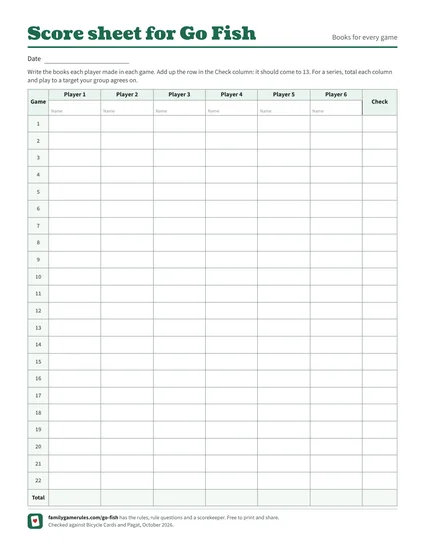
Setup
2 to 6 players, each playing alone. The game works with 2 and is at its best with 3 or more. A note on 2 players is further down.
You need: A standard 52-card deck with the jokers taken out.
| In the set | Count |
|---|---|
| Number cards, 2 through 10 | 36 |
| Jacks | 4 |
| Queens | 4 |
| Kings | 4 |
| Aces | 4 |
| Total | 52 |
- The deck has 13 kinds of card, ace through king, with 4 of each. The 4 cards of one kind make a book, so a game has 13 books.
- Suits do not matter in Go Fish. Only the number or letter on a card counts.
- Use a standard 52-card deck with the jokers taken out.
- Choose a dealer. One way is to deal 1 card face up to each player. The lowest card deals, and aces are high.
- The dealer shuffles and deals the cards face down, one at a time, starting with the player on their left. With 2 or 3 players, deal 7 cards each. With 4 or more, deal 5 cards each.
- Put the rest of the deck face down in the middle of the table. This pile is the pool.
- Pick up your cards and keep them hidden from the other players.
| Players | Each player gets | Notes |
|---|---|---|
| 2 | 7 cards | 38 cards go in the pool. |
| 3 | 7 cards | 31 cards go in the pool. |
| 4 | 5 cards | 32 cards go in the pool. |
| 5 | 5 cards | 27 cards go in the pool. |
| 6 | 5 cards | 22 cards go in the pool. |
Each hand with 2 or 3 players
7 cards
Each hand with 4 to 6 players
5 cards
The pool
All the leftover cards, face down
- If you are dealt all 4 cards of one kind, show them and lay them down as a book right away.
- Some rules deal 5 cards each to 3 players and keep the 7-card deal for 2 players only.
How to play
Turns pass to the left around the table. On your turn you ask one player for cards, and you keep asking for as long as you get what you asked for.
-
Ask one player for a rank
The player on the dealer’s left goes first. On your turn, choose any one player and ask for a rank. The rank is the number or letter on a card. You must already hold at least 1 card of that rank. Ask out loud, for example “Leo, do you have any 7s?”
- Suits do not matter. A 7 is a 7, whether it is a heart or a club.
- You cannot ask for a rank you do not hold. To ask for queens, you need at least 1 queen in your hand.
- The exact words are up to you. A question and a plain request both work, as long as you name one player and one rank.
-
Hand over every card of that rank
If the player you asked holds any cards of that rank, they must give you all of them. You then take another turn. You can ask the same player or a different one, and you can ask for the same rank or another rank in your hand.
- Nobody may hold cards back. A player with three 7s hands over all three.
- A turn has no fixed length. You keep going for as long as you get the rank you ask for.
- Some rules have you show each card you are handed, so the others can check it.
-
Go fish
If the player has no cards of that rank, they say “Go fish.” Draw the top card of the pool and add it to your hand. If it is the rank you asked for, show it to everyone and take another turn. If it is any other rank, your turn ends. The player on your left goes next.
- Taking a card from the pool after “Go fish” is called fishing.
- You draw only when you are told to go fish, or when it is your turn and you have no cards. A normal turn does not start with a draw.
- A drawn card of any other rank goes into your hand, and only a card of the rank you asked for has to be shown. From then on you may ask for the new card’s rank, because you now hold it.
-
Lay down each book
A book is all 4 cards of one rank, such as the four 9s. As soon as you hold a book, show it and lay it face up in front of you. Those cards are out of play for the rest of the game.
- Completing a book does not change whose turn it is. If the card that completed it was the rank you asked for, you go again as usual. If you fished a different rank and it completed a book, lay the book down and end your turn. Some groups give another turn for any book.
- Some players turn each book face down once everyone has seen it.
A book of 9s
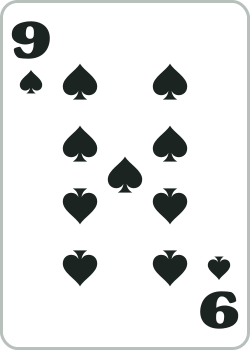
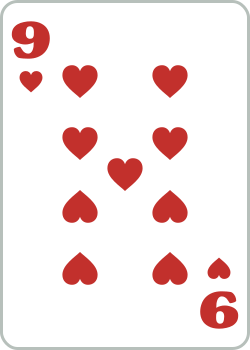
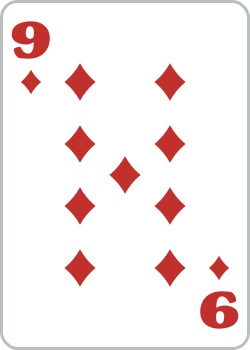
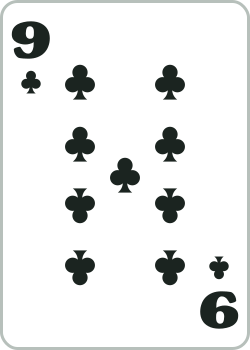
A book is all 4 cards of one rank. The suits do not matter. -
If you run out of cards
If you have no cards on your turn, draw the top card of the pool and then ask a player for that rank. If the pool is empty too, you are out of the game. You keep your books, and they still count at the end.
- You can run out by handing your last cards to another player, or by laying down a book.
- If you run out during another player’s turn, wait. You draw when your own turn comes.
- If your last cards go down as a book in the middle of your own turn and you get to go again, draw from the pool right away and ask for that rank.
- If you are asked for cards while you hold none, say “Go fish” as usual.
-
Play on until all 13 books are made
Keep playing after the last card is drawn from the pool. Nobody can fish now. If the player you ask has none of the rank, your turn ends and the player on your left goes next. The game is over when all 13 books are on the table.
- A player who has no cards once the pool is empty is out of the game and waits for the count.
| What happened | Another turn |
|---|---|
| The player you asked gave you cards | Yes |
| You fished and drew the rank you asked for | Yes, after you show the card |
| You fished and drew a different rank | No |
| You fished a different rank and it completed a book | No. Lay the book down, and your turn ends. |
| The pool is empty and the player you asked had none | No |
Example: a turn that carries on, then ends
Four people are playing, and it is your turn. You hold the 7 of hearts, the 7 of clubs, the queen of spades, the 4 of diamonds and the 9 of clubs. You ask, “Leo, do you have any 7s?” Leo has one, the 7 of spades, and hands it over. You got the rank you asked for, so you take another turn. Now you ask Maya for queens, which you may do because you hold a queen. Maya has none and says “Go fish.” You draw the top card of the pool, and it is the 2 of hearts. That is not a queen, so your turn ends and the player on your left goes next. A queen from the pool would have earned you another turn.
Your hand at the start
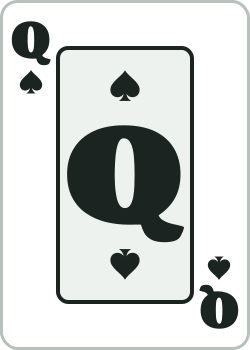
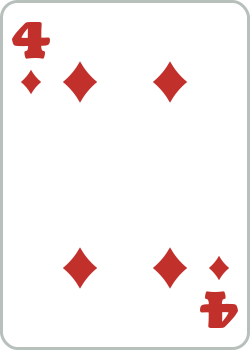
Leo hands over
You asked for 7s and got one, so you go again
You fish from the pool
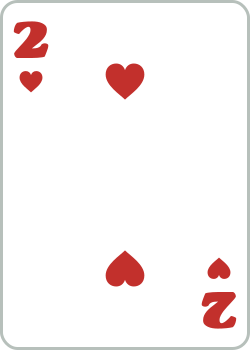
You asked for queens, so your turn ends
Your hand after the turn
Three 7s. The fourth would make a book.
Scoring
Scoring is a count of books. Each book counts as 1, whatever its rank.
| What you made | Points each | How many in a game |
|---|---|---|
| A book: all 4 cards of one rank | 1 | 13 |
- At the end, everyone’s books should add up to 13.
- A player who is out of the game still counts their books.
The game ends when all 13 books have been laid down. The player with the most books wins.
Nothing needs to be written down for one game. Your books sit face up in front of you, so the count is on the table. If you play several games to a target, write down 1 point for each book after every game.
A worked example: counting books with 3 players
Maya, Leo and Sam finish a game, and all 13 books are on the table. Each book counts as 1. Maya has 6 books, Leo has 4 and Sam has 3, so Maya wins. The counts add up to 13, which shows that no book was missed.
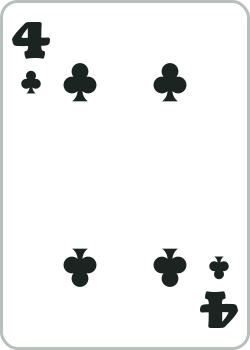
Book of 4s
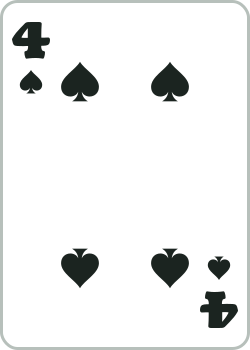
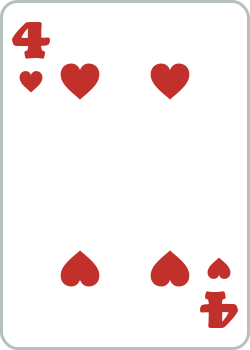
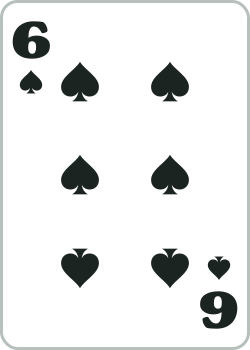
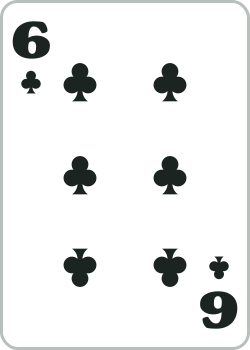
Book of 6s
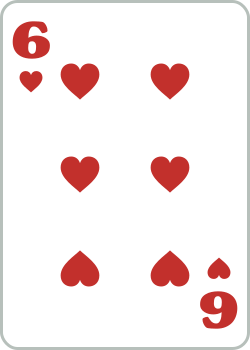
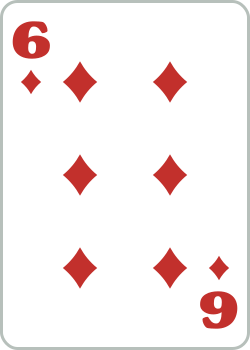
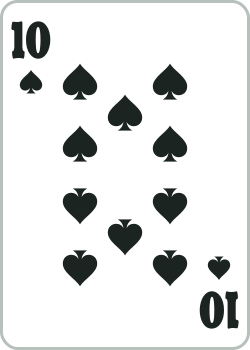
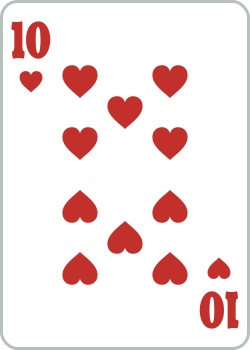
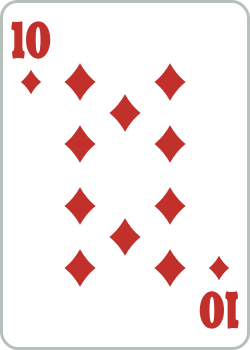
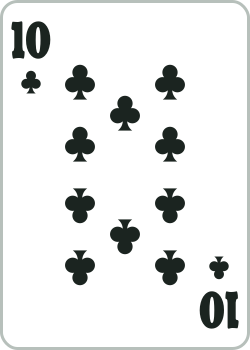
Book of 10s
| What happened | Goes to | Points |
|---|---|---|
| Maya’s books: 3s, 7s, 9s, jacks, kings and aces | Maya | 6 |
| Leo’s books: 2s, 5s, 8s and queens | Leo | 4 |
| Sam’s books: 4s, 6s and 10s | Sam | 3 |
| Maya | 6 | |
| Leo | 4 | |
| Sam | 3 |
Scorekeeper
One tally for each player. Add 1 for every book laid down. A game has 13 books, and the most books wins. It works in this browser, keeps the game if the page reloads, and needs no account.
Other ways to play
Go Fish for 2 players
Deal 7 cards each and put the other 38 face down as the pool. Every other rule stays the same. With only one other player, you always ask the same person. If they have the rank, you go again. If they say “Go fish” and the card you draw is a different rank, they take their turn. Play until all 13 books are down. A full game for 2 cannot end in a tie, because 13 books cannot be split evenly. The game works with 2 and is at its best with 3 or more.
House rules and other versions
- Pairs, an easier game for young children
- Collect pairs instead of books of 4. Any 2 cards of the same rank make a pair. Lay down the pairs you are dealt, and each new pair as soon as you make it. The other rules stay the same. Hands run out often. See the step on running out of cards. The deck makes 26 pairs, and the most pairs wins.
- Jokers in the pairs game
- Leave the 2 jokers in the deck. They match each other and make 1 more pair, which brings the count to 27. Ask for jokers the way you ask for any rank.
- 5 cards each with 3 players
- Some rules deal 5 cards each whenever 3 or more people play. Only a 2-player game gets 7 cards each.
- Stop when a hand or the pool runs out
- The game ends as soon as one player has no cards left, or as soon as the last card is drawn from the pool. The player with the most books at that moment wins.
- A new hand when you run out
- A player who runs out of cards takes 5 new cards from the pool and plays on. If the pool holds fewer than 5 cards, they take all of them.
- The turn goes to the player you asked
- After a failed fish, the next turn belongs to the player who said “Go fish.” It does not pass to the player on your left.
- Every draw ends your turn
- Your turn is over whenever you are told to go fish, even if the card you draw is the rank you asked for.
- Another turn for any book
- You take another turn whenever a card from the pool completes a book, even when it is not the rank you asked for.
- Ask for one exact card
- Ask for a single card, such as the jack of hearts, instead of a whole rank. You must hold at least 1 card of that rank. The asked player hands the card over if they have it. If you fish, you go again only when you draw that exact card. Agree first whether you may ask for a card you already hold.
- Spread-out pool
- Spread the leftover cards face down in a loose pile in the middle instead of stacking them. A player who fishes takes 1 card from the spread.
- No pool (Authors)
- Deal out the whole deck as evenly as you can, so there is no pool and nobody fishes. When the player you ask has none of the rank, your turn ends and the player on your left goes next. Play until every card is in a book. This game is known as Authors.
- Several games to a target
- Play more than one game and score 1 point for each book. The first player to reach a target you agree on, such as 10 points, wins.
- First to run out wins
- In another version, the winner is the first player to get rid of every card by laying down books.
Rule questions
How many cards do you get in Go Fish?
7 cards each with 2 or 3 players, and 5 cards each with 4 or more. The game uses a full 52-card deck, and the cards left after the deal go face down in the middle as the pool. Some rules give 5 cards each to 3 players and keep the 7-card deal for 2 players only.
Can you ask for a card you do not have?
No. You must hold at least 1 card of the rank you ask for. If you hold no 7s, you cannot ask for 7s. After you fish a card of a new rank, you may ask for that rank from then on.
Do you go again if you fish the card you asked for?
Yes. If the card you draw from the pool is the rank you asked for, show it to everyone and take another turn. A card of any other rank ends your turn, even when it is a card you wanted. Some groups play that every draw ends the turn.
Do you get another turn for making a book?
Yes, when the card that completed it was the rank you asked for. That covers every card a player hands you, and a card from the pool that matches your ask. If you fish a different rank and it completes a book, lay the book down and end your turn. Some groups give another turn for any book, so agree first.
What happens when you run out of cards?
You stay in the game while the pool lasts. When your turn comes, draw the top card of the pool and ask for that rank. If the pool is empty, you are out, and the books you made still count. Other rules end the whole game as soon as one player runs out, or give that player 5 new cards from the pool.
What happens when the pool runs out?
Play goes on until all 13 books are made. Nobody can fish, so your turn ends as soon as a player you ask has none of the rank. A player with no cards is out of the game. Some rules stop the game the moment the pool is empty and count the books then.
Can you say “Go fish” when you have the card?
No. If you hold the rank you are asked for, you must hand over every card of it. The rule sources we checked set no penalty for a wrong “Go fish.” Agree on a fix before you play, such as handing the cards over as soon as the mistake is found.
Who goes first in Go Fish?
The player on the dealer’s left. After that, turns pass to the left around the table.
How does Go Fish end, and how many books do you need to win?
The game ends when all 13 books have been laid down, and the player with the most books wins. There is no set number to reach. Once you have 7 books you cannot be beaten, because only 6 are left for everyone else.
What happens if there is a tie?
The rule sources we checked do not say. You can share the win or play one more game to settle it. With 2 players a full game cannot be tied, because 13 books cannot be split evenly. With 3 or more players it can, for example at 5 books, 5 books and 3 books.
Do you collect pairs or sets of 4 in Go Fish?
Sets of 4 in the standard game. All 4 cards of one rank make a book. Collecting pairs is an easier version that suits young children. Deal and play the same way, but any 2 cards of the same rank make a pair, and the player with the most pairs wins. Decide which game you are playing before the deal.
Can you play Go Fish with 2 players?
Yes. Deal 7 cards each and put the other 38 in the pool. The rules do not change, and you always ask the same player. The game is at its best with 3 or more players.
Words used in Go Fish
- Rank
- The number or letter on a card: ace, 2 through 10, jack, queen or king. Go Fish uses only the rank and ignores the suit.
- Suit
- Hearts, diamonds, clubs or spades. Suits make no difference in Go Fish.
- Book
- All 4 cards of one rank, such as the four 9s. A deck holds 13 books.
- Pool
- The face-down cards left over after the deal. You draw from it when you are told to go fish. Card players also call it the stock.
- Go fish
- What a player says when they hold none of the rank you asked for. It tells you to draw a card from the pool.
- Fishing
- Drawing a card from the pool after being told to go fish.
- Catch
- Getting a card of the rank you asked for. A catch gives you another turn.
- Hand
- The cards you are holding. Keep them hidden from the other players.
- Dealer
- The player who shuffles and hands out the cards. The player on the dealer’s left takes the first turn.
- Pair
- Any 2 cards of the same rank. The easier version of the game collects pairs instead of books.
What you need
- A standard deck of playing cardsOne 52-card deck is enough for 2 to 6 players.Find it on Amazon (A standard deck of playing cards, opens in a new tab)
- A Go Fish deck for childrenOptional. Picture cards made for young children. Read the rules in the box, because these decks may match pairs instead of sets of 4.Find it on Amazon (A Go Fish deck for children, opens in a new tab)
- A playing card holderOptional. It stands the cards up for a child who cannot yet fan 5 or 7 cards in one hand.Find it on Amazon (A playing card holder, opens in a new tab)
As an Amazon Associate, we earn from qualifying purchases. How the site is paid for.
Checked against
These rules are written in our own words from Bicycle Cards and checked against Pagat. Sources last checked on October 11, 2026.
- First source: Bicycle Cards, Go Fish. The deal for 2 to 5 players, choosing the dealer, asking, handing over cards, go fish, books laid face up, running out of cards and the ending when all 13 books are made.
- Second source: Pagat, Go Fish. Another turn for drawing the rank asked for, the best player counts, the 5-card deal for 6 players, play after the pool runs out and most of the variants.
Other sources we used (1)
- Wikipedia, Go Fish. A third opinion on the 7-card deal for 3 players, the usual asking words, the name Fish, and the variants with pairs, jokers, a spread-out pool, one card handed over and a turn that ends after any draw.
Where the sources differ (10)
| Topic | Bicycle Cards | Pagat | This page |
|---|---|---|---|
| Cards dealt to 3 players | 7 cards each with 2 or 3 players, and 5 each with 4 or 5. | 5 cards each, or 7 each when only 2 play. | Follows Bicycle, and Wikipedia gives the same deal. The 5-card deal for 3 players is listed as a variant and in the rule questions. |
| Number of players | Lists 2 or more players and gives deal sizes for 2 to 5. | Best for 3 to 6 players, and possible for 2. | 2 to 6 players, best with 3 or more. The 5-card deal for 6 players comes from Pagat. |
| Drawing the rank you asked for | Does not say outright. The turn passes when a player goes fishing without making a catch, which points to another turn after a catch from the stock. | The player shows the card and gets another turn. | Another turn, following Pagat. Wikipedia makes this a variation and ends the turn after any draw, which is listed as a variant. |
| Another turn for completing a book | A player who gets the fourth card of a book shows the book and plays again. It does not say whether this covers a book completed by a drawn card of a different rank. | Says only that a book must be shown and discarded face down. It does not link a book to another turn. The turn passes whenever the drawn card is not the rank asked for. | Another turn only for getting the rank asked for, which is how Pagat’s turn rule works out. Another turn for any book is listed as a variant and in the rule questions. |
| Where books go | Face up on the table in front of everyone. | Shown, then discarded face down. | Face up in front of the player, with a note that some players turn books face down. |
| A player who runs out of cards | On their turn they draw from the stock and ask for that rank. If the stock is empty, they are out of the game. | The game ends as soon as any player has no cards. A variation gives the player a new hand of 5 cards from the stock. | Follows Bicycle. Both Pagat rules are listed as variants. |
| How the game ends | When all 13 books have been won. | When someone has no cards left or the stock runs out. A variation plays on until every card is in a book. | All 13 books, as in Bicycle. Pagat’s main ending is listed as a variant. |
| A failed ask when the pool is empty | Not stated. | In the play-on variation, nobody says go fish once the stock is gone, and the turn passes. | Uses Pagat’s rule, because the page plays on until all 13 books are made. |
| Choosing the dealer and dealing | Each player is dealt 1 card face up, and the lowest card deals. Aces are high. The player on the dealer’s right cuts, and the cards are dealt one at a time. | Says only that the dealer deals. | Follows Bicycle, as one way to choose a dealer. The cut is left out. |
| Ties and a wrong “Go fish” | Not stated. | Not stated. | Says the sources are silent. Suggests sharing the win or playing again, and handing the cards over when a mistake is found. |
What on this page is our own
- The playing time of about 15 minutes is our estimate.
- The example turn and the 3-player book count are our own.
- The pool sizes after the deal, the 26 pairs in a deck and the 27 with jokers are our arithmetic. So are the points that 7 books cannot be beaten, that 2 players cannot tie over 13 books and that 3 players can tie at 5, 5 and 3.
- We call the leftover cards the pool. The sources call them the stock.
- Bicycle’s rule for a player with no cards is brief. Drawing exactly 1 card, drawing right away when it happens in the middle of your own turn, and keeping your books when you are out are our reading of it.
- No source covers ties or a wrong “Go fish.” The suggested fixes are ours.
- The notes under What you need describe products and are not rules.
- That completing a book does not by itself earn another turn is our reading of Pagat’s turn rule. Bicycle says a player who completes a book plays again, without saying whether that covers a book completed by a fished card of another rank.
- The pairs game follows Wikipedia’s one-line description, pairs in place of books. Laying down dealt pairs at once and keeping the other rules unchanged is our reading. Pagat describes a different pairs game, Australian Fish, with 7-card hands that are refilled from the stock.
- Bicycle says a player with no cards may draw from the stock. The page treats that draw as the normal thing to do.
- That the asking words are up to the players, and that a player with no cards answers “Go fish,” are our inferences.
- Calling the pairs game easier and a good fit for young children is our judgment.
- The pieces pictured at the top of the page are our own example.
Spotted a mistake? Email contact@familygamerules.com and we'll check it against the sources.