BS (Cheat) rules
BS is a bluffing card game for 2 to 10 players, also called Cheat and I Doubt It. You play cards face down and say what they are, and the cards do not have to match what you say. Anyone who doubts you can challenge. The first player to get rid of every card wins.
Also called Cheat, I Doubt It.
- Players
- 2 to 10. Many groups use two decks with 5 or more.
- You need
- A standard 52-card deck, without the jokers
- Deal
- All the cards, as far as they go. Some players may get 1 more card than others.
- Each turn
- Play 1 to 4 cards face down and call them as the next rank: aces, then 2s, up to kings, then aces again
- Goal
- Be the first to get rid of all your cards
- Game ends
- When a player’s last cards go down and are not shown to be a lie. That player wins.
- Playing time
- About 15 to 30 minutes
Quick start
- Deal out the whole deck. Some players may get 1 more card than others. The player on the dealer’s left goes first, and turns pass to the left.
- On your turn, put 1 to 4 cards face down on the pile and say what they are, such as “Two aces.” The first player calls aces, the next 2s, and so on.
- After kings, start again with aces. You must call the rank for your turn, but the cards you put down do not have to be that rank. You may lie.
- Before the next player puts down cards, any player can challenge by calling “Cheat” or “I doubt it.” Turn the cards just played face up.
- If any card is not the rank called, or the count is wrong, the player who played them takes the whole pile. If the call was true, the challenger takes it.
- Play goes on to the left with the next rank. The first player out of cards wins, unless their last play is challenged and shown to be a lie.
Rule sheet and score sheet
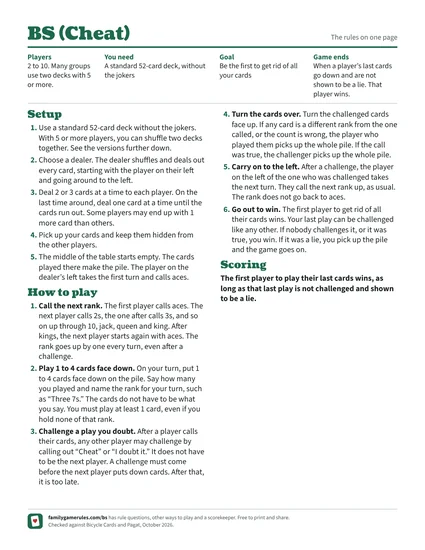
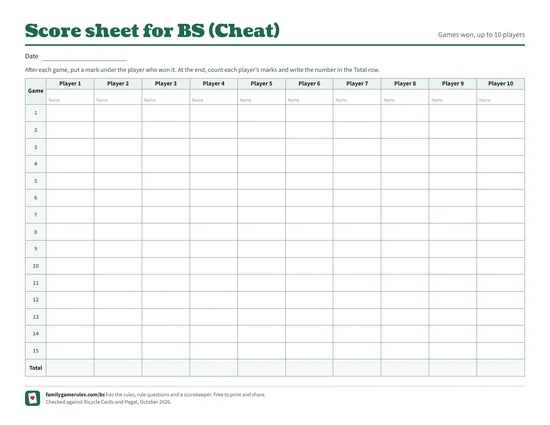
Print the whole game on one page, and a score sheet made for BS (Cheat). Both are free PDFs for Letter paper.
Setup
2 to 10 players, each playing alone. One deck is enough for any number. Many groups use two decks with 5 or more, as described further down.
You need: One standard 52-card deck with the jokers taken out.
| In the set | Count |
|---|---|
| Aces | 4 |
| Number cards, 2 through 10 | 36 |
| Jacks | 4 |
| Queens | 4 |
| Kings | 4 |
| Total | 52 |
- The deck has 13 ranks, ace through king, with 4 cards of each. Suits do not matter in this game.
- With two decks shuffled together there are 104 cards, and 8 of each rank.
- Use a standard 52-card deck without the jokers. With 5 or more players, you can shuffle two decks together. See the versions further down.
- Choose a dealer. The dealer shuffles and deals out every card, starting with the player on their left and going around to the left.
- Deal 2 or 3 cards at a time to each player. On the last time around, deal one card at a time until the cards run out. Some players may end up with 1 more card than others.
- Pick up your cards and keep them hidden from the other players.
- The middle of the table starts empty. The cards played there make the pile. The player on the dealer’s left takes the first turn and calls aces.
| Players | Each player gets | Notes |
|---|---|---|
| 2 | 26 cards | |
| 3 | 17 cards | 1 player gets 18. |
| 4 | 13 cards | |
| 5 | 10 cards | 2 players get 11. |
| 6 | 8 cards | 4 players get 9. |
| 7 | 7 cards | 3 players get 8. |
| 8 | 6 cards | 4 players get 7. |
| 9 | 5 cards | 7 players get 6. |
| 10 | 5 cards | 2 players get 6. |
Each player’s hand
13 cards, kept hidden
- Dealing one card at a time all the way around gives the same hand sizes as the method above.
- Some groups pick the first player at random instead. That player still calls aces, and turns go to the left.
How to play
Turns pass to the left. On each turn you put cards face down on the pile and say what they are. Anyone who thinks you are lying can challenge you.
-
Call the next rank
The first player calls aces. The next player calls 2s, the one after calls 3s, and so on up through 10, jack, queen and king. After kings, the next player starts again with aces. The rank goes up by one every turn, even after a challenge.
- Rank means the number or letter on a card. Suits do not matter.
- You must call the rank for your turn. You cannot choose a different one.
-
Play 1 to 4 cards face down
On your turn, put 1 to 4 cards face down on the pile. Say how many you played and name the rank for your turn, such as “Three 7s.” The cards do not have to be what you say. You must play at least 1 card, even if you hold none of that rank.
- A play that is not what you say is a bluff. You can play any cards at all and call them the rank for your turn.
- Telling the truth is allowed too. If you hold three 7s on the 7s turn, you can play them and say so.
- There is no passing in the main rules. A player with none of the rank has to bluff. Some groups allow a pass. See the house rules.
- Some groups set no limit on how many cards you may play. See the house rules.
-
Challenge a play you doubt
After a player calls their cards, any other player may challenge by calling out “Cheat” or “I doubt it.” It does not have to be the next player. A challenge must come before the next player puts down cards. After that, it is too late.
- Groups that call the game BS call out its name instead.
- Nobody has to challenge. If no one does, the cards stay face down on the pile and the next player takes their turn.
-
Turn the cards over
Turn the challenged cards face up. If any card is a different rank from the one called, or the count is wrong, the player who played them picks up the whole pile. If the call was true, the challenger picks up the whole pile.
- Picking up the pile means taking every card in the middle into your hand, including the cards just turned over.
- Only the cards from the last play are turned over. The rest of the pile is not shown.
- The middle of the table is now empty, and the next play starts a new pile.
-
Carry on to the left
After a challenge, the player on the left of the one who was challenged takes the next turn. They call the next rank up, as usual. The rank does not go back to aces.
-
Go out to win
The first player to get rid of all their cards wins. Your last play can be challenged like any other. If nobody challenges it, or it was true, you win. If it was a lie, you pick up the pile and the game goes on.
- The game ends when one player wins. The others do not play on for second place.
Example: a challenge that catches a bluff
Four people are playing. The player before Sam called 4s, so Sam must call 5s. Sam has only one 5. Sam puts down the 5 of hearts and the 9 of clubs and says “Two 5s.” Leo sits on Sam’s left. Before Leo can play, Maya calls “I doubt it.” The 2 cards are turned face up. The 9 is not a 5, so Sam picks up the whole pile, these 2 cards included. Leo plays next and calls 6s. If both cards had been 5s, Maya would have picked up the pile instead.
The pile before Sam’s turn
Earlier plays, face down
Sam plays and says “Two 5s”
Turned face up after the challenge
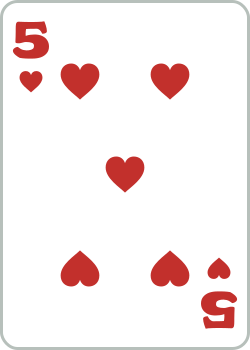
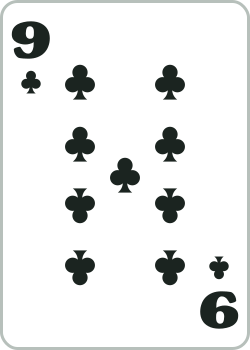
The 9 is not a 5. Sam takes the whole pile.
Scoring
BS has no points. You win by being the first player to get rid of every card.
The first player to play their last cards wins, as long as that last play is not challenged and shown to be a lie.
Nothing is written down during a game. To play a match, mark the winner of each game on the score sheet and count up the wins at the end.
Scorekeeper
BS has no points. This counts the games each player wins, so you can play a match. It works in this browser, keeps the game if the page reloads, and needs no account.
Other ways to play
Big groups: two decks
With 5 or more players, many groups shuffle two standard decks together for 104 cards. Deal them all out the same way. Every rank now has 8 cards, so a true play can hold more than 4 cards of one rank. Everything else stays the same. The rule sources we checked do not say whether the limit of 4 cards a turn changes with two decks. Agree on it before you start, or play with no limit.
House rules and other versions
- Any number of cards
- Play 1 or more cards on a turn, with no upper limit.
- One card a turn
- Every player puts down exactly 1 card on each turn.
- Count down instead of up
- The ranks go down instead of up: aces, then kings, queens, jacks, 10s and so on.
- One rank up or down
- Call either the rank one above or the rank one below the last call. After a call of 10s, the next player may call jacks or 9s.
- Same rank, up or down
- You may also call the same rank as the last player, as well as one above or one below. After 10s, the next player may call 9s, 10s or jacks.
- Same rank until a challenge
- Everyone keeps calling the same rank until someone challenges.
- Sneak in extra cards
- You may try to put down more cards than you call, such as 4 cards called as three 9s. A challenge catches it in the usual way, because the play does not match the call.
- Show every card after a challenge
- After a challenge, all the cards are turned face up for everyone to see, not only the ones just played.
- Passing allowed
- A player who does not want to lie may pass instead of playing. This is a common rule in Britain.
Rule questions
Is BS the same game as Cheat and I Doubt It?
Yes. It is one game with different names. It is usually called Cheat in Britain and BS in the United States, and many rule books call it I Doubt It. A different game is also sometimes called I Doubt It or Bluff. In that one, everyone plays the same rank.
How many cards can you put down at once?
1 to 4 cards on a turn. You must put down at least 1. Some groups set no upper limit.
What if you have none of the rank you have to call?
You still play. Put down at least 1 card and call it the rank for your turn. That is a bluff, and it is allowed. You cannot pass in the main rules, though some groups allow it.
Can any player challenge, or only the next one?
Any player can challenge, not only the next one. Call out “Cheat” or “I doubt it” before the next player puts down cards. Once they have, it is too late to challenge the play before.
Who picks up the pile after a challenge?
The loser of the challenge. If any card turned over is not the rank called, or the count is wrong, the player who played them takes the whole pile. If the call was true, the challenger takes it.
Who goes next after a challenge?
The player on the left of the one who was challenged, whoever won the challenge. They call the next rank up. The rank does not start again at aces.
Can you challenge someone’s last card?
Yes. A player’s last play can be challenged like any other. If it was true, or nobody challenges, that player wins. If it was a lie, they pick up the pile and the game goes on.
Can you lie about how many cards you put down?
Not safely. A wrong count makes the call false, the same as a wrong rank. If you are challenged, you pick up the pile. Some groups let players try to sneak in extra cards, with the same risk.
Do you need two decks?
No. One deck works for 2 to 10 players. Many groups shuffle two decks together when 5 or more play, so each rank has 8 cards.
What if two players challenge at the same time?
The rule sources we checked do not say. Agree before you start. A simple fix is that the first voice heard counts as the challenger.
Words used in BS (Cheat)
- Rank
- The number or letter on a card: ace, 2 through 10, jack, queen or king. Suits do not matter in this game.
- Pile
- The face-down cards played in the middle of the table since the last challenge.
- Call
- What you say when you play, such as “Three 7s”: how many cards and the rank for your turn.
- Bluff
- A play where the cards are not what you called.
- Challenge
- Calling out “Cheat” or “I doubt it” to have the last play turned face up. The loser of the challenge picks up the pile.
- Going out
- Getting rid of your last card. The first player to go out wins, unless their last play is caught as a bluff.
What you need
- A standard deck of playing cardsOne 52-card deck is enough for 2 to 10 players.Find it on Amazon (A standard deck of playing cards, opens in a new tab)
- A second deckOptional, for 5 or more players. Decks are often sold two to a box.Find it on Amazon (A second deck, opens in a new tab)
As an Amazon Associate, we earn from qualifying purchases. How the site is paid for.
Checked against
These rules are written in our own words from Bicycle Cards and checked against Pagat. Sources last checked on October 12, 2026.
- First source: Bicycle Cards, I Doubt It. One 52-card deck, dealing the whole deck from the dealer’s left, the first turn on the dealer’s left, ranks from aces up to kings and back to aces, 1 to 4 cards a turn, calling the count and rank, lying allowed, any player may challenge, who picks up the cards, and winning on a last play that is true or not challenged.
- Second source: Pagat, Cheat / I Doubt It. 2 to 10 players, the names by region, uneven hands, no passing, who picks up the pile, who plays after a challenge, a caught last play, two or more decks for many players, and the variants on ranks and extra cards.
Other sources we used (1)
- Wikipedia, Cheat (game). Two decks with 5 or more players, the time limit on a challenge, the call of the count, and the variants with one card a turn, the same rank until a challenge, wrong counts, showing every card and passing.
Where the sources differ (12)
| Topic | Bicycle Cards | Pagat | This page |
|---|---|---|---|
| Names and the challenge call | Calls the game I Doubt It. The challenge is “I doubt it.” | Cheat in Britain, the full name behind BS in the United States, and I Doubt It in many books. The challenge is the game’s name or “I doubt it.” | Titled BS (Cheat). The challenge is “Cheat” or “I doubt it,” or the game’s name. |
| Number of players | 2, 3, 4 or 5 and more. | 2 to 10. | 2 to 10, from Pagat. Wikipedia gives 3 to 10. |
| Two decks | One 52-card pack. Two decks are not mentioned. | One pack. A variation uses two or more packs with a lot of players, without a number. | One deck as the main rule. Two decks with 5 or more is a version, with the count of 5 from Wikipedia, which combines two packs from 5 players up. |
| Dealing | 2 or 3 cards at a time from the dealer’s left, then one at a time on the last round as far as they go. | All the cards are dealt, and some players may have a few more than others. The method is not given. | Follows Bicycle, with a note that one at a time all the way gives the same counts. |
| First player | The player on the dealer’s left. | Chosen at random, then play goes clockwise. | The dealer’s left, which Wikipedia also gives. Choosing at random is in the setup notes. |
| Cards a turn | 1 to 4. | 1 or more, with no upper limit. Wikipedia agrees. | 1 to 4, following Bicycle. No limit is a house rule and in the rule questions. |
| What you say | The number of cards and the rank. | The main rules say to call the rank. The examples in the variations include the count, such as “two tens.” | The number and the rank, following Bicycle and Wikipedia. |
| What makes a call false | A call wrong in any respect, which covers the count as well as the rank. | Any card that differs from the rank called. A variation says a play with more cards than called is also caught. | A wrong rank or a wrong count, following Bicycle. |
| When a challenge must be made | The next player plays once the call has been doubted or not, which points to a challenge before the next play. It is not stated outright. | Not stated. | Before the next player puts down cards, as Wikipedia says outright. |
| Who plays after a challenge | Once the call has been doubted or not, the player on the left of the one who just played goes next with the next rank. | The player on the left of the challenged player, calling the next rank. | The same rule in both. Stated plainly in the play steps and the rule questions. |
| A false last play | A player wins on their last card if not doubted, or doubted and shown to be right. A false last play is not covered. | The winner must survive any challenge to the last play. A player caught picks up the pile and play continues. | Follows Pagat, which agrees with Bicycle and covers the missing case. |
| Variants | None. | More packs, ranks going down, one rank up or down, the same rank allowed, and playing more cards than called. A Chinese version with no rank order. | Pagat’s extra packs are the two-deck version. Its other variants are listed, except the Chinese version, and so is its main rule of any number of cards. Four more come from Wikipedia. |
What on this page is our own
- The playing time of about 15 to 30 minutes is our estimate.
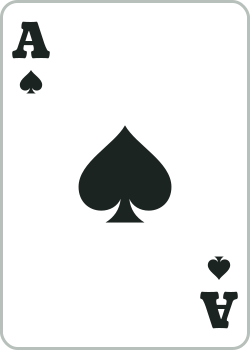
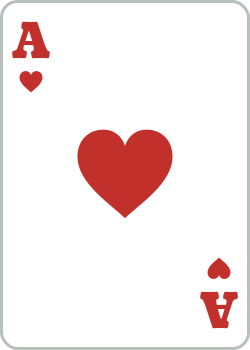
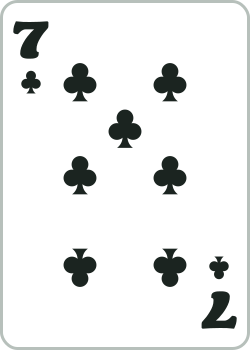
- The challenge example and the pieces pictured at the top of the page are our own.
- The deal sizes for each number of players, the 104 cards and 8 of each rank in two decks, and the note that one-at-a-time dealing gives the same counts are our arithmetic.
- No source says how to choose the dealer. The page leaves it to the players.
- The advice to agree on the 4-card limit when playing with two decks is ours. No source ties the limit to the number of decks.
- That the middle is empty after a challenge, and that only the challenged cards are turned over, are our reading of both main sources, which have the whole pile picked up and the last play turned face up.
- That the game ends when one player wins, with no play for second place, is our reading. Bicycle and Wikipedia end the game when one player goes out. Pagat names the first player out as the winner and does not say whether the others play on.
- No source covers two players challenging at once. The suggested fix is ours.
- That the challenge call can be the game’s name follows Pagat. The page does not spell out what BS stands for.
- The notes under What you need describe products and are not rules. The score sheet and scorekeeper are our own design.
Spotted a mistake? Email contact@familygamerules.com and we'll check it against the sources.