Sorry rules
Sorry is a race board game for 2 to 4 players. Each player tries to move 4 pawns out of Start, around the board and into Home. Cards, not dice, say how far you move. Landing on another player’s pawn sends it back to its Start, and a Sorry card lets you do that on purpose.
- Players
- 2 to 4
- Ages
- 6 and up
- You need
- A Sorry board, 4 pawns in each of 4 colors and the deck of 45 Sorry cards
- Each turn
- Draw the top card and move one of your pawns as it says. If no pawn can use it, your turn is over.
- Goal
- Move all 4 of your pawns from your Start, around the board and into your Home
- Game ends
- When one player has all 4 pawns in Home. That player wins.
- Playing time
- About 30 to 60 minutes
SORRY! is a registered trademark of Hasbro, Inc. This site is not affiliated with or endorsed by Hasbro.
Quick start
- Each player puts the 4 pawns of one color in that color’s Start. Shuffle the cards and put them face down in the middle of the board.
- On your turn, draw the top card and move one of your pawns as it says. Play passes to the left. A 2 also lets you draw again.
- A pawn leaves Start only on a 1, a 2 or a Sorry card. Most cards move a pawn forward. A 4 moves it backward, and a 10 can move it back 1.
- End your move on an opponent’s pawn and it goes back to its Start. You may not land on your own pawn. Stop on the start of another color’s slide and ride it.
- Only your own pawns may enter your Safety Zone, the 5 squares before your Home. A pawn never moves forward past its entrance without going in, and needs the exact count to reach Home.
- If no pawn can use your card, your turn is over. Otherwise you must use it, even when it hurts, though an 11 never forces a switch. First to get all 4 pawns Home wins.
Rule sheet and score sheet
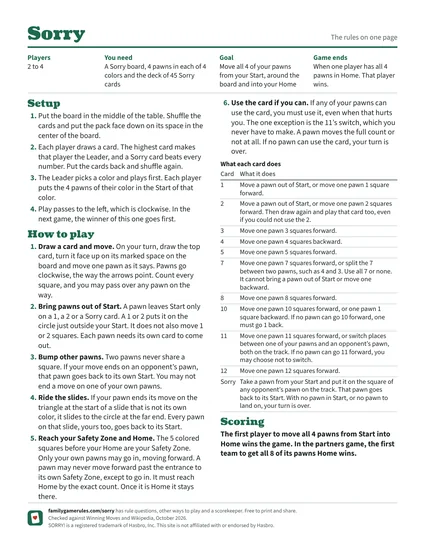
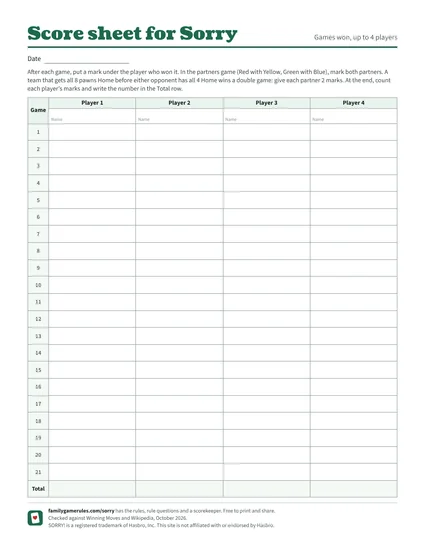
Print the whole game on one page, and a score sheet made for Sorry. Both are free PDFs for Letter paper.
Setup
2 to 4 players, each playing alone. A partners game for 4 and a puzzle for 1 player are further down.
You need: A Sorry board, 16 pawns in 4 colors, and a deck of 45 cards.
| In the set | Count |
|---|---|
| 1 cards | 5 |
| 2 cards | 4 |
| 3 cards | 4 |
| 4 cards | 4 |
| 5 cards | 4 |
| 7 cards | 4 |
| 8 cards | 4 |
| 10 cards | 4 |
| 11 cards | 4 |
| 12 cards | 4 |
| Sorry cards | 4 |
| Total | 45 |
- There are no 6 or 9 cards.
- The original deck had 44 cards, 4 of each kind. A fifth 1 card was added later to make the game quicker. The rules work the same with either deck.
- The board has 60 squares around its edge, called the track. There are 2 slides on each side, 8 in all. Each color has a Start, a Safety Zone of 5 colored squares, and a Home at the end of it.
- Each player uses the 4 pawns of one color: red, blue, yellow or green. Boxes of the 2013 edition hold 12 pawns, 3 of each color.
- Put the board in the middle of the table. Shuffle the cards and put the pack face down on its space in the center of the board.
- Each player draws a card. The highest card makes that player the Leader, and a Sorry card beats every number. Put the cards back and shuffle again.
- The Leader picks a color and plays first. Each player puts the 4 pawns of their color in the Start of that color.
- Play passes to the left, which is clockwise. In the next game, the winner of this one goes first.
Red’s Start

Blue’s Start

Yellow’s Start

Green’s Start

The pack
Face down in the center
- Putting the cards drawn for the Leader back in the pack is our suggestion. The rules we checked do not say what to do with them.
How to play
Players take turns, going clockwise. Each turn you draw one card and use it to move one pawn, or two with a 7. The table after the steps says what every card does.
-
Draw a card and move
On your turn, draw the top card, turn it face up on its marked space on the board and move one pawn as it says. Pawns go clockwise, the way the arrows point. Count every square, and you may pass over any pawn on the way.
- When more than one of your pawns could make the move, you choose which one.
- Squares with pawns on them count the same as empty ones.
- When the pack runs out, shuffle the used cards and put them face down as a new pack.
-
Bring pawns out of Start
A pawn leaves Start only on a 1, a 2 or a Sorry card. A 1 or 2 puts it on the circle just outside your Start. It does not also move 1 or 2 squares. Each pawn needs its own card to come out.
- With a 1 or a 2 you may move a pawn already on the board instead.
- After a 2 brings a pawn out, the extra card you draw may move any of your pawns, the new one too.
- A Sorry card does not use the circle. The pawn goes straight from Start to the square of an opponent’s pawn. See the card table.
- No other card brings a pawn out. Early in the game you may draw several cards that you cannot use.
- If one of your own pawns is still on the circle, you cannot bring out another until it moves, because you may not land on your own pawn.
- If an opponent’s pawn sits on that circle, the pawn you bring out bumps it back to its Start.
-
Bump other pawns
Two pawns never share a square. If your move ends on an opponent’s pawn, that pawn goes back to its own Start. You may not end a move on one of your own pawns.
- Only the square where a move ends matters. Passing over a pawn does nothing to it.
- Sending a pawn back this way is called bumping. The Sorry card and the 11 can also bump.
- You can never be made to bump your own pawn. The one way your own pawn goes back to Start is on a slide.
-
Ride the slides
If your pawn ends its move on the triangle at the start of a slide that is not its own color, it slides to the circle at the far end. Every pawn on that slide, yours too, goes back to its Start.
- A pawn never slides on a slide of its own color. It stays on the triangle.
- It makes no difference how the pawn got to the triangle. A pawn moved there by a switch with an 11, or put there with a Sorry card, slides too.
- A pawn that passes over the triangle, or stops on a square partway along a slide, does not slide.
- Slides are 4 or 5 squares long.
-
Reach your Safety Zone and Home
The 5 colored squares before your Home are your Safety Zone. Only your own pawns may go in, moving forward. A pawn may never move forward past the entrance to its own Safety Zone, except to go in. It must reach Home by the exact count. Once it is Home it stays there.
- An opponent’s 11 may still switch your pawn onto a square past your entrance. That pawn then goes around the board again before it can go in.
- A card that would carry a pawn past Home cannot be used for that pawn.
- Other players cannot bump a pawn in your Safety Zone, since their pawns cannot go in. The Sorry card and the 11 cannot touch it either.
- A 4 or a 10 can move a pawn backward out of the Safety Zone, and sometimes you must. Back on the track, it can be bumped like any other pawn.
- A pawn cannot go into the Safety Zone backward. It enters only by moving forward.
-
Use the card if you can
If any of your pawns can use the card, you must use it, even when that hurts you. The one exception is the 11’s switch, which you never have to make. A pawn moves the full count or not at all. If no pawn can use the card, your turn is over.
- If your only pawn out of Start is in your Safety Zone and you draw a 4, it must go back 4 squares.
- With a 10, if no pawn can go forward 10, one of them must go back 1, even out of the Safety Zone.
- With an 11, if no pawn can go forward 11 and you choose not to switch, your turn is over.
- A 2 gives you another draw even when you cannot use it.
- Losing a turn this way is called forfeiting.
| Card | What it does |
|---|---|
| 1 | Move a pawn out of Start, or move one pawn 1 square forward. |
| 2 | Move a pawn out of Start, or move one pawn 2 squares forward. Then draw again and play that card too, even if you could not use the 2. |
| 3 | Move one pawn 3 squares forward. |
| 4 | Move one pawn 4 squares backward. |
| 5 | Move one pawn 5 squares forward. |
| 7 | Move one pawn 7 squares forward, or split the 7 between two pawns, such as 4 and 3. Use all 7 or none. It cannot bring a pawn out of Start or move one backward. |
| 8 | Move one pawn 8 squares forward. |
| 10 | Move one pawn 10 squares forward, or one pawn 1 square backward. If no pawn can go 10 forward, one must go 1 back. |
| 11 | Move one pawn 11 squares forward, or switch places between one of your pawns and an opponent’s pawn, both on the track. If no pawn can go 11 forward, you may choose not to switch. |
| 12 | Move one pawn 12 squares forward. |
| Sorry | Take a pawn from your Start and put it on the square of any opponent’s pawn on the track. That pawn goes back to its Start. With no pawn in Start, or no pawn to land on, your turn is over. |
Example: splitting a 7 between two pawns
You play red. One red pawn is in your Safety Zone, 3 squares from Home. Another is on the track, 4 squares behind a blue pawn, and that square is not the start of a slide. You draw a 7. The first pawn cannot take all 7, because that would carry it past Home. You could move the track pawn all 7, but you choose to split the card. The first pawn moves 3 squares and goes Home by the exact count. The other pawn moves the remaining 4, lands on the blue pawn and bumps it back to Blue’s Start. The two moves add up to 7.
You draw
Red pawn in your Safety Zone, 3 squares from Home
Moves 3 and goes Home
Red pawn on the track, 4 squares behind a blue pawn
Red moves 4 and lands on blue
Blue’s Start
The bumped pawn goes back here
Scoring
The regular game has no points. The first player to get all 4 pawns Home wins. The 1939 rules also give a scoring game, Point Scoring Sorry. How to play it is under Other ways to play, and its points are listed here.
- Point Scoring Sorry: when a player gets all 4 pawns Home, the game ends and everyone scores 1 point for each of their pawns in Home.
- The winner scores 4 for their own pawns, plus 1 point for each opponent pawn in Home.
- The winner also gets one bonus: 24 points if no opponent has a pawn Home, 16 if no opponent has more than 1 Home, or 8 if no opponent has more than 2 Home. Give the largest one that fits.
- In a doubled game the final score is doubled. If every other player drops out when someone doubles, the game ends there and the player who doubled wins 5 points.
- The rule sources we checked give no target score for Point Scoring Sorry. Agree before you start on a number of games or a total to play to.
The first player to move all 4 pawns from Start into Home wins the game. In the partners game, the first team to get all 8 of its pawns Home wins.
Nothing is written down in the regular game. To play a match, mark the winner of each game on the score sheet and count the wins at the end. For Point Scoring Sorry, write down each player’s points after every game.
A worked example: one game of Point Scoring Sorry
Four people play Point Scoring Sorry. Ana gets her fourth pawn Home first, so she wins. At that moment Ben has 1 pawn Home, Cal has 2 and Dee has none. Cal has 2 pawns Home, so the 24 and 16 bonuses do not fit. No opponent has more than 2, so Ana gets the 8-point bonus.
| What happened | Goes to | Points |
|---|---|---|
| Ana: her 4 pawns in Home | Ana | 4 |
| Ana: 1 for each opponent pawn in Home (1 + 2 + 0) | Ana | 3 |
| Ana: bonus, no opponent has more than 2 pawns Home | Ana | 8 |
| Ben: 1 pawn in Home | Ben | 1 |
| Cal: 2 pawns in Home | Cal | 2 |
| Dee: no pawns in Home | Dee | 0 |
| Ana | 15 | |
| Ben | 1 | |
| Cal | 2 | |
| Dee | 0 |
Scorekeeper
Sorry has no points in the regular game. This counts the games each player wins, so you can play a match. For the partners game, enter each partnership as one player, such as Red and Yellow. A double game counts as 2 wins, so enter it twice. It works in this browser, keeps the game if the page reloads, and needs no account.
Other ways to play
Sorry with partners
Play in 2 teams. Red and Yellow are partners, and so are Green and Blue, sitting on opposite sides of the board. Use each card for a pawn of either color. You forfeit only if neither color can use it. A Sorry card must be used, even if it bumps your partner. If the only move for either color lands on your partner’s pawn, make it, and that pawn goes back to Start. A 7 may be split between any two pawns of the team. The extra draw from a 2 may be used for either color. With all 4 of your pawns Home, keep drawing for your partner. The first team with all 8 pawns Home wins. Doing it before either opponent has all 4 Home counts as 2 wins. Everything else follows the regular rules.
Point Scoring Sorry
A scoring game from the 1939 rules. Each player starts with 1 pawn already on the circle outside their Start. Deal 5 cards to each player and put the rest face down as the pack. On your turn, play 1 card from your hand, move as it says, then draw 1 card, so you always hold 5. If no card in your hand can be used, discard 1 and draw 1, and your turn ends. Play passes to the left. The first player with all 4 pawns Home by the exact count wins, and everyone scores. The points are under Scoring. Any player may call double, or redouble, at any time. Each other player then accepts or drops out.
Patience Sorry, for 1 player
A puzzle for one player from the 1939 rules. You move 4 red pawns and 4 yellow pawns, drawing a card for red, then one for yellow, and so on. Every move follows the regular rules. The goal is to reach the moment when 2 pawns of each color are Home and the other 2 of each color are in their Safety Zone. You fail if a third pawn of one color reaches Home before the fourth pawn of the other color is in its Safety Zone.
House rules and other versions
- Faster game with 3 pawns
- Each player uses 3 pawns instead of 4. Everything else stays the same, and the game is much shorter. A win then means getting all 3 pawns Home.
- Other decks
- The original deck has 44 cards, 4 of each kind. The modern deck has 45, with a fifth 1 card added to make the game quicker. A 1996 Waddingtons edition had 5 of every card. Play the same way with any of them.
- The 2013 edition: card changes
- Boxes made since 2013 give each player 3 pawns and change some rules. A pawn can leave Start on any number card that moves it forward. The 2 gives no extra draw. A Sorry card can instead move one of your pawns 4 squares forward. The slides are colored differently, so a pawn may ride a slide of its own color.
- The 2013 edition: Fire and Ice
- The same edition adds Fire and Ice. Depending on the card drawn, they are placed on pawns and change the rules for those pawns. Fire lets a pawn move ahead quickly, before its player’s turn. Ice stops a pawn from being moved or removed from play at all. A 1 may also move the ice and a 2 the fire.
- Older boards with a diamond
- Some older boards have a colored diamond just behind where each color’s pawns come out of Start. A pawn of that color may not move forward over it and turns toward its own Home instead. Later editions dropped the diamond and its rule. This page follows the 1939 rules, which set a similar limit at the Safety Zone entrance without naming a diamond.
Rule questions
How many cards are in a Sorry deck?
45 in the modern deck: five 1 cards and 4 each of the 2, 3, 4, 5, 7, 8, 10, 11, 12 and Sorry cards. There are no 6s or 9s. The original deck had 44 cards, with only four 1s.
Which cards get a pawn out of Start?
A 1, a 2 or a Sorry card. A 1 or 2 puts the pawn on the circle just outside your Start, and it does not also move 1 or 2 squares. A Sorry card puts it on the square of an opponent’s pawn instead. A 7 or an 11 can never bring a pawn out. After a 2, the extra card you draw may move any of your pawns, the new one too.
How does the 7 card work in Sorry?
Move one pawn 7 squares forward, or split the 7 between two of your pawns, such as 5 and 2. You must use all 7. Each part can bump a pawn or set off a slide, and both pawns can go Home on the same card. A 7 cannot bring a pawn out of Start or move one backward.
What does the 11 card do, and do you have to switch?
Move one pawn 11 squares forward, or switch places between one of your pawns and an opponent’s pawn, both on the track. You choose which. If no pawn can go 11 forward, you do not have to switch, and your turn is over. Pawns in Start, in a Safety Zone or in Home cannot be switched. Your own switch may not move your pawn forward past its Safety Zone entrance, though an opponent’s switch may.
Do you get to draw again after a 2?
Yes. Make your 2 move first, then draw again and play the new card. You get the extra draw even when the 2 itself could not be used. In the 2013 edition the 2 gives no extra draw.
Can you slide on your own color?
No. A pawn that stops on the triangle of a slide in its own color stays there. Only slides of other colors carry it to the far end. In the 2013 edition the slides are colored differently, and a pawn may ride a slide of its own color.
Can you land on your own pawn in Sorry?
No. You may pass over it, but you may not end a move on it. If that is the only move the card allows, you lose the turn. The one way your own pawn can go back to Start is when it is on a slide another of your pawns rides down.
Do you need an exact count to get Home?
Yes. A pawn must land exactly in Home. A card that would carry it past Home cannot be used for that pawn. If no other pawn can use the card, your turn is over. A split 7 can help, because part of it can take a pawn Home and the rest moves another pawn.
Can a pawn be moved backward out of the Safety Zone?
Yes, by a 4 or a 10. If your only pawn out of Start is in the Safety Zone and you draw a 4, it must go back 4 squares. A 10 that no pawn can use going forward must move a pawn back 1, even out of the Safety Zone. Back on the track, it can be bumped. It still may not move forward past its Safety Zone entrance, except to go back in.
Why would you move backward on purpose?
To take a shortcut. The entrance to your Safety Zone is a few squares behind your Start. A pawn on the circle outside your Start that goes back 4 is close to its Safety Zone, and a later forward move can take it in without a trip around the board. A pawn can enter the Safety Zone only by moving forward.
What happens if you draw a Sorry card and have no pawn in Start?
Your turn is over. The Sorry card needs a pawn in your Start and an opponent’s pawn on the track to land on. Pawns in a Safety Zone or in Home cannot be bumped by it. If you can use it, you must, even in the partners game when the only target is your partner’s pawn.
What happens if you cannot move in Sorry?
You forfeit the move, and your turn is over. That happens when no pawn can use the card: every pawn is in Start and the card cannot bring one out, or every possible move would overshoot Home or land on your own pawn. If a move is possible, you must make it, except the 11’s switch.
Words used in Sorry
- Pawn
- One of your playing pieces. Each player has 4 in one color. Older rules call them men.
- Start
- The space of your color where your pawns wait at the beginning, and where bumped pawns go back to.
- Track
- The 60 squares around the edge of the board. Pawns in Start, in a Safety Zone or in Home are not on the track.
- Slide
- A colored strip of 4 or 5 squares on the track. A pawn that stops on the triangle at its start rides to the end, unless the slide is its own color.
- Safety Zone
- The 5 squares of your color leading to your Home. Only your pawns may enter it, and a pawn never moves forward past its entrance without going in.
- Home
- The space at the end of your Safety Zone. A pawn needs the exact count to get there, and then it is out of play.
- Bump
- To send an opponent’s pawn back to its Start by ending your move on its square.
- Split
- Sharing the 7 squares of a 7 card between two of your pawns.
- Switch
- Trading the places of one of your pawns and an opponent’s pawn with an 11 card.
- Forfeit
- To lose your move because no pawn can use the card you drew.
- Leader
- The player who drew the highest card before the game. The Leader picks a color first and plays first.
What you need
- A Sorry board gameCheck the pawns. Older boxes and classic reissues have 4 of each color. Boxes from the 2013 edition have 3 of each color, which suits the 3-pawn game.Find it on Amazon (A Sorry board game, opens in a new tab)
- Paper and a pencilOnly needed for Point Scoring Sorry, or to count wins over a match. Our printable score sheet and scorekeeper count wins only, so write Point Scoring Sorry points on paper.Find it on Amazon (Paper and a pencil, opens in a new tab)
As an Amazon Associate, we earn from qualifying purchases. How the site is paid for.
Checked against
These rules are written in our own words from Winning Moves and checked against Wikipedia. Sources last checked on October 12, 2026.
- First source: Winning Moves, The Rules of Sorry! (1939 United States version), classic edition instruction sheet made by Winning Moves under license, item 1171, copyright 2012 Hasbro, copy kept by the Buffalo and Erie County Public Library. The 44-card pack, choosing the Leader, play to the left, starting a pawn out, the 5-square Safety Zone, the 60 track squares, rules A to I (no shared squares, bumping, no landing on your own pawn, passing over, exact count, entering the Safety Zone and never moving forward past its entrance), the slide rule, the card rules for 1, 2, 3, 4, 5, 7, 8, 10, 11 and 12, the faster 3-pawn game, partners, Point Scoring Sorry with doubling, and Patience Sorry.
- Second source: Wikipedia, Sorry! (game). Checks every card and rule against the first source. Adds the Sorry card’s effect, the 45-card modern deck with five 1s, 2 to 4 players, ages 6 and up, the 8 slides of 4 or 5 squares, the extra draw from a 2 that cannot be used, the 11 and Sorry card not reaching a Safety Zone, partners sitting opposite, the 1996 Waddingtons deck, the 2013 edition’s rule changes and Fire and Ice, and the older boards’ diamond.
Other sources we used (1)
- Hasbro, Sorry! product page, product A5065 (current edition with Fire and Ice). Ages 6 and up, 2 to 4 players, the current box’s 12 pawns and 45 cards, and 3 pawns for each player to get Home. The rule sheet PDF linked from this page could not be read..
Where the sources differ (13)
| Topic | Winning Moves | Wikipedia | This page |
|---|---|---|---|
| Deck size | 44 cards: four each of 1, 2, 3, 4, 5, 7, 8, 10, 11, 12 and Sorry. | The first edition had 44. The modern deck has 45, with a fifth 1 added as an option for quicker play. A 1996 Waddingtons board had five of each card. | 45 in the deck list, as on Hasbro’s current product page, with the 44-card deck named in the equipment notes, a variant and a rule question. |
| Number of players | Not stated. The partners game implies 4. | Marketed for 2 to 4. | 2 to 4. Hasbro’s product page says the same. |
| Who goes first | Each player draws a card. The highest is the Leader, with the Sorry card highest. The Leader picks a color and plays first. The winner of a game leads the next. | One player is selected to play first, with no method given. | Follows the first source. |
| The extra draw when a 2 cannot be used | The 2 move is made before the extra draw. Silent on a 2 that cannot be used. | The extra draw comes even when the 2 does not allow a move. | Follows Wikipedia. |
| The 4 card | Its text names the 4 as a backward move only when a pawn in the Safety Zone is the only one in play, and in the Rule G example of a pawn going back 4 from its starting circle. | Move a pawn four spaces backward. | The 4 always moves a pawn 4 backward, with the Safety Zone case as a must-move example. |
| The 10 card | A player unable, or not wishing, to move 10 forward must move a pawn back 1, even in the Safety Zone. | 10 forward or 1 back. If no pawn can go 10 forward, one must go back 1. | Combines both. You choose, and must go back 1 when no pawn can go 10 forward. |
| The 11 card | The move is forfeited only if no pawn can go 11 forward and the player does not wish to change places with an opponent’s pawn on the track. | 11 forward or switch with an opponent. No switching a pawn in a Safety Zone. A player who cannot go 11 forward may decline the switch. | Forward 11 or switch, your choice. The switch may be declined when 11 forward is impossible. |
| The Sorry card | Counts highest when drawing for Leader and brings a pawn out of Start. The sheet’s text does not describe the bump. | Take a pawn from Start onto any opponent’s pawn, which goes back to its Start. Not onto a pawn in a Safety Zone or Home. With no pawn in Start or no target, the turn ends. | Follows Wikipedia for the card’s effect. |
| Partners | Red with Yellow and Green with Blue, with seven special rules and the double game. | Partners sit on opposite sides, can bump each other and play for each other. | Uses both. The double game is from the first source only. |
| Point Scoring Sorry bonuses | Lists the 24, 16 and 8 point bonuses without saying whether more than one can apply. | The winner gets a bonus of 24, 16 or 8. | One bonus, the largest that fits. Marked as our reading in the editorial notes. |
| Faster game and doubling | Gives the 3-pawn faster game and the doubling rules for Point Scoring Sorry. | Does not mention either. | Both are on the page from the first source. |
| Age | Not stated. | Marketed for ages 6 and up. | 6 and up. Hasbro’s product page for the current edition says the same. |
| Moving past your Safety Zone entrance | A man may never move forward past the square that enters its Safety Zone, except to go in. This does not apply to an exchange made by an opponent’s 11. | Older boards had a colored diamond one space back from each start square. A pawn of that color may not move forward over it and turns toward Home. Later editions removed the diamond and its rule. | The main rules follow the first source. The diamond and its removal are in a variant. |
What on this page is our own
- The playing time of about 30 to 60 minutes is our estimate.
- The 7-card example and the Point Scoring Sorry example are our own, and so is their arithmetic.
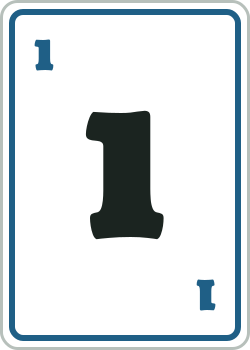
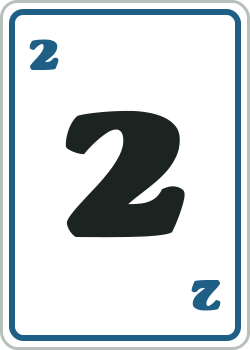
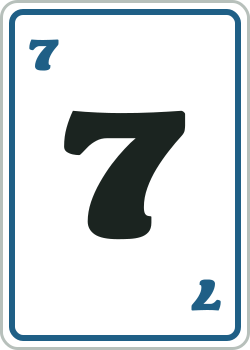
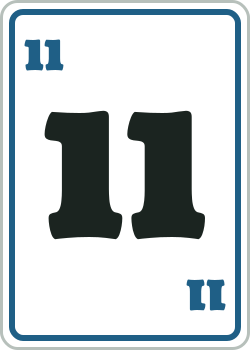
- The pieces pictured at the top of the page are our own example.
- Putting the cards drawn for the Leader back and reshuffling is our suggestion. The first source does not say.
- The total of 16 pawns is our arithmetic from 4 pawns for each of 4 colors. Hasbro’s product page gives each player 3 pawns. Taking that current box to be Wikipedia’s 2013 edition, which also has 3 pawns each, is our match.
- That you cannot bring a second pawn out while your own pawn sits on the circle outside Start is our reading of the rules that two pawns never share a square and that you may not land on your own pawn.
- That a pawn brought out onto an opponent’s pawn on the start circle bumps it is our reading of the rule that any move ending on an opponent’s pawn sends it to its Start.
- That pawns in a Safety Zone cannot be bumped by other colors follows from the rule that only a pawn of that color may enter.
- That only one Point Scoring Sorry bonus is given, the largest that fits, is our reading. The first source lists the three bonuses, and Wikipedia gives a bonus of 24, 16 or 8.
- That a pawn stopping partway along a slide does not slide follows from the slide rule, which applies only to a pawn that ends its move on the triangle.
- That the entrance to your Safety Zone is a few squares behind your Start is our description of the board. Both sources say a backward move from near Start can reach the Safety Zone without going around the board.
- The advice to agree on a target or a number of games for Point Scoring Sorry is our own. Neither source gives a target.
- Entering each partnership as one player on the scorekeeper, marking both partners on the score sheet, and entering a double game twice are our own suggestions.
- The notes under What you need describe products and are not rules. The score sheet and scorekeeper are our own design.
- That play to the left goes clockwise is our wording. The first source says the player on the Leader’s left plays next and, in Point Scoring Sorry, that play continues to the left.
- That a pawn in the 2013 edition leaves Start on any number card that moves it forward is our reading of Wikipedia’s “any positive number card”.
- That the card drawn after a 2 may move the pawn the 2 just brought out is our reading. Neither source limits which pawn that card moves.
- That Patience Sorry’s moves follow the regular rules is our reading of the first source’s “fair moves according to the rules”.
- That the older boards’ diamond and the first source’s rule against moving past the Safety Zone entrance set a similar limit is our reading.
- That a pawn switched past its entrance by an opponent’s 11 goes around the board again before it can go in is our reading of the first source’s rule.
- That your own 11 switch may not carry your pawn past its entrance is our reading of the first source, whose exception names only an opponent’s 11.
Spotted a mistake? Email contact@familygamerules.com and we'll check it against the sources.