Backgammon rules
Backgammon is a race for two players. Each of you moves 15 checkers around the board by the roll of two dice, brings them all home, then takes them off. Single checkers can be hit and sent back to the start, and a doubling cube lets either player raise the stakes.


- Players
- 2
- You need
- A backgammon board, 15 checkers for each player, two dice for each player, a dice cup each and a doubling cube
- Each turn
- Roll two dice and move your checkers by the two numbers. Doubles are played four times.
- Goal
- Bring all 15 of your checkers into your home board, then bear them off the board before your opponent does
- Game ends
- When one player has borne off all 15 checkers, or when a player refuses a double. A match ends when one player reaches the agreed number of points, such as 5.
- Playing time
- About 15 minutes a game, and about an hour for a match to 5
Quick start
- Set up 15 checkers each: 2 on your 24-point, 5 on your 13-point, 3 on your 8-point and 5 on your 6-point, counting from your side.
- Each player rolls one die. Reroll a tie. The higher roller moves first, using both numbers rolled. After that, take turns rolling two dice.
- Move a checker by each number, or one checker by both. You cannot land on a point held by 2 or more opposing checkers. Doubles are played four times.
- Landing on a single opposing checker hits it and puts it on the bar. A player with a checker on the bar must bring it in before making any other move.
- Once all 15 of your checkers are in your home board, bear them off by the numbers you roll. The first player to bear off all 15 wins.
- A win scores 1, a gammon 2, a backgammon 3, times the cube. Before rolling you may double the stakes. The other player plays on or gives up. Then only the cube’s holder may double.
Rule sheet and score sheet
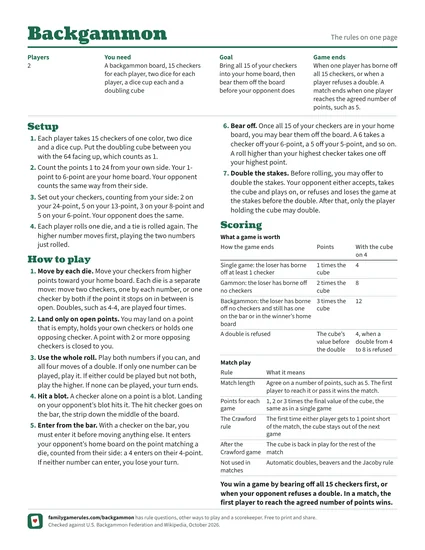
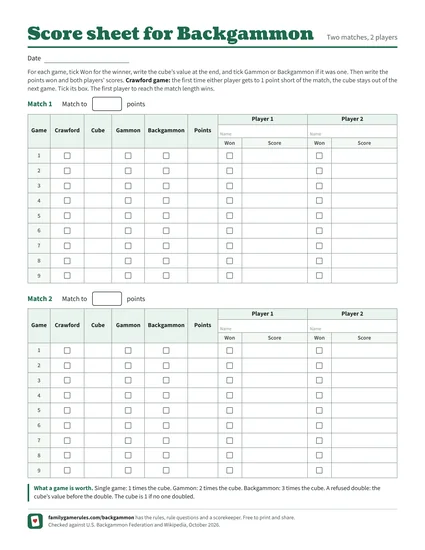
Print the whole game on one page, and a score sheet made for Backgammon. Both are free PDFs for Letter paper.
Setup
2 players. A team form for 3 or more, called a chouette, is further down.
You need: A backgammon board with 30 checkers, 4 dice and a doubling cube.
| In the set | Count |
|---|---|
| White checkers | 15 |
| Black checkers | 15 |
| Dice, a pair for each player | 4 |
| Doubling cube, marked 2, 4, 8, 16, 32 and 64 | 1 |
| Total | 35 |
- Each player also has a dice cup for shaking and rolling their dice.
- The checkers can be any two colors. This page calls them White and Black.
- The board has 24 long triangles called points, 12 on each side. A raised strip down the middle, called the bar, splits the board into four quarters of 6 points each.
- Each player takes 15 checkers of one color, two dice and a dice cup. Put the doubling cube between you with the 64 facing up, which counts as 1.
- Count the points 1 to 24 from your own side. Your 1-point to 6-point are your home board. Your opponent counts the same way from their side.
- Set out your checkers, counting from your side: 2 on your 24-point, 5 on your 13-point, 3 on your 8-point and 5 on your 6-point. Your opponent does the same.
- Each player rolls one die, and a tie is rolled again. The higher number moves first, playing the two numbers just rolled.
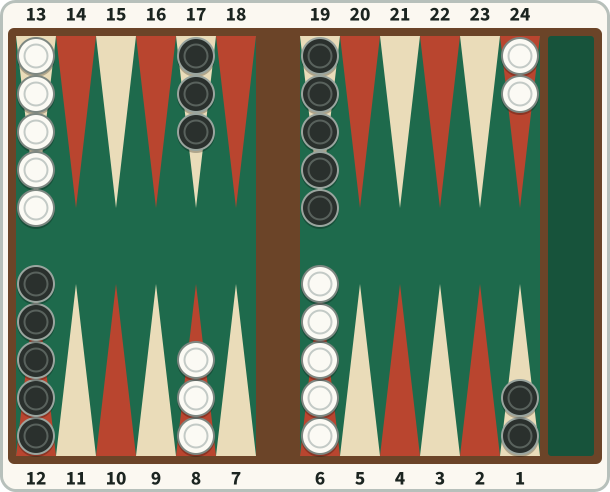
- Sit across the board from each other. The two home boards face each other across the board, on the same side of the bar.
- Your checkers travel from your 24-point down to your 1-point, so the two players move in opposite directions around the board.
- The first player never starts with doubles, because a tied opening roll is always rolled again.
- Roll both dice together from the cup. They must land flat on the section of the board to your right. If a die lands off that section, on a checker or tilted, roll both dice again. Tournament rules count a die that rests flat on checkers on the same side of the bar as it was rolled, unless it falls into a gap between them or the tournament director has announced otherwise.
How to play
Players take turns. On your turn you roll your two dice and move your checkers by the numbers shown. Your turn ends when you pick up your dice.
-
Move by each die
Move your checkers from higher points toward your home board. Each die is a separate move: move two checkers, one by each number, or one checker by both if the point it stops on in between is open. Doubles, such as 4-4, are played four times.
- The opening turn is the one exception to rolling your own two dice. The first player plays the two single dice from the opening roll and does not roll again.
- A checker that uses both dice makes two separate stops. With a 5-2, it moves 5 and then 2, or 2 and then 5, and at least one of those first stops must be open.
- With a double, you can split the four moves among one, two, three or four checkers.
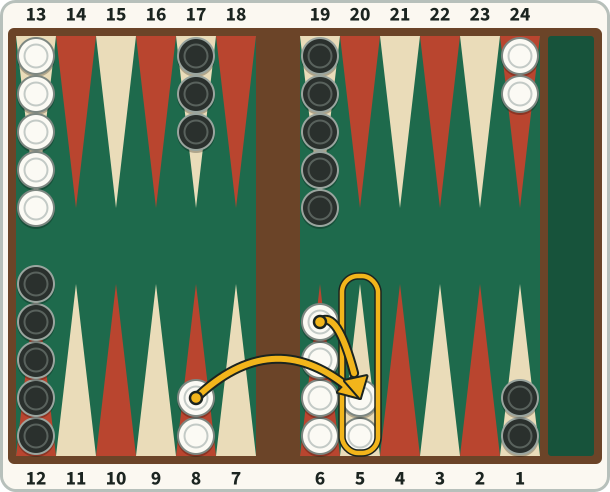
White’s opening roll
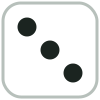

An opening move. White rolled a 3 and Black rolled a 1, so White goes first with 3-1. One way to play it: 8 to 5 with the 3 and 6 to 5 with the 1, which puts 2 checkers on point 5. -
Land only on open points
You may land on a point that is empty, holds your own checkers or holds one opposing checker. A point with 2 or more opposing checkers is closed to you.
- You can jump over closed points. Only the point where a checker stops has to be open.
- Two or more of your own checkers on a point make it yours. Your opponent cannot land there until you leave only one.
-
Use the whole roll
Play both numbers if you can, and all four moves of a double. If only one number can be played, play it. If either could be played but not both, play the higher. If none can be played, your turn ends.
- You cannot pass by choice. When a legal way to use both numbers exists, you must find it, even if you would rather play only one.
- If you cannot play all four moves of a double, play as many as you can.
-
Hit a blot
A checker alone on a point is a blot. Landing on your opponent’s blot hits it. The hit checker goes on the bar, the strip down the middle of the board.
- A checker that only passes over a blot does not hit it. A blot is hit only where a checker stops, and that includes the stop in between when one checker uses both dice.
- Your own blots can be hit in the same way, so leaving a checker alone is a risk.
-
Enter from the bar
With a checker on the bar, you must enter it before moving anything else. It enters your opponent’s home board on the point matching a die, counted from their side: a 4 enters on their 4-point. If neither number can enter, you lose your turn.
- On this page’s board, White enters on point 25 minus the die, so a 4 puts White on point 21. Black enters on the point with the same number as the die.
- With two or more checkers on the bar, enter as many as you can. If any are left on the bar, the rest of the turn is lost.
- Once all your checkers are in, play any number still unused, with the checker that just entered or with another one.
- If all 6 points of your opponent’s home board are closed, you cannot enter at all. You do not roll until one of those points opens.
-
Bear off
Once all 15 of your checkers are in your home board, you may bear them off the board. A 6 takes a checker off your 6-point, a 5 off your 5-point, and so on. A roll higher than your highest checker takes one off your highest point.
- If you roll a number and have no checker on that point, you must use it to move a checker down from a higher point. Only when no checker sits higher may you bear off from your highest point.
- You may move a checker inside your home board instead of bearing one off, as long as the move is legal.
- You can use one die to move a checker down and the other die to bear the same checker off.
- If one of your checkers is hit while you are bearing off, enter it and bring it back to your home board before you bear off any more.
-
Double the stakes
Before rolling, you may offer to double the stakes. Your opponent either accepts, takes the cube and plays on, or refuses and loses the game at the stakes before the double. After that, only the player holding the cube may double.
- Doubling is only allowed at the start of your own turn, before you roll.
- Either player may make the first double while the cube sits in the middle.
- The player who accepts puts the cube on their side of the board with the new value facing up, 2 after the first double. They alone may make the next double, called a redouble, to 4. If that is accepted, the cube changes sides again.
- So nobody can double twice in a row. Each double must wait until the cube has been passed to you.
- Refusing a redouble costs the points at stake before it. Refusing a redouble from 2 to 4 loses 2 points.
- There is no limit to the number of redoubles. The cube’s faces go up to 64, and the stakes can go higher still: 128, 256 and on.
- In a match, the cube is not used in the Crawford game. See the scoring section.
Example: a hit, and entering from the bar
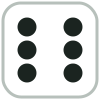
On the opening roll Black rolled a 6 and White a 2, so Black moved first with 6-2. Black moved one of its two checkers on point 1 six points, to point 7, and moved a checker 2 points, from point 12 to point 14. That left blots on points 1, 7 and 14. White now rolls 6-1. White moves 6 from point 13 to point 7 and hits the blot there, which goes to the bar. With the 1, White moves from point 8 to point 7, so point 7 now holds 2 white checkers. On Black’s next turn Black rolls 6-4. White holds point 6, so the 6 cannot enter. The 4 enters on point 4. Only then may Black play the 6, with any checker that can move it.
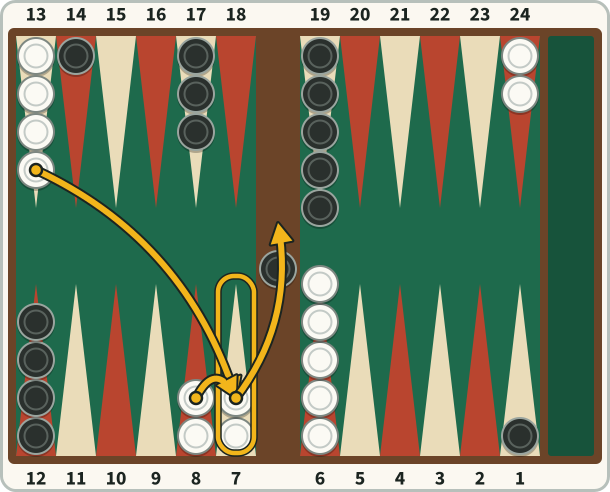
White rolled
Scoring
A game is worth 1, 2 or 3 points, times the number on the doubling cube. Play single games for an agreed stake per point, or play a match to a set number of points.
| How the game ends | Points | With the cube on 4 |
|---|---|---|
| Single game: the loser has borne off at least 1 checker | 1 times the cube | 4 |
| Gammon: the loser has borne off no checkers | 2 times the cube | 8 |
| Backgammon: the loser has borne off no checkers and still has one on the bar or in the winner’s home board | 3 times the cube | 12 |
| A double is refused | The cube’s value before the double | 4, when a double from 4 to 8 is refused |
| Rule | What it means |
|---|---|
| Match length | Agree on a number of points, such as 5. The first player to reach it or pass it wins the match. |
| Points for each game | 1, 2 or 3 times the final value of the cube, the same as in a single game |
| The Crawford rule | The first time either player gets to 1 point short of the match, the cube stays out of the next game |
| After the Crawford game | The cube is back in play for the rest of the match |
| Not used in matches | Automatic doubles, beavers and the Jacoby rule |
- The cube starts with 64 facing up, which counts as 1. A game that is never doubled is worth 1, 2 or 3 points.
- A gammon or backgammon multiplies the cube. A gammon with the cube on 2 is worth 4 points.
- A refused double is always a single game. The refusing player cannot lose a gammon by refusing.
- The Crawford game happens only once in a match. If neither player is ever exactly 1 point short before the match ends, there is no Crawford game.
- Under tournament rules, a player who would win the match by winning the game at the cube’s current value may not double. Any double that player makes does not count.
You win a game by bearing off all 15 checkers first, or when your opponent refuses a double. In a match, the first player to reach the agreed number of points wins.
In a match, write down each game: who won, the cube’s value at the end, whether it was a gammon or backgammon, the points and both running scores. Mark the Crawford game when it comes. When you play single games for a stake, keep a running total of points won and lost.
A worked example: the first games of a match to 5
Game 1 is never doubled. In game 2, Black doubles, White accepts and the cube goes to 2. Black then bears off all 15 checkers before White bears off any, which is a gammon. That puts Black on 4, one point short of 5, so game 3 is the Crawford game and nobody may double. White wins it. After 3 games Black leads 4 to 2. Under tournament rules, from game 4 only White can double, because any win gives Black the match.
| What happened | Goes to | Points |
|---|---|---|
| Game 1: White wins a single game, cube on 1 (1 × 1) | White | 1 |
| Game 2: Black wins a gammon, cube on 2 (2 × 2) | Black | 4 |
| Game 3, the Crawford game: White wins a single game, no cube (1 × 1) | White | 1 |
| White | 2 | |
| Black | 4 |
Scorekeeper
Keeps a match between two players, to 5 points. For each game, pick the winner, a single game, gammon or backgammon, and the cube’s value, and the points are added for you. Enter a refused double as a single game at the cube’s value before the double. The game after a player first reaches 1 point short of the match is marked as the Crawford game, with no doubling. The cube can be set from 1 to 64, so a game played on a higher cube cannot be entered. It works in this browser, keeps the game if the page reloads, and needs no account.
Other ways to play
Chouette: backgammon for 3 or more
One player, called the box, plays against everyone else as a team. Each player rolls one die to start, rerolling ties. The highest roller is the box and the second highest is the captain. The captain plays for the team and has the final say on each play. Groups differ on how much the team may discuss moves. If the box wins, each team member pays the box. If the team wins, the box pays each team member. When the box wins, the captain goes to the back of the line and the next player becomes captain. When the team wins, the box goes to the back, the captain becomes the box and the next player becomes captain. In most chouettes now, each team member has a separate cube, and the box keeps its place if it beats the captain.
House rules and other versions
- Automatic doubles
- If the opening roll is a tie, the stakes double. Turn the cube to 2 and leave it in the middle, so either player may still make the next double. Players usually allow only one automatic double a game. Not used in matches.
- Beavers
- A player who has just been doubled may redouble at once and keep the cube. This is called a beaver. The first doubler then either plays on at the new, higher stakes or refuses and pays the doubled stakes. Not used in matches.
- Raccoons
- Where beavers are played, a player who has been beavered may double yet again, called a raccoon. If it is accepted, the game is played for 8 times the starting stakes.
- Jacoby rule
- Gammons and backgammons count only as a single game unless the cube has been offered and accepted during the game. Common in games for a stake, but not used in matches.
- Holland rule
- An older match rule. In the games after the Crawford game, a player may not double until each side has rolled at least twice. It is rarely played now.
Rule questions
Who goes first in backgammon?
Each player rolls one die, and the higher number goes first. If the numbers match, both roll again. The first player does not roll again. They move by the two numbers already on the board, so the opening move can never be a double.
What if I can play one number but not the other?
Play the one you can. If either number could be played on its own but not both together, you must play the higher one. If neither can be played, your turn ends. When a way to use both numbers exists, you must use both.
Can one checker use both dice?
Yes, if the point where it stops in between is open. It moves by one number and then the other, so each stop must be a point you could land on. With doubles, one checker can make all four moves if every stop is open.
What happens if I cannot enter from the bar?
You lose your turn. You cannot move any other checker while one of yours is on the bar. If all 6 points of your opponent’s home board are closed, you do not roll at all until a point opens.
Do I have to bear off if I can move inside my home board instead?
No. You may use a number to move a checker down inside your home board instead of bearing off. You must still use both numbers if you can.
What if my checker is hit while I am bearing off?
It goes to the bar like any hit checker. You must enter it and bring it all the way back to your home board before you can bear off again. If you have already borne off a checker, you can no longer be gammoned.
What is a gammon, and what is a backgammon?
A gammon is a win before the loser has borne off any checkers. It scores 2 times the cube. A backgammon is a gammon where the loser also still has a checker on the bar or in the winner’s home board. It scores 3 times the cube.
What happens if you refuse a double?
You lose the game at once and pay the stakes before the double. Refusing the first double costs 1 point. Refusing a redouble from 2 to 4 costs 2 points.
Can you double twice in a row?
No. After your double is accepted, your opponent holds the cube, and only they may double next. You can double again only after they redouble and you accept.
What is the Crawford rule?
In a match, the first time either player gets to 1 point short of winning, nobody may double in the next game. That game is the Crawford game. From the game after it, the cube is used as usual. Example: in a match to 5, the game after a player first reaches 4 is played without the cube.
How high can the doubling cube go?
There is no limit. The cube’s faces go up to 64, but redoubles can carry the stakes on to 128, 256 and beyond.
What if a player makes an illegal move?
The opponent chooses. They can accept the move as played or have the player change it to a legal one. This must happen before the opponent rolls or doubles, because either of those accepts the move.
Words used in Backgammon
- Point
- One of the 24 long triangles on the board. Each player numbers them 1 to 24 from their own side.
- Home board
- Your 1-point to 6-point, where you bring all your checkers before bearing off. Also called the inner board.
- Outer board
- Your 7-point to 12-point, the quarter beside your home board on the other side of the bar.
- Bar
- The raised strip down the middle of the board. Hit checkers wait there until they enter.
- Blot
- A single checker alone on a point. It can be hit.
- Hit
- To land on an opposing blot and send it to the bar.
- Enter
- To bring a checker from the bar into your opponent’s home board.
- Making a point
- Putting 2 or more of your checkers on one point, which closes it to your opponent.
- Prime
- A wall of closed points in a row that blocks your opponent’s checkers.
- Anchor
- A point you hold with 2 or more checkers in your opponent’s home board.
- Bear off
- To take a checker off the board once all 15 of yours are in your home board.
- Doubling cube
- A large die marked 2, 4, 8, 16, 32 and 64 that shows the stakes of the game.
- Take and drop
- Accepting a double is a take. Refusing it, and losing the game at once, is a drop. Also called a pass.
- Redouble
- Any double after the first one in a game. Only the player holding the cube may make it.
- Gammon
- A win before the loser has borne off any checkers. Worth 2 times the cube.
- Backgammon
- A gammon in which the loser still has a checker on the bar or in the winner’s home board. Worth 3 times the cube.
- Match
- A series of games played until one player reaches an agreed number of points.
- Crawford game
- The one game in a match played without the cube, right after a player first gets to 1 point short of winning.
- Beaver
- An optional rule: redoubling at once after being doubled, while keeping the cube.
- Chouette
- Backgammon for 3 or more, with one player, the box, against a team led by a captain.
What you need
- A backgammon setA folding board with 30 checkers, dice, dice cups and a doubling cube.Find it on Amazon (A backgammon set, opens in a new tab)
- A doubling cubeOptional. Some sets leave it out.Find it on Amazon (A doubling cube, opens in a new tab)
- Spare dice and dice cupsOptional. Each player needs a pair of dice and a cup.Find it on Amazon (Spare dice and dice cups, opens in a new tab)
As an Amazon Associate, we earn from qualifying purchases. How the site is paid for.
Checked against
These rules are written in our own words from U.S. Backgammon Federation and checked against Wikipedia. Sources last checked on October 12, 2026.
- First source: U.S. Backgammon Federation, Backgammon Basics: How To Play. The board, equipment and starting position, the opening roll, moving, hitting and entering, bearing off, doubling, gammons and backgammons, optional rules, irregularities, match play, the Crawford rule and the chouette.
- Second source: Wikipedia, Backgammon. Checks of the setup, movement, the higher-number rule, entering against a closed board, bearing off, scoring and the cube. Also raccoons, the Holland rule, stakes above 64, the Jacoby rule being for money play, and automatic doubles and the Jacoby rule not being used in match play.
Other sources we used (1)
- U.S. Backgammon Federation, USBGF Tournament Rules, effective January 2025. The exact Crawford wording (the first game after either player is one point from the match), dead cubes, and valid rolls, including a die that comes to rest on checkers.
Where the sources differ (12)
| Topic | U.S. Backgammon Federation | Wikipedia | This page |
|---|---|---|---|
| Entering against a closed home board | If neither number gives an open point, the player loses their turn. | If the opponent’s home board is fully closed, the player stops rolling and playing until a point opens. | You lose your turn when you cannot enter. The note and rule question add that you do not roll at all while all 6 points are closed, which is the same result. |
| The Jacoby rule | Gammons and backgammons count only as a single game if neither player has offered a double. | Gammons and backgammons count only if the cube has been offered and accepted. Used in money play, not in matches. | Offered and accepted. A refused double ends the game as a single game anyway, so the two say the same thing in play. |
| Highest value of the cube | The cube’s faces go to 64, and there is no limit to redoubles. | The faces go to 64, and stakes may rise to 128, 256 and so on. | No limit to redoubles, and the faces go to 64. The scorekeeper’s cube goes up to 64 and no higher. |
| Crawford rule wording | When one player reaches one point short of a match to n, the cube is out of play for one game. | When a player first reaches one point short, the following game is played without the cube. A Crawford game may never happen. | The first time either player reaches one point short, the next game is played without the cube. The USBGF tournament rules word it differently, as the first game after either player is exactly one point away from winning the match. The meaning is the same. |
| Bearing off after being hit | The hit checker must be brought back to the home board before bearing off resumes. | Not stated directly. Bearing off needs all checkers in the home board, which gives the same result. | Follows the USBGF. |
| Moving inside the home board instead of bearing off | A player need not bear off if another legal move is available. | Not stated. | Follows the USBGF. |
| Dice and dice cups | Each player has their own pair of dice and a dice cup. | Two dice are rolled. A dice cup is mentioned only in a section on cheating. | Each player has two dice and a cup. |
| Board layout | Four quarters of 6 points, split by the bar. Each player has a home board and an outer board. | Points 1 to 6 are the home or inner board and points 7 to 12 the outer board. No quarters are named. | Uses both: four quarters, with home and outer boards. |
| Match length | Matches go to an agreed number of points. Its examples are matches to 5. | No standard length. Play goes on until one side reaches or passes a set score. | An agreed number of points, with 5 as the example. The scorekeeper starts at 5. |
| Gammons and the cube | A gammon loses twice the cube and a backgammon three times the cube. | A gammon is worth 2 points and a backgammon 3. Stakes are raised by gammons and by the cube, without spelling out the multiplying. | Follows the USBGF: 1, 2 or 3 times the cube. |
| Beavers in matches | Automatic doubles, beavers and the Jacoby rule are not used in match play. | Describes beavers in money games only. Says automatic doubles and the Jacoby rule are not used in match play. | All three are variants and are marked as not used in matches. |
| Raccoons and the Holland rule | Not mentioned. | Raccoons are a further double after a beaver. The Holland rule stops a player from doubling after the Crawford game until each side has rolled at least twice, and is rarely used now. | Both listed as variants from Wikipedia. |
What on this page is our own
- The playing times of about 15 minutes a game and an hour for a match to 5 are our estimates.
- The 3-1 opening diagram, the hit example and the three-game match example are our own, built from the sourced rules. In the match example, that only White can double from game 4 is our reading of the tournament dead-cube rule.
- The column of points with the cube on 4, and the 4 points for a gammon on a cube of 2, are our arithmetic.
- The equipment total of 35 is our count of 30 checkers, 4 dice and 1 cube.
- That White enters on point 25 minus the die is our arithmetic from the numbering on this page’s board.
- Several statements follow from the sourced rules without being spelled out in them: the two home boards face each other, you can pass over closed points, a checker that only passes a blot does not hit it, a refused double can never be a gammon, a player who has borne off a checker can no longer be gammoned, and the Crawford game can happen only once.
- The notes under What you need describe products and are not rules.
- The pieces pictured at the top of the page are our own example.
Spotted a mistake? Email contact@familygamerules.com and we'll check it against the sources.