Mancala rules
Mancala is a board game for 2 players. On your turn you scoop up the stones in one pit and drop them one by one around the board, trying to fill the big store at your end. Mancala is the name of a whole family of games. This page covers Kalah, the version most popular in the West.
Also called Kalah, Kalaha.

- Players
- 2
- Ages
- 7 and up
- You need
- A mancala board with 12 small pits and 2 stores, and 48 stones
- Each turn
- Pick up every stone in one of your pits and drop them one at a time, counterclockwise
- Goal
- Have the most stones in your store at the end
- Game ends
- When all 6 pits on one side are empty. The other player moves their leftover stones into their own store.
- Playing time
- About 10 minutes
Quick start
- Put 4 stones in each of the 12 small pits. Your pits are the 6 nearest you, and your store is the big pit on your right.
- Toss a coin to see who goes first. On your turn, pick up all the stones in one of your pits.
- Going counterclockwise, drop them one at a time into the pits that follow, including your own store. Skip the other player’s store.
- If your last stone lands in your own store, take another turn.
- If your last stone lands in an empty pit on your side, take it and any stones in the pit across. Put them all in your store.
- When all 6 pits on one side are empty, the other player puts their leftover stones in their store. The bigger store wins.
Rule sheet and score sheet
Print the whole game on one page, and a score sheet made for Mancala. Both are free PDFs for Letter paper.
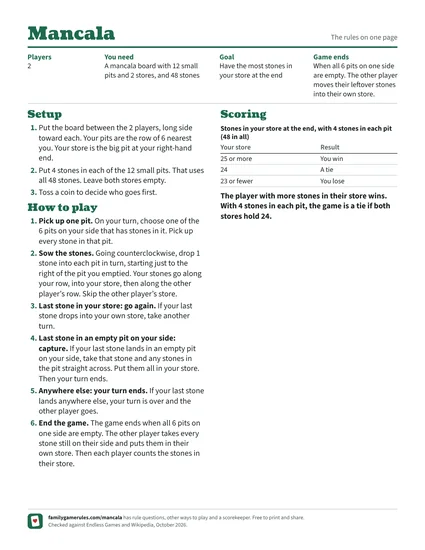
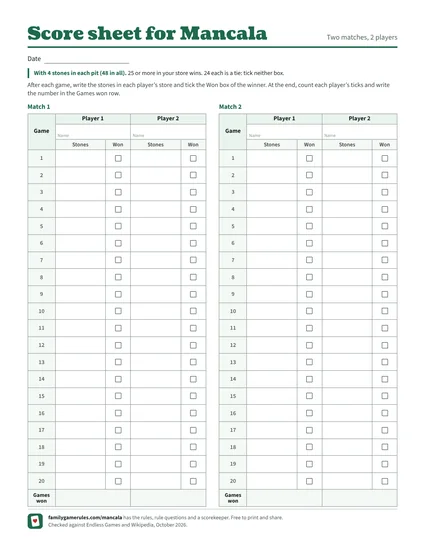
Setup
2 players.
You need: A mancala board and 48 stones.
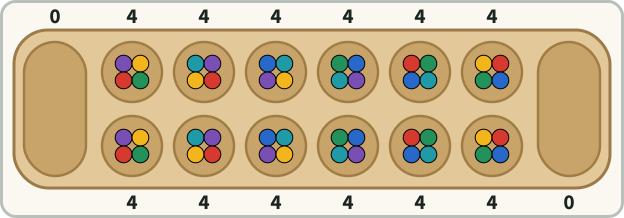
- The board has 2 rows of 6 small pits, with a large pit called a store at each end.
- The color of the stones does not matter. Every stone counts the same.
- Put the board between the 2 players, long side toward each. Your pits are the row of 6 nearest you. Your store is the big pit at your right-hand end.
- Put 4 stones in each of the 12 small pits. That uses all 48 stones. Leave both stores empty.
- Toss a coin to decide who goes first.
How to play
Players take turns. Every turn starts the same way, and where your last stone lands decides what happens next.
-
Pick up one pit
On your turn, choose one of the 6 pits on your side that has stones in it. Pick up every stone in that pit.
- You never pick up stones from a store or from the other player’s pits.
-
Sow the stones
Going counterclockwise, drop 1 stone into each pit in turn, starting just to the right of the pit you emptied. Your stones go along your row, into your store, then along the other player’s row. Skip the other player’s store.
- Dropping the stones this way is called sowing.
- With enough stones you go all the way around the board and back into your own pits. Keep dropping one stone at a time, and skip only the other player’s store.
-
Last stone in your store: go again
If your last stone drops into your own store, take another turn.
- There is no limit. You can earn several extra turns in a row.
-
Last stone in an empty pit on your side: capture
If your last stone lands in an empty pit on your side, take that stone and any stones in the pit straight across. Put them all in your store. Then your turn ends.
- If the pit across is empty, you take just your last stone. Under some rules, a capture needs stones in the pit across. That rule is under Variants.
- Landing in an empty pit on the other player’s side captures nothing.
-
Anywhere else: your turn ends
If your last stone lands anywhere else, your turn is over and the other player goes.
-
End the game
The game ends when all 6 pits on one side are empty. The other player takes every stone still on their side and puts them in their own store. Then each player counts the stones in their store.
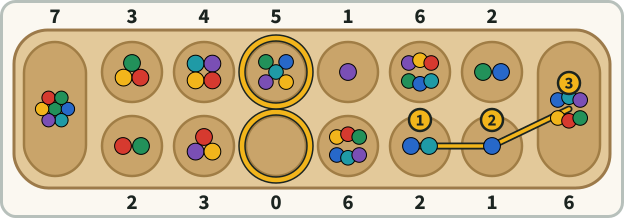
Example: an extra turn, then a capture
You are the near player. Your fifth pit holds 2 stones. You pick them up, drop one in your sixth pit and the last one in your store. That earns you another turn. Next you pick up the 2 stones in your first pit. One goes in your second pit, and the last lands in your third pit, which was empty. The pit across from it holds 5 stones. You take those 5 and your last stone and put all 6 in your store. Your store has gone from 6 to 13, and your turn ends.
Scoring
Mancala has no points. At the end each player counts the stones in their store. There are 48 stones in all.
| Your store | Result |
|---|---|
| 25 or more | You win |
| 24 | A tie |
| 23 or fewer | You lose |
The player with more stones in their store wins. With 4 stones in each pit, the game is a tie if both stores hold 24.
Nothing is written down during a game, because the stores keep the count. To play a match, write each player’s stones at the end of every game and mark the winner.
A worked example: the final count
The other player has just emptied the last of their 6 pits, so the game is over. You still have 7 stones in your pits. They go into your store, which already holds 20. The other player’s store holds 21. You win 27 to 21, and the two totals add up to 48.
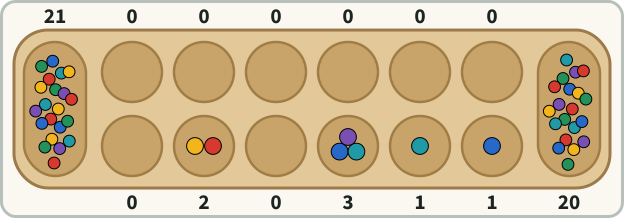
| What happened | Goes to | Points |
|---|---|---|
| Stones already in your store | You | 20 |
| Stones left in your pits, moved to your store | You | 7 |
| Stones in the other player’s store | Other player | 21 |
| You | 27 | |
| Other player | 21 |
Scorekeeper
Mancala has no running score. This counts the games each player wins, so you can play a match. A tie is not counted for either player. It works in this browser, keeps the game if the page reloads, and needs no account.
Other ways to play
House rules and other versions
- Capture only with stones across
- Under some rules, a capture needs stones in the pit across. If your last stone lands in an empty pit on your side and the pit across is empty too, nothing is captured. Your stone stays where it landed and your turn ends.
- 3, 5 or 6 stones in each pit
- Start with a different number of stones in every pit. With 3 there are 36 stones in all, with 5 there are 60, and with 6 there are 72.
- Leftover stones at the end
- Some groups give the stones left on the board to the player who ran out first, not to the player whose side they are on. Others leave the leftover stones out of the count.
- Clockwise sowing
- Some players drop their stones clockwise instead. Your stones then start off away from your store, so it takes more of them to reach it.
- Keep sowing
- Nothing is captured. When your last stone lands in a small pit on either side that already holds stones, pick up all of them and keep sowing. When it lands in an empty pit, your turn ends. A last stone in your store earns another turn as usual. Also called seed on.
Rule questions
How many stones go in each pit in mancala?
4. Put 4 stones in each of the 12 small pits, which uses all 48 stones. The 2 stores start empty. Some groups play with 3, 5 or 6 stones in each pit instead.
Which store is mine?
The one on your right. Your pits are the row of 6 nearest you, and your store is the big pit at the right-hand end of that row.
Who goes first in mancala?
Toss a coin. That is the usual way to decide who starts.
Do you drop a stone in the other player’s store?
No. Skip it and drop the stone in the next pit. You only drop stones in your own store.
How many extra turns can you get?
There is no limit. Every time your last stone drops into your own store, you take another turn.
What happens if the pit across from your empty pit is empty?
You still take your last stone and put it in your store. Then your turn ends. Under some rules, a capture needs stones in the pit across, so the stone stays where it landed. Agree on it before you play.
Can you capture on the other player’s side?
No. A capture happens only when your last stone lands in an empty pit on your own side. If it lands in an empty pit on the other player’s side, your turn ends.
What happens to the stones left when one side is empty?
The player whose side they are on puts them in their own store. Then both players count. Some groups give those stones to the player who ran out first, or leave them out of the count.
Can mancala end in a tie?
Yes. With 4 stones in each pit there are 48 stones, so if each store holds 24 at the end, the game is a tie.
Words used in Mancala
- Pit
- One of the 12 small hollows on the board. Each player owns the 6 on their side. Also called a pocket or a house.
- Store
- The big pit at each end of the board. Yours is on your right. Also called a mancala.
- Sowing
- Dropping the stones from one pit one at a time into the pits that follow.
- Capture
- When your last stone lands in an empty pit on your side: taking that stone and any stones in the pit across from it, and putting them all in your store.
- Kalah
- The name of the version of mancala on this page. Mancala is the name of the whole family of games.
What you need
- A mancala board with stonesMost sets come with 48 stones, enough for 4 in every pit.Find it on Amazon (A mancala board with stones, opens in a new tab)
- A folding wooden mancala boardOptional. It closes like a case with the stones inside, which suits travel.Find it on Amazon (A folding wooden mancala board, opens in a new tab)
As an Amazon Associate, we earn from qualifying purchases. How the site is paid for.
Checked against
These rules are written in our own words from Endless Games and checked against Wikipedia. Sources last checked on October 12, 2026.
- First source: Endless Games, Mancala instruction sheet (2015). The ages, the board, the 48 stones and 4 in each pit, the store on your right, counterclockwise sowing, skipping the other store, the extra turn, the capture, the end of the game and the count. A copy posted by the Buffalo and Erie County Public Library..
- Second source: Wikipedia, Kalah. The rules checked line by line, no limit on extra turns, ties, its standard rule that a capture needs stones in the pit across, and the named variants: empty capture, which matches the main rule here, other stone counts, clockwise sowing, seed on and other ways to count leftover stones..
Other sources we used (2)
- Wood Expressions, Mancala instructions. Tossing a coin for the first turn, the playing time of about 10 minutes, and giving the leftover stones to the player who empties their pits first. Its capture rule, like the first source’s, sets no condition that the pit across holds stones. A maker’s sheet posted by the Smithsonian Store..
- Wikipedia, Mancala. Mancala as the name of a family of games, and Kalah as the most popular version in the West..
Where the sources differ (8)
| Topic | Endless Games | Wikipedia | This page |
|---|---|---|---|
| When the pit across is empty | When your last stone lands in an empty pit on your side, you capture it and any stones in the pit directly across. It sets no condition that the pit across holds stones. | A capture needs stones in the pit across. Taking the lone stone anyway is named as the empty capture variant. | Follows the Endless Games sheet: if the pit across is empty, you take just your last stone. Wikipedia’s rule, capture only with stones across, is listed as a variant and in the rule questions. |
| Who goes first | Not stated. | Not stated. Its analysis assumes South moves first. | Toss a coin, from the Wood Expressions sheet. |
| Leftover stones at the end | The player who still has stones on their side captures them. | The other player moves the remaining stones to their store. Other rules give them to the player who emptied their pits, or do not count them. | The player whose side they are on takes them. The two other ways are listed as a variant and in the rule questions. The Wood Expressions sheet backs the first of them, giving the stones to the player who empties their pits first. |
| Extra turns | Another turn each time your last stone lands in your store. It does not say whether there is a limit. | Another move each time. There is no limit on the moves in a turn. | No limit. |
| Ties | Not stated. | A draw is possible. | A tie at 24 each, with 4 stones in each pit. |
| Stones in each pit | 4 in each of the 12 pockets, from 48 pieces. | 4 is the traditional number. The game may start with a different number, and the article covers 3, 5 and 6. | 4 each, 48 in all. 3, 5 or 6 is a variant. |
| Direction of sowing | Counterclockwise. | Counterclockwise. Clockwise sowing is named as an alternative rule. | Counterclockwise. Clockwise is a variant. |
| Names for the parts | Pockets, pieces or stones, and stores also called mancalas. | Houses, seeds, and stores or end zones. | Pits, stones and stores, with the other names in Terms. |
What on this page is our own
- The extra-turn and capture example, the final count and the pieces pictured at the top of the page are our own.
- The 24 stones on each side, the 25 needed to win, the tie at 24 each, and the 36, 60 and 72 stones for other starting counts are our arithmetic.
- That your turn ends after a capture, and when the last stone lands anywhere other than your store, is our reading. So is the last stone staying put in the variant where a capture needs stones in the pit across. Both main sources name only the extra turn and the capture, and players take turns.
- That a long sowing goes all the way around and back into your own pits is our reading of the rule to drop one stone in each pit in turn, skipping only the other store.
- The notes under What you need describe products and are not rules.
- In the keep sowing variant, that a last stone in your store still earns another turn is our reading. The rule we checked says only that the turn ends when the last stone falls in an empty pit.
Spotted a mistake? Email contact@familygamerules.com and we'll check it against the sources.