Speed rules
Speed is a card game for 2 players with no turns. Both of you play at once, as fast as you can, onto two piles in the middle. Each card must be one rank higher or one rank lower than the card it covers. The first player to get rid of all their cards wins.
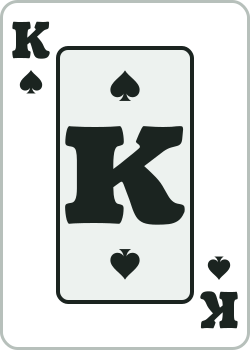
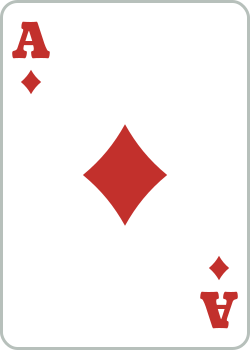
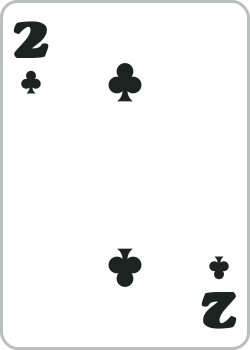
- Players
- 2
- You need
- A standard 52-card deck, without the jokers
- Deal
- 20 cards each: 5 in your hand and 15 in a face-down draw pile. Two side piles of 5 and 2 single cards go in the middle.
- Goal
- Be the first to play every one of your cards
- Game ends
- When a player has played every card from hand and draw pile and claims the win by saying “Speed”. That player wins.
- Playing time
- About 5 minutes a game
Quick start
- Deal 20 cards face down to each of the 2 players. Pick up your top 5 as your hand. The other 15 are your draw pile.
- In the middle, deal 2 face-down side piles of 5 cards. Put the last 2 cards face down between them.
- Both players turn up one of those 2 single cards at the same moment. Then play as fast as you can. There are no turns.
- Play one card at a time onto either middle pile. It must be one rank higher or lower than the top card. Suits do not matter, and the ace goes next to both king and 2.
- Draw to keep 5 cards in your hand. When neither of you can play, each turns a side-pile card onto a middle pile at the same moment.
- The first player with no cards left in hand or draw pile wins. Slap the table and say “Speed” to claim the win.
Rule sheet and score sheet
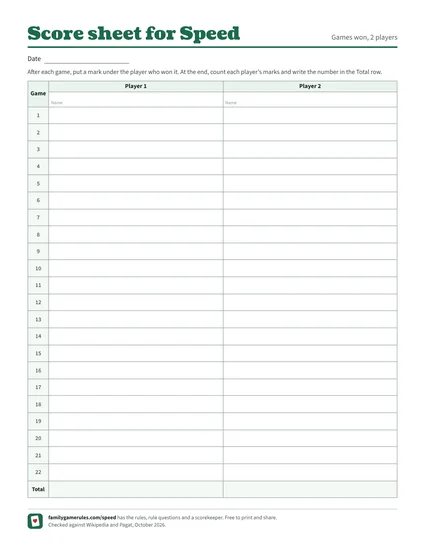
Print the whole game on one page, and a score sheet made for Speed. Both are free PDFs for Letter paper.
Setup
2 players. A rule question further down covers playing with 3 or 4.
You need: A standard 52-card deck with the jokers taken out.
| In the set | Count |
|---|---|
| Number cards, 2 through 10 | 36 |
| Jacks | 4 |
| Queens | 4 |
| Kings | 4 |
| Aces | 4 |
| Total | 52 |
- Suits and colors do not matter in Speed. Only the rank counts.
- The ace sits between the king and the 2, so it can follow either of them.
- Use a standard 52-card deck with the jokers taken out. Shuffle, and deal 20 cards face down to each of the 2 players.
- Each player picks up the top 5 of their 20 cards as a hand and keeps it hidden. The other 15 stay face down in front of them as a draw pile.
- Deal 2 side piles of 5 cards each, face down, in the middle of the table, one toward each end.
- Put the last 2 cards face down side by side, between the side piles. These 2 single cards will start the middle piles.
Other player’s draw pile
15 cards, plus 5 in their hand
Side pile
5 cards, face down
Single cards
Turned up together to start
Side pile
5 cards, face down
Your draw pile
15 cards, face down
Your hand
5 cards, kept hidden
- The rules we checked do not say who deals. Either player can.
- Some players deal 15 cards each instead of 20, with 10 in each side pile. See the variants.
How to play
There are no turns. Both players play at the same time, as fast as they can, until one of them runs out of cards.
-
Start together
When both players are ready, each turns one of the 2 single cards face up at the same moment. These 2 cards start the middle piles. From then on nobody waits for a turn.
- Keep your hand hidden from the other player all game.
-
Play one higher or one lower
Play a card from your hand onto either middle pile. It must be one rank higher or one rank lower than the top card of that pile. Suits and colors do not matter. Play one card at a time, using one hand. The ace sits between the king and the 2, so the ranks go round in a loop.
- On a king you can play a queen or an ace. On an ace you can play a king or a 2.
- Each card only has to fit the card it covers. A pile can go up, then down, then up again: a 7, then an 8, then another 7.
- Some groups also let you play a card of the same rank, such as a 6 on a 6. See the variants.
Top of a middle pile
One lower
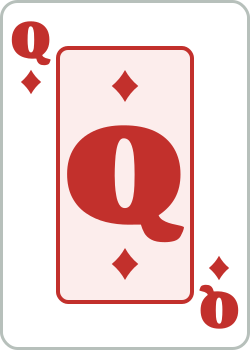
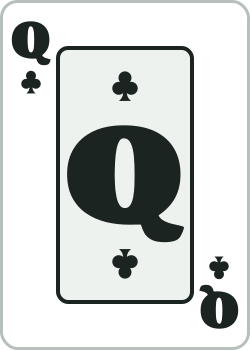
One higher
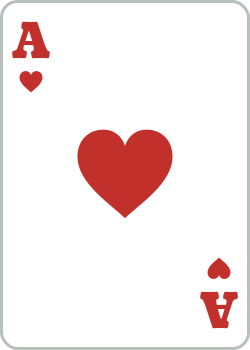
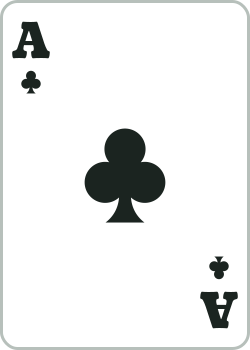
The ace comes after the king
What can be played on the king of spades. -
Keep 5 cards in your hand
Each time you play a card, draw one from your draw pile so you hold 5 again. You never hold more than 5. Once your draw pile is empty, keep playing from your hand without drawing.
- You do not have to draw the moment you play. If you fall behind, fill your hand back to 5 before any side-pile cards are turned up.
-
When nobody can play
If neither player can play, both first fill their hands to 5. If there is still no play, each player turns the top card of one side pile face up onto the middle pile beside it, both at the same moment. Then play on.
- A player whose draw pile is empty turns up a side-pile card with fewer than 5 cards in hand.
-
When the side piles run out
If nobody can play and the side piles are empty, leave the top card of each middle pile where it is. Shuffle the rest of the middle cards together and make 2 new face-down side piles. Then turn up a card from each, as before.
- Some groups pick up each middle pile whole and shuffle it on its own into a new side pile. See the variants.
-
Run out to win
The first player with no cards left, in hand or in draw pile, wins. As you play your last card, slap the table and say “Speed” to claim the win.
- Agree before the game what a player must do to claim the win. A player who runs out but does not do it takes one of the middle piles as a new draw pile and plays on.
- In the main game the cards the other player still holds do not count. To play for points, see the variants.
Example: from king to ace
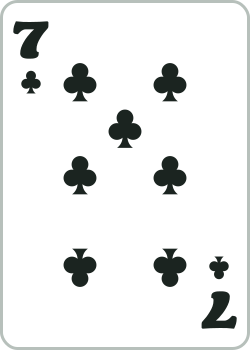
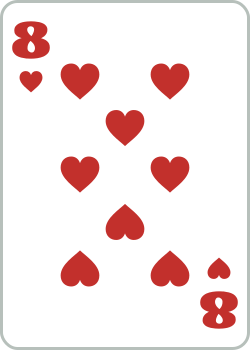
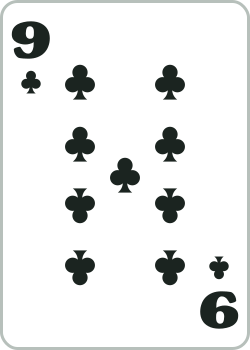
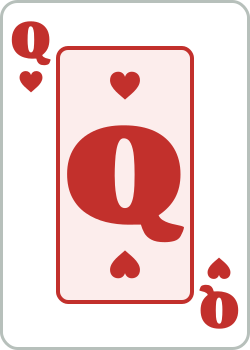
The middle piles start with the 7 of clubs and the queen of hearts. Ana plays the 8 of hearts on the 7. Ben plays the king of spades on the queen. Ana plays the ace of diamonds on Ben’s king, because the ace comes after the king. Ben plays the 9 of clubs on the 8, and Ana plays the 2 of clubs on her ace. After each play, the player draws a card to get back to 5.
Left middle pile
7, then Ana’s 8, then Ben’s 9
Right middle pile
The ace goes on the king, and the 2 on the ace
Scoring
Speed has no points in the main game. The first player out of cards wins. To play a match, count the games each player wins.
The first player to get rid of every card, from both hand and draw pile, wins the game.
Nothing is written down during a game. To play a match, mark the winner of each game on the score sheet and add up the games at the end.
Scorekeeper
Speed has no points. This counts the games each player wins, so you can play a match. It works in this browser, keeps the game if the page reloads, and needs no account.
Other ways to play
House rules and other versions
- 15 cards each
- Deal 15 cards to each player instead of 20: 5 for the hand and 10 for the draw pile. Each side pile then holds 10 cards. The 2 single cards in the middle stay the same.
- Same rank too
- A card may also go on a card of the same rank, such as a 6 on a 6, as well as one higher or one lower.
- Jokers
- Leave the 2 jokers in, for 54 cards, and put 6 cards in each side pile instead of 5. A joker is wild and can be played as any card that fits the pile. Once played, it counts as the card it stood for. A joker cannot be your last card. A joker turned up in the middle takes any card.
- Race to the slap
- Once either player runs out of cards, both may slap a middle pile and say “Speed”. Whoever does it first wins. The player who ran out still has the best chance.
- Play for points
- The player who runs out scores 1 point for each card the other player has left in hand and draw pile. Deal again and play on. The first player to reach a total agreed before you start, such as 25 points, wins.
- New side piles from whole middle piles
- When the side piles run out, pick up each middle pile, top card included, and shuffle it on its own. Put the two piles face down as the new side piles, and turn up a card from each.
- Spit
- A close relative with a different layout. Each player gets 26 cards and lays out 15 in 5 piles of 1 to 5 cards, top cards face up. The other 11 stay face down to turn up. You play from your piles. When a player clears their piles, each takes a middle pile and lays out again. Run out of cards to win.
Rule questions
How many cards do you deal in Speed?
20 to each player: 5 for the hand and 15 for the draw pile. The other 12 go in the middle as 2 side piles of 5 and 2 single cards. Some players deal 15 each instead, with side piles of 10.
Can you play an ace on a king in Speed?
Yes. The ace sits between the king and the 2, so the ranks go round in a loop. On a king you can play a queen or an ace, and on an ace a king or a 2.
Do suits or colors matter in Speed?
No. Only the rank counts. A red 9 can go on a black 8, and so can any other 9.
Can you play the same number on a middle pile?
Not in the main rules here. A card must be one rank higher or one rank lower. Some groups also allow a card of the same rank, such as a 6 on a 6. Agree on it before you start.
Can you hold more than 5 cards?
No. You draw only to bring your hand back up to 5. Once your draw pile is empty, you play out the cards in your hand and do not draw again.
What happens when neither player can play?
Both players fill their hands to 5 first. If there is still no play, each turns the top card of a side pile face up onto a middle pile, both at the same moment. Then play goes on.
What happens when the side piles run out?
Leave the top card of each middle pile in place. Shuffle the rest of the middle cards and make 2 new face-down side piles. Then turn up a card from each as usual. Some groups shuffle each whole middle pile on its own instead.
What if both players play on the same pile at once?
The Speed rules we checked do not say. In Spit, a close relative of Speed, a card counts as played the moment it touches the pile. A simple way to settle it is that the card that touched the pile first stays, and the other player takes theirs back. They can play it again if it fits the new top card.
Do you have to say “Speed” to win?
Under the main rules on this page, yes. As you play your last card, slap the table and say “Speed”. A player who runs out but does not make the agreed call takes one of the middle piles as a new draw pile and plays on. Agree on the call before the game.
Can you use both hands?
No. Play with one hand only, and play one card at a time.
Can 3 or 4 people play Speed?
The main rules are for 2 players. One source we checked sketches a 3-player game: each player gets 5 side-pile cards, 3 cards go face down in the middle, and the rest are dealt evenly as draw piles. For 4 quick or experienced players it suggests two decks shuffled together, and one deck for new or young players. It gives no fuller rules than that.
Words used in Speed
- Hand
- The 5 cards you hold and play from. Keep it hidden from the other player.
- Draw pile
- Your face-down cards. You draw from it to keep 5 cards in your hand. Also called the stock.
- Side piles
- The 2 face-down piles at the ends of the middle row. A card is turned up from each when nobody can play.
- Middle piles
- The 2 face-up piles in the center that both players play onto. Also called the center piles.
- Rank
- The number or letter on a card: ace, 2 through 10, jack, queen or king. Speed uses only the rank.
- Speed
- What you say, with a slap on the table, as you play your last card and win.
What you need
- A standard deck of playing cardsOne 52-card deck is enough. Take the jokers out.Find it on Amazon (A standard deck of playing cards, opens in a new tab)
- Plastic playing cardsOptional. Fast play is hard on paper cards, and plastic ones last longer.Find it on Amazon (Plastic playing cards, opens in a new tab)
As an Amazon Associate, we earn from qualifying purchases. How the site is paid for.
Checked against
These rules are written in our own words from Wikipedia and checked against Pagat. Sources last checked on October 12, 2026.
- First source: Wikipedia, Speed (card game). Used in place of Bicycle Cards, which has no Speed page. 5 cards in hand and 15 in the draw pile, playing one card at a time with one hand, keeping 5 in hand, turning up side-pile cards together, saying “Speed” with a slap of the table, the penalty for not doing it, jokers, the same-rank rule, the slap race, new side piles from whole middle piles, and the sketch for 3 or 4 players.
- Second source: Pagat, Spit / Speed. The Speed layout of side piles at the ends with 2 single cards between, the 20-card and 15-card deals, no turns, one higher or one lower, drawing to keep 5, filling up before turning up side cards, keeping the top cards when the side piles run out, playing out your hand once the draw pile is empty, the points version, and from its Spit rules: suits and colors do not matter, the ace next to king and 2, one hand only, a card counts once it touches the pile.
Other sources we used (1)
- Wikipedia, Spit (card game). A second statement that the ace counts as next to both the king and the 2, that Speed differs from Spit in the stock layout, and that Speed allows jokers as wild cards.
Where the sources differ (10)
| Topic | Wikipedia | Pagat | This page |
|---|---|---|---|
| The layout | 5 cards in hand and 15 in a draw pile for each player. Two face-down piles of 6 in the center, and play starts when both players turn up a center card. | A 15-card stock for each player, 5 of them drawn as the hand. Two end piles of 10 face down with 2 single cards between them. Notes that some players use 20-card stocks and end piles of 5. | 20 cards each, side piles of 5 and 2 single cards. This is Pagat’s 20-card layout, and it uses the same counts as Wikipedia, whose two piles of 6 are a side pile of 5 plus a starting card. Pagat’s 15-card deal is a variant. |
| What may be played | One number above, one below or the same number. Its joker notes treat the same number as a separate Doubles rule. | The next higher or the next lower card. | One higher or one lower. The same rank is a variant and a rule question. |
| Aces | For Speed, names only the ace and the 2 as a looping sequence. It puts the ace next to both king and 2 only when describing Spit. | The Speed section does not say. Pagat’s Spit rules, which the Speed section builds on, let cards turn the corner: on an ace you can play a 2 or a king. | The ace goes next to both the king and the 2. Wikipedia’s Spit article says the same for Spit. |
| Suits | Matches cards by number only. Suits are not mentioned. | The Spit rules say suit and color do not matter. The Speed section does not repeat it. | Suits and colors do not matter. |
| Drawing | Whenever your hand drops below 5, draw back up to 5 until the draw pile is empty. | Each time you play from your hand you can draw one card. If you are stuck with fewer than 5, fill up to 5. Once the stock is gone, play on from your hand. | Draw after each play, with Pagat’s points that you may fall behind and must fill up before side cards are turned up. |
| When the side piles run out | Each center pile is shuffled on its own and turned face down as a new side pile. | Shuffle all the center cards except the top card of each pile, and place them face down on either side as new end piles. | Follows Pagat. Wikipedia’s way is a variant and is in the rule questions. |
| Winning | The player who runs out says “Speed” and hits the table to win. A player who fails to do what was agreed takes a center pile as a draw pile and plays on. In a variant, both race to slap and call once either runs out. | The player who runs out of hand and stock wins the deal and scores 1 point for each card in the other player’s hand and stock. The game goes to an agreed total, such as 25. | The first player out wins, with the call and the penalty. Pagat’s points and Wikipedia’s slap race are variants. |
| Jokers | Optional wild cards, with rules for how they are played. | Not mentioned. | No jokers. Wikipedia’s joker rules are a variant. |
| More players | Sketches a 3-player deal and suggests two decks for 4. | 2 players only. | 2 players. Wikipedia’s sketch is in a rule question, not as a full version, because it gives no complete layout. |
| One hand, one card | One card at a time, using only one hand. | The Spit rules say one hand and one card at a time. The Speed section does not repeat it. | One card at a time, with one hand. Wikipedia gives both for Speed. Pagat gives the one-hand rule in its Spit rules. |
What on this page is our own
- The playing time of about 5 minutes a game is our estimate. Wikipedia lists the playing time as any time.
- The example plays, the king of spades diagram and the pieces pictured at the top of the page are our own.
- That the ace goes next to the king in Speed is our reading. Pagat states it only in its Spit rules, which its Speed section builds on, and Wikipedia’s Speed article speaks of a looping sequence but names only the ace and the 2.
- The 12 cards in the middle are our arithmetic. Reading Wikipedia’s two center piles of 6 as a side pile of 5 plus a starting card is our reading, which matches Pagat’s 20-card layout.
- That either player may deal, that each player turns up one of the single cards and one side-pile card, and that each side-pile card goes on the middle pile beside it, are our readings. The sources say only that the cards are turned up together.
- Splitting the shuffled middle cards into 2 new side piles and then turning up a card from each is our reading of Pagat, which places the cards on either side but does not say to turn up new cards. Turning up a card after Wikipedia’s reshuffle is our reading too.
- That a pile can change direction, that you never hold more than 5 cards, and that a player with an empty draw pile turns up side cards with a short hand, follow from the rules but are not stated in them.
- Using Spit’s touch rule to settle two cards played on one pile at once, with the second player taking their card back, is our suggestion.
- In the slap race, Wikipedia says to hit “the stack”. Reading that as a middle pile is ours.
- The notes under What you need describe products and are not rules. The score sheet and scorekeeper are our own design.
- With jokers, putting the 2 extra cards in the side piles, 6 each, is our suggestion. The sources do not say how to deal 54 cards.
- That a joker turned up in the middle can take any card is our suggestion. The sources do not cover it.
Spotted a mistake? Email contact@familygamerules.com and we'll check it against the sources.