Farkle rules
Farkle is a push-your-luck dice game for 2 or more players. You roll 6 dice, set aside the ones that score, and decide after every roll whether to keep your points or roll again. One roll with nothing that scores wipes out the whole turn. Families and boxed sets differ on a few rules, and this page shows where.
Also called Farkel, 10,000 (Ten Thousand), Zilch, Greed, Zonk, Hot Dice.




- Players
- 2 or more
- Ages
- 8 and up
- You need
- 6 dice, plus paper and a pencil to keep score
- Each turn
- Roll, set aside at least 1 scoring die, then stop and bank your points or roll the rest
- Goal
- Reach 10,000 points and finish with the highest score
- Game ends
- A player reaches 10,000 or more, then every other player gets one last turn
- Playing time
- About 30 minutes
Farkle is a traditional dice game that is also sold in boxed sets by PlayMonster and other companies. This site is not affiliated with or endorsed by any of them.
Quick start
- Everyone rolls 1 die, and the highest roll goes first. Choose someone to keep score. On your turn, roll all 6 dice.
- Set aside at least 1 die that scores. A 1 is worth 100 and a 5 is worth 50. Three of a kind and other combinations score when rolled together.
- Next, either stop and bank your turn total, which adds it to your score, or roll the remaining dice for more. When you stop, pass the dice to your left.
- A roll with no scoring dice is a farkle. Your turn ends and you lose every point from that turn.
- If all 6 dice have scored, you can roll all 6 again. Your first score of the game must be at least 500 points in one turn.
- When someone reaches 10,000 or more, every other player gets one last turn to beat it. The highest score wins.
Rule sheet and score sheet
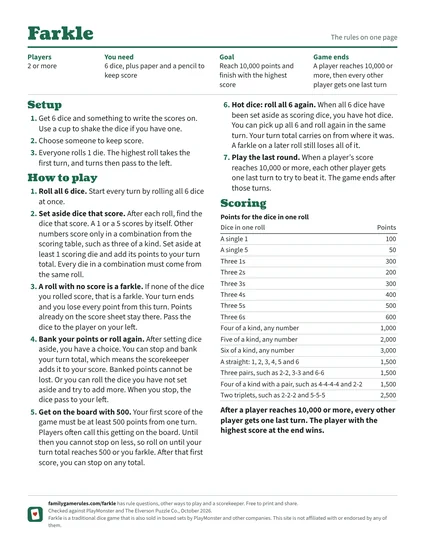
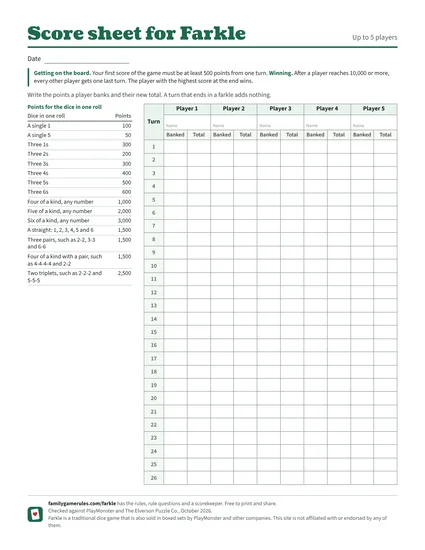
Print the whole game on one page, and a score sheet made for Farkle. Both are free PDFs for Letter paper.
Setup
2 or more players. Everyone plays for themselves and shares one set of 6 dice.
You need: 6 standard six-sided dice.
- You also need paper and a pencil, or a printed score sheet.
- A cup for shaking the dice is optional. Some boxed sets include one.
- Get 6 dice and something to write the scores on. Use a cup to shake the dice if you have one.
- Choose someone to keep score.
- Everyone rolls 1 die. The highest roll takes the first turn, and turns then pass to the left.
The dice for the first roll of a turn

How to play
A turn is a string of rolls. Each roll that scores adds to your turn total, and one roll that does not score wipes the total out. Points go on the score sheet only when you choose to stop.
-
Roll all 6 dice
Start every turn by rolling all 6 dice at once.
- If a die falls off the table, roll that die again.
-
Set aside dice that score
After each roll, find the dice that score. A 1 or a 5 scores by itself. Other numbers score only in a combination from the scoring table, such as three of a kind. Set aside at least 1 scoring die and add its points to your turn total. Every die in a combination must come from the same roll.
- You do not have to set aside every die that scores. If you roll two 5s, you can set aside one for 50 and roll the other again with the rest of the dice.
- Dice from different rolls never join up. A 5 you set aside earlier and two 5s in your next roll are three single 5s worth 150. They do not count as three 5s worth 500.
- Dice you have set aside stay out of your rolls until your turn ends or all 6 have scored.
Three of a kind
400
A single 1
100
A single 5
50
Does not score
One roll of 6 dice. Five of these dice score, and you must set aside at least 1 of them. -
A roll with no score is a farkle
If none of the dice you rolled score, that is a farkle. Your turn ends and you lose every point from this turn. Points already on the score sheet stay there. Pass the dice to the player on your left.
- A farkle can happen on any roll, including the first roll of a turn.
-
Bank your points or roll again
After setting dice aside, you have a choice. You can stop and bank your turn total, which means the scorekeeper adds it to your score. Banked points cannot be lost. Or you can roll the dice you have not set aside and try to add more. When you stop, the dice pass to your left.
- There is no limit on the number of rolls in a turn. You roll until you bank or farkle.
-
Get on the board with 500
Your first score of the game must be at least 500 points from one turn. Players often call this getting on the board. Until then you cannot stop on less, so roll on until your turn total reaches 500 or you farkle. After that first score, you can stop on any total.
- Totals below 500 cannot be saved up over several turns. The whole 500 must come from one turn.
-
Hot dice: roll all 6 again
When all 6 dice have been set aside as scoring dice, you have hot dice. You can pick up all 6 and roll again in the same turn. Your turn total carries on from where it was. A farkle on a later roll still loses all of it.
- Hot dice can come from a single roll, such as a straight, or build up over several rolls.
- Rolling again is your choice. You can bank instead, as long as you are on the board or your turn total is at least 500.
- Hot dice can happen more than once in the same turn.
-
Play the last round
When a player’s score reaches 10,000 or more, each other player gets one last turn to try to beat it. The game ends after those turns.
- The player who reached 10,000 first does not roll again.
- Scores can go past 10,000. Nobody has to land on it exactly.
- The rule sources we checked do not say what happens in a tie. Agree on that before the last round.
Example: one turn, three rolls
You roll all 6 dice and get 5, 5, 2, 3, 4 and 6. Only the 5s score, so you set both aside for 100. You roll the other 4 dice and get 3, 3, 3 and 5. The three 3s are worth 300 and the 5 is worth 50. That 5 does not join the two 5s from your first roll to make three 5s, because they came from different rolls. Your turn total is 450 and all 6 dice have scored. That is hot dice, so you may roll all 6 again. You do, and get 1, 1, 6, 2, 6 and 4. The two 1s add 200, which makes 650. Now you have a choice. You can bank the 650, or you can roll the other 4 dice and risk losing it all.
Roll 1: all 6 dice


Set aside both 5s for 100
Roll 2: the other 4 dice
Three 3s and a 5 add 350. Turn total 450
Roll 3: hot dice, so all 6 again
Set aside both 1s for 200. Turn total 650
The choice
Bank 650, or roll these 4 dice
Scoring
Score each roll by itself, then add the rolls together for your turn total. The first table follows the rule sheet of a boxed Farkle set. Groups and other boxed sets change some of these scores, so agree on a table before you start.
| Dice in one roll | Points |
|---|---|
| A single 1 | 100 |
| A single 5 | 50 |
| Three 1s | 300 |
| Three 2s | 200 |
| Three 3s | 300 |
| Three 4s | 400 |
| Three 5s | 500 |
| Three 6s | 600 |
| Four of a kind, any number | 1,000 |
| Five of a kind, any number | 2,000 |
| Six of a kind, any number | 3,000 |
| A straight: 1, 2, 3, 4, 5 and 6 | 1,500 |
| Three pairs, such as 2-2, 3-3 and 6-6 | 1,500 |
| Four of a kind with a pair, such as 4-4-4-4 and 2-2 | 1,500 |
| Two triplets, such as 2-2-2 and 5-5-5 | 2,500 |
| Rule | Main rules on this page | Another published version |
|---|---|---|
| Three 1s | 300 | 1,000 |
| Four of a kind with a pair | 1,500 | Not listed |
| 3 farkles in a row | No penalty | Lose 1,000 points |
| First score of the game | At least 500 in one turn | No minimum |
- Three 1s score 300 in the first table, the same as three single 1s. Many groups play them as 1,000.
- Four, five and six of a kind score the same whatever the number. Four 1s are worth 1,000, the same as four 6s.
- A pair has no score of its own. Two 1s are worth 200 and two 5s are worth 100, as single dice.
- A straight, three pairs, four of a kind with a pair, two triplets and six of a kind each use all 6 dice, so scoring one gives you hot dice.
- The two published versions agree on every score that is not in the second table.
After a player reaches 10,000 or more, every other player gets one last turn. The player with the highest score at the end wins.
One player keeps score on paper, with a column for each player. Each time a player banks, write that turn’s points under their name and update their running total. A turn that ends in a farkle adds nothing.
A worked example: adding up one turn
Your first roll is 6, 6, 6, 1, 3 and 4. You set aside the three 6s and the 1. You roll the other 2 dice and get a 1 and a 5, so all 6 dice have scored. With hot dice you choose to roll all 6 again, and get 2, 2, 2, 5, 4 and 6. You set aside the three 2s and the 5, then bank 1,100 points.
Roll 1: all 6 dice
Three 6s and a 1: 700
Roll 2: the other 2 dice
A 1 and a 5: 150
Roll 3: all 6 dice again
Three 2s and a 5: 250
| What happened | Points |
|---|---|
| Roll 1: three 6s | 600 |
| Roll 1: a single 1 | 100 |
| Roll 2: a single 1 | 100 |
| Roll 2: a single 5 | 50 |
| Roll 3: three 2s | 200 |
| Roll 3: a single 5 | 50 |
| Turn total | 1,100 |
Scorekeeper
Each player races to 10,000. Add the points a player banks, or mark a farkle for a turn that scored nothing. A first score must be at least 500. When a player reaches 10,000, every other player gets one last turn and the highest score wins. It works in this browser, keeps the game if the page reloads, and needs no account.
Other ways to play
House rules and other versions
- Three 1s score 1,000
- Many groups score three 1s as 1,000 points instead of 300, and so does another published set we checked. Settle this one before the first roll.
- A penalty for 3 farkles in a row
- Some rules take points off a player who farkles on 3 turns in a row. One published set takes off 1,000 points. Another version takes off 500.
- No opening score, or a higher one
- One published set has no minimum, so any score can be banked from the first turn on. Some groups go the other way and ask for 1,000 points to get on the board.
- A minimum for every turn
- Some groups do not let you bank a turn worth less than 300 or 350 points, at any stage of the game.
- Other scores for the big combinations
- Some groups score a straight as 1,000 or 3,000 instead of 1,500. Three pairs can be 750 or 2,000, and two triplets can be 3,000.
- Four or more of a kind by adding or doubling
- Some groups build these scores from three of a kind. By adding, each extra matching die adds the three-of-a-kind score again, so four 2s are 400, five are 600 and six are 800. By doubling, each extra die doubles the score, so with three 1s at 1,000, four are 2,000, five are 4,000 and six are 8,000.
- You must roll after hot dice
- Some groups make you roll all 6 dice again after hot dice. You cannot bank until that roll is made.
- Set aside every scoring die
- Some groups make you set aside every scoring group of dice you roll, when that is possible. Those dice cannot be rolled again.
- Piggybacking
- The next player can start fresh with 6 dice or roll the dice the last player left over. If that roll scores, they add the last player’s turn total to their own. Also called high stakes.
- Exactly 10,000
- The winner must land on exactly 10,000. A player who goes over gives that turn’s points to the player with the lowest score.
- Five dice
- Some groups play with 5 dice instead of 6. Three pairs cannot be made, and five of a kind on the first roll of a turn often wins the game on the spot.
Rule questions
How many dice do you use in Farkle?
6. Every turn starts with a roll of all 6, and everyone shares the same set. Some groups play a version with 5 dice.
How many points do you need to get on the board?
500 in a single turn, by the main rules on this page. Until you have banked that first score, you cannot stop on a smaller total. After that you can stop on any score. Another published version has no minimum, and some groups ask for 1,000.
Can you combine dice from different rolls?
No. Each roll is scored by itself. A 5 from one roll and two 5s from the next are three single 5s worth 150, and they do not count as three 5s worth 500. In the same way, three 4s from one roll and a fourth 4 from the next are not four of a kind.
Do you have to set aside every scoring die?
No. You must set aside at least 1 scoring die after each roll, and you can roll the others again. If your first roll has two 5s, you can set aside one for 50 and roll the other 5 dice. Some groups do make you set aside all of them.
What is hot dice, and do you have to roll again?
Hot dice means all 6 of your dice have scored. You can pick up all 6 and roll again, adding to the same turn total. In the main rules that roll is your choice, and you can bank instead. Some groups make the extra roll a must.
Is three 1s worth 300 or 1,000?
Both are played. The main table on this page comes from a boxed set and gives 300. Another published set gives 1,000, and so do many family games. Neither is wrong, so agree on one before you start.
What happens if you farkle three times in a row?
Nothing extra, by the main rules on this page. You lose each turn’s points and that is all. One published version takes 1,000 points off your score for 3 farkles in a row, and another takes off 500.
What happens when someone reaches 10,000?
The game does not stop at once. Every other player gets one last turn to try to beat that score. The highest score after those turns wins, even if it belongs to a different player from the one who reached 10,000 first. That first player does not roll again.
Can you lose points you have already banked?
No. A farkle costs only the points from the turn you are on. Points written on the score sheet stay yours. The one exception is the rule, played in some versions, that takes points off a player for 3 farkles in a row.
Can you farkle on the first roll of a turn?
Yes. If a roll of all 6 dice has no 1, no 5, no three of a kind and no three pairs, nothing in it scores. That is a farkle. You score nothing for the turn and pass the dice.
What are four, five and six of a kind worth?
1,000 for four of a kind, 2,000 for five and 3,000 for six. The number on the dice does not matter, so four 1s and four 6s both score 1,000. In the main rules, four of a kind with a pair on the other 2 dice scores 1,500.
Is Farkle the same game as 10,000, Zilch and Greed?
Yes, or very close to it. Farkle is a folk game with many names, among them Ten Thousand or 10,000, Zilch, Greed or Greedy, Hot Dice and Zonk. The games under those names are the same or nearly the same. Score tables, opening scores and penalties change from group to group, so compare the table you know with the one on this page.
Words used in Farkle
- Farkle
- A roll in which no dice score. It ends your turn and wipes out the points from that turn.
- Scoring dice
- Dice that are worth points in the roll they came from: any 1, any 5, and the dice of a scoring combination.
- Set aside
- To put scoring dice to one side. Their points join your turn total, and they stay out of your rolls until your turn ends or all 6 dice have scored.
- Turn total
- The points from all your rolls so far this turn. They become yours only when you bank them.
- Bank
- To stop rolling and have your turn total added to your score.
- Hot dice
- Having all 6 dice set aside as scoring dice. You can roll all 6 again in the same turn.
- On the board
- Having a first score written down. The main rules ask for 500 points in one turn to get there.
- Three of a kind
- Three dice showing the same number in one roll. Also called a triplet.
- Straight
- One each of 1, 2, 3, 4, 5 and 6 in a single roll of 6 dice.
- Three pairs
- A roll of 6 dice that makes 3 pairs, such as 2-2, 3-3 and 6-6.
- Last turn
- The one extra turn each other player gets after someone reaches 10,000 or more.
What you need
- 6 diceAny six-sided dice work. They do not have to match.Find it on Amazon (6 dice, opens in a new tab)
- A boxed Farkle setUsually 6 dice, a shaker cup and a score pad.Find it on Amazon (A boxed Farkle set, opens in a new tab)
- A dice tray or dice cupOptional. A tray keeps the dice on the table.Find it on Amazon (A dice tray or dice cup, opens in a new tab)
- Farkle score padsOptional. You can also print the score sheet from this site.Find it on Amazon (Farkle score pads, opens in a new tab)
As an Amazon Associate, we earn from qualifying purchases. How the site is paid for.
Checked against
These rules are written in our own words from PlayMonster and checked against The Elverson Puzzle Co.. Sources last checked on October 11, 2026.
- First source: PlayMonster, Farkle: The Classic Dice-Rolling, Risk-Taking Game, rule sheet (copyright 2016). The turn, the farkle, the full scoring table, scoring each roll by itself, the 500-point first score, rolling all 6 again, the game to 10,000 and the last turns, who goes first, ages, players and playing time.
- Second source: The Elverson Puzzle Co., Farkle Rules. A second published version: three 1s at 1,000, the 1,000-point penalty for 3 farkles in a row, no opening score, and scores that match the first source on every other line it lists.
Other sources we used (3)
- Wikipedia, Farkle. The other names for the game, the term hot dice and the common house rules listed under variants.
- The Elverson Puzzle Co., Farkle instructions (printable sheet). The same publisher’s printed sheet. Its point values match the web page, and it confirms that scoring uses the dice of a single roll..
- The Elverson Puzzle Co., Farkle Score Sheets. Spells out that publisher’s scoring list in words, which confirms each value.
Where the sources differ (9)
| Topic | PlayMonster | The Elverson Puzzle Co. | This page |
|---|---|---|---|
| Three 1s | 300 points. | 1,000 points. | 300 in the main table. The 1,000 score is in the second scoring table, the variants and the rule questions. |
| Four of a kind with a pair | 1,500 points, listed as its own combination. | Not listed. Four of a kind scores 1,000. | 1,500 in the main table. The second table shows that the other version does not list it. |
| Opening score | A player needs a turn total of at least 500 before stopping to record a first score. After that there is no minimum. | No minimum. A player who has rolled at least one scoring die may bank. | 500 in the main text. No minimum, and Wikipedia’s 1,000 minimum, are listed as a variant. |
| Three farkles in a row | Not mentioned. | Lose 1,000 points. | No penalty in the main text. The 1,000 penalty is in the second scoring table. It and Wikipedia’s example of a 500 penalty are both in a variant and a rule question. |
| Rolling again when all 6 dice have scored | The player can roll all 6 again and keep building the turn total. The sheet gives this no name. | Not mentioned. | Follows PlayMonster and uses the name hot dice, which comes from Wikipedia. |
| How many scoring dice must be set aside | At least one die after each roll. | Some or all of the scoring dice. | At least 1, and the rest may be rolled again. Wikipedia’s note that some groups require all of them is a variant. |
| End of the game | When a score reaches 10,000 or more, each other player gets one last turn to beat it, and the highest score wins. | The final round starts when any player reaches 10,000 or more, and the highest score above 10,000 in that round wins. It does not say how long the round lasts. | Follows PlayMonster. |
| Who goes first, and which way play passes | Each player rolls one die, the highest roll goes first, and play passes to the left. | Not stated. | Follows PlayMonster. |
| Players, ages and playing time | 2 or more players, ages 8 and up, 30 minutes. | Its product listings say 2 or more players, ages 8 to adult. Its rules pages give no player count, ages or playing time. | 2 or more, ages 8 and up, about 30 minutes. |
What on this page is our own
- The upper limit of 8 players in the page data is our own cap for sorting games by player count. Both publishers say 2 or more, and the page text says 2 or more.
- The turn in the play example, the roll pictured in the second play step and the turn in the scoring example are our own, scored from the PlayMonster table.
- These points are our reading of the rules and are not stated outright in a source: a fourth matching die from a later roll does not make four of a kind, the 500 opening points cannot be saved up across turns, combinations that use all 6 dice always give hot dice, a first-roll farkle means no 1, no 5, no three of a kind and no three pairs, and the player who reached 10,000 first does not roll again.
- The advice to agree on a tie-break is ours. PlayMonster, Elverson and Wikipedia say nothing about ties.
- The name Greedy comes from the list of searches for this page. The sources give Greed.
- The score sheet layout and the scorekeeper’s quick-add buttons are our own.
- The notes under What you need describe products and are not rules.
- The phrase getting on the board is common among players but is not in the sources. PlayMonster’s sheet says getting on the score pad.
- The pieces pictured at the top of the page are our own example.
Spotted a mistake? Email contact@familygamerules.com and we'll check it against the sources.